Disclosure: This page contains affiliates. If you buy through them, The Desk Brief may earn a commission at no extra cost to you.
Wildfire smoke used to feel like a problem that happened somewhere else. Now a hazy sky and an air-quality alert can land almost anywhere in Canada, often right when you want the windows open. Add spring pollen, pets, dust, and long hours in a home office, and it is easy to see why more Canadians are shopping for an air purifier.
The frustrating part is that the category is full of enormous room-size claims, vague filter language, and very little discussion of replacement costs. My best HEPA air purifier pick for most people is the Levoit Core 400S. It has enough clean-air output for a real bedroom or office, useful automatic controls, and filters that are reasonably easy to find here. The smaller Core 300S is my budget pick, while the Core 600S is the one I would buy for a large room during smoke season.
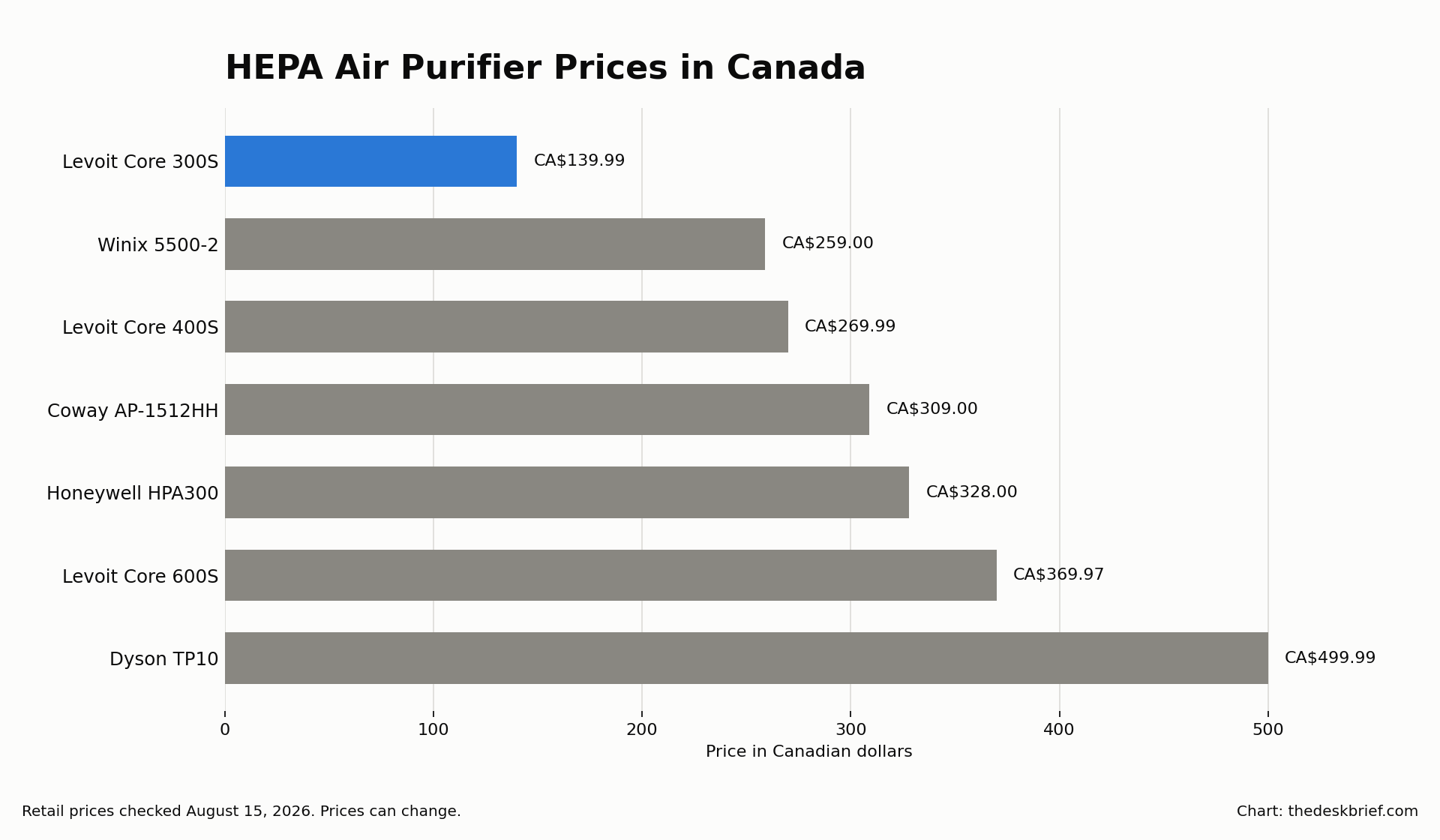
Price note: I checked Canadian retailer pricing on August 15, 2026. Prices and marketplace availability change quickly, so treat these as a useful snapshot rather than a promise.
Don’t want to read the whole article? Here are our quick picks.
1Best overall Levoit Core 400S. Balanced airflow and smart controls suit most rooms.
2Best budget Levoit Core 300S. Compact smart purifier covers bedrooms on a budget.
3Best for large rooms Levoit Core 600S. Higher airflow makes it the stronger large-room choice.
As an Amazon Associate I earn from qualifying purchases.
Best HEPA Air Purifier: Quick Comparison
Last updated: September 2026.
| Model | Price | Practical room size | Smoke CADR | Filter | Noise | Smart features | Replacement-filter source | Buy |
|---|---|---|---|---|---|---|---|---|
| Levoit Core 300S | Check current price | 195 sq. ft. | 126 cfm | 3-stage particle and carbon | 22 to 50 dB | Wi-Fi, app, voice, auto mode | Check replacement-filter source | Amazon |
| Winix 5500-2 | Check current price | 370 sq. ft. | 232 cfm | True HEPA, washable carbon | About 28 to 55 dB | Sensor, auto mode, remote | Check current price | Amazon |
| Levoit Core 400S | Check current price | 358 sq. ft. | 231 cfm | 3-stage particle and carbon | 22 to 52 dB | Wi-Fi, app, voice, auto mode | Check replacement-filter source | Amazon |
| Coway Airmega AP-1512HH | Check current price | 361 sq. ft. | 233 cfm | True HEPA, carbon, pre-filter | 24 to 53 dB | Sensor, auto and Eco modes | Check replacement-filter source | Amazon |
| Honeywell HPA300 | Check current price | 465 sq. ft. | 300 cfm | True HEPA, carbon pre-filter | 48.3 to 71.2 dB measured | Timer, filter reminder, Turbo | Check replacement-filter source | Amazon |
| Levoit Core 600S | Check current price | 611 sq. ft. | 394 cfm | 3-stage particle and carbon | From 26 dB | Wi-Fi, app, voice, auto mode | Check replacement-filter source | Amazon |
| Dyson TP10 Cool Gen1 | CA$499.99 (US$370) | Dyson does not publish an AHAM size | Not published | H13 HEPA and carbon | 42.6 to 61.4 dB(A) | LCD, auto sensing, oscillation, remote | About CA$100 (US$74) | Not listed |
The practical room sizes above are based on high-rate cleaning near 4.8 air changes per hour where certified data is available. That is much more useful for smoke and allergies than a claim based on cleaning the room only once per hour. For an eight-foot ceiling, a simple target is a smoke CADR at least two-thirds of the room’s square footage. I prefer extra capacity for wildfire smoke so the purifier can keep up without living on its loudest setting.
What True HEPA Actually Means
A HEPA filter is designed to capture at least 99.97% of particles at 0.3 microns in the commonly cited North American definition. That particle size is used because it is difficult to trap, not because smaller smoke particles sail straight through. Diffusion helps a proper filter capture many smaller particles too.
“HEPA-type,” “HEPA-like,” and “HEPA-style” are not the same promise. Those labels can describe a filter that looks similar but has not been represented as meeting the same efficiency level. I would not buy one for wildfire smoke unless the manufacturer provides credible filtration and CADR test data. “H13” is also not magic by itself. A very efficient filter in a leaky housing with a weak fan can clean a room more slowly than a well-built unit with a strong, independently measured CADR.
This is why I put CADR beside filter language. CADR measures how much clean air the complete machine delivers. It folds airflow and particle removal into one practical number. A purifier with a smoke CADR of 300 delivers much more useful clean air than a tiny unit with excellent filter media and barely any airflow.
Carbon deserves a reality check too. The thin carbon layer in most consumer purifiers can help with mild odours, but it will not remove every gas in wildfire smoke. A particle purifier also does not remove carbon dioxide, add oxygen, control humidity, or replace a carbon monoxide alarm. It is a targeted tool, not a complete indoor-air system. If dry winter air is the separate problem, use the Canadian humidifier guide rather than expecting a purifier to change humidity.
Best budgetBudget Pick: Levoit Core 300S
At CA$139.99 (US$104), the Core 300S is the easiest recommendation for a small bedroom or closed home office. Its certified smoke CADR of 126 cfm suits about 195 sq. ft., and the app lets you schedule it, check the sensor, or turn off display lights without getting out of bed. Noise starts around 22 dB on the lowest setting.
The compromise is capacity. A retailer may advertise a much larger area based on one air change per hour, but I would not ask this purifier to protect a 500 sq. ft. open-concept living space during a bad smoke day. Buy it for one modest room, close the door, and run it continuously. If your office also needs a cleaner physical layout, the site’s work from home laptop setup guide covers the rest of the gear without pretending one device fixes everything.
Top pickMid-Range Pick: Levoit Core 400S
The Core 400S is the sweet spot. Its smoke CADR of 231 cfm is almost double the Core 300S output, yet the machine is still compact enough to live beside a desk or dresser. It is a sensible match for roughly 358 sq. ft., which covers many Canadian bedrooms, offices, and smaller living rooms.
I also like that its smart features are useful rather than decorative. The particle sensor drives automatic mode, the VeSync app handles schedules and remote control, and voice support is there if you want it. On smoky days I would still override auto mode and choose a steady medium or high speed. A sensor beside the purifier can see locally cleaned air and slow the fan before the far side of the room is clean.
The Winix 5500-2 and Coway AP-1512HH are excellent alternatives at this size. The Winix gives you a washable carbon stage and strong CADR for CA$259.00 (US$192), though it lacks Wi-Fi. Its PlasmaWave feature can be switched off if you prefer filtration only. The Coway costs a little more, but its simple auto and Eco modes, washable pre-filter, and long track record make it an appealing set-it-and-forget-it option.
Best for large roomsPremium Pick: Levoit Core 600S
For a large living room, basement, or open work area, I would spend the extra money on airflow, not a luxury logo. The Core 600S delivers a smoke CADR around 394 cfm and is sized for roughly 611 sq. ft. at a meaningful cleaning rate. At CA$369.97 (US$274), it costs less than the Dyson while moving enough filtered air to be genuinely useful during wildfire smoke.
The Honeywell HPA300 is the simpler high-output alternative. Its 300 cfm smoke CADR is good for about 465 sq. ft., and there is no app account to manage. The downside is fan noise and a filter system that uses three HEPA cartridges plus a carbon pre-filter. Consumer Analysis measured 48.3 dB on its lowest setting and 71.2 dB at maximum. It works, but its noise and annual consumables bill can be unpleasant.
The Dyson TP10 is available at CA$499.99 (US$370) and adds a polished bladeless fan, oscillation, an LCD, and H13 filtration. Dyson reports 42.6 to 50.0 dB(A) at its minimum measured flow setting and 57.8 to 61.4 dB(A) at maximum flow. I do not consider it the best air-cleaning value because Dyson does not publish an AHAM smoke CADR for this model. Buy it if you specifically want the design and fan functions. If clean-air output per dollar is the priority, the Core 600S is the stronger purchase.
The Hidden Cost: Replacement Filters
The sticker price is only the first payment. A filter loading up with smoke, pet hair, and dust creates resistance, and eventually the purifier moves less air. Most makers suggest replacement somewhere around six to twelve months, but a severe smoke season can shorten that interval.
Based on Canadian replacement-filter pricing, budget roughly CA$80 (US$59) to CA$160 (US$118) per year for the Core 300S, CA$74 (US$55) to CA$148 (US$110) for the Core 400S, and CA$100 (US$74) to CA$200 (US$148) for the Core 600S. The genuine Winix Filter H is around CA$79.99 (US$59) and normally covers a year. Coway’s filter set typically lands around CA$70 (US$52) to CA$110 (US$81) per year. Dyson’s combined 360 Glass HEPA and carbon filter is CA$99.99 (US$74). The HPA300 can reach CA$143 (US$106) to CA$200 (US$148) because it needs multiple HEPA filters and regular carbon pre-filters.
Those are estimates, not a schedule you should follow blindly. Check the filter, watch for reduced airflow, and follow the machine’s indicator. Vacuum a washable pre-filter regularly, but do not wash a disposable HEPA filter unless its manual explicitly says you can. Water can damage the fibres and ruin its performance.
Filter availability in Canada matters more than an extra app feature. Before buying any purifier, search for the exact replacement-filter code and confirm that a reputable Canadian retailer stocks it. A bargain machine becomes electronic furniture when its unusual filter disappears.
What to Actually Check Before You Buy
Start with smoke CADR
Measure the room and multiply length by width. For an eight-foot ceiling, aim for a smoke CADR at least two-thirds of that square-foot number. Go larger for high ceilings, open doorways, or heavy wildfire smoke. Two medium purifiers placed apart can work better than one huge unit tucked in a corner.
Ignore one-hour coverage claims
A box claiming 3,000 sq. ft. may mean the fan processes that volume once in an hour on maximum speed. That is not the same as rapidly reducing incoming smoke. Compare room sizes at 4.8 or five air changes per hour whenever possible.
Buy enough capacity to run quietly
Published minimum noise numbers are measured at the weakest setting, where clean-air output is also lowest. A slightly oversized purifier running at medium speed is often easier to live with than an undersized unit screaming on Turbo beside your bed.
Plan for Canadian filters
Check the exact filter price, how many cartridges the machine needs, and whether the listing is genuine or third-party. Put the first replacement cost into your purchase comparison. It is better to learn about a CA$150 (US$111) annual bill before checkout.
Use it properly on smoky days
Close windows and exterior doors when outdoor air is poor, set the purifier where its intake and outlet are not blocked, and run it continuously. Avoid candles, frying, and other indoor particle sources. A purifier reduces airborne particles, but it cannot seal a leaky house or make dangerous outdoor activity safe.
Frequently Asked Questions
What is the best HEPA air purifier for wildfire smoke?
For most rooms, the Levoit Core 400S offers the best balance of CA$269.99 (US$200) price, 231 cfm smoke CADR, noise, and filter availability. For a large room or open space, step up to the Core 600S. Its 394 cfm smoke CADR gives it much more capacity.
Will a HEPA purifier remove wildfire smoke?
It can substantially reduce the airborne particles in wildfire smoke when sized correctly and run continuously in a closed room. Its small carbon layer may reduce some odours, but it will not remove every gas. Follow public-health guidance and do not treat a purifier as permission to ignore evacuation or air-quality warnings.
Should I run my air purifier all day?
Yes, especially during smoke season or when allergies are active. Particle levels rebound when the fan stops. A steady medium setting is often a good balance of clean-air output and noise, while high speed is useful when outdoor conditions worsen or after opening a door.
Is a bigger air purifier always better?
More CADR gives you useful headroom, but a huge unit costs more, takes up space, and may use pricier filters. Choose enough capacity for about five air changes per hour in your room, then add a margin for high ceilings or open areas.
Does an air purifier help with dust and allergies?
Yes, it can capture airborne pollen, pet dander, and fine dust. It will not remove dust already settled on a desk or carpet, so regular cleaning still matters. Place the purifier in the room where you spend the most time.
The Short Version
- The Levoit Core 400S is the best all-around choice for most Canadian bedrooms, offices, and smaller living rooms.
- Choose the Core 300S for a closed room under about 195 sq. ft., or the Core 600S for a large space and serious wildfire-smoke duty.
- Compare smoke CADR and room size at roughly five air changes per hour. Ignore giant coverage numbers based on one slow air change.
- Budget CA$70 (US$52) to CA$200 (US$148) a year for filters, and confirm the exact replacement is readily available in Canada before buying.