RTX 5060 Ti RiTONA OC should not get your money until Palit reveals the price. The white two-slot card is compact, cheerful and unusually easy to power, but the character art does not change the awkward part: this is an 8GB RTX 5060 Ti in a market where the 16GB version launched for US$50 more.
Palit announced the card on September 18, 2026. There is no retail price, firm sale date, regional distribution list or independent exact-model test yet. That makes this specification analysis, not a review. I have not handled or benchmarked the card.
The RTX 5060 Ti RiTONA OC makes sense for a visible white build if its eventual premium is small and 1080p is the target. Anyone buying for 1440p, ray tracing, local AI or a long service life should start with 16GB instead. Anime charm is many things. Extra VRAM is not one of them.
Table of Contents
- What the RTX 5060 Ti RiTONA OC Actually Is
- What Palit Confirmed
- The 8GB Problem
- RiTONA OC vs RTX 5060 Ti 16GB
- Price and Availability
- Who Should Buy It
- Who Should Skip This
- Frequently Asked Questions
- The Short Version
What the RTX 5060 Ti RiTONA OC Actually Is
This is Palit’s anime-themed version of NVIDIA’s 8GB RTX 5060 Ti. RiTONA is the company’s digital ambassador, and the card carries her mint, white and yellow palette across the shroud and full-colour metal backplate. Palit adds addressable RGB lighting along the side, where it can actually be seen through a case window.
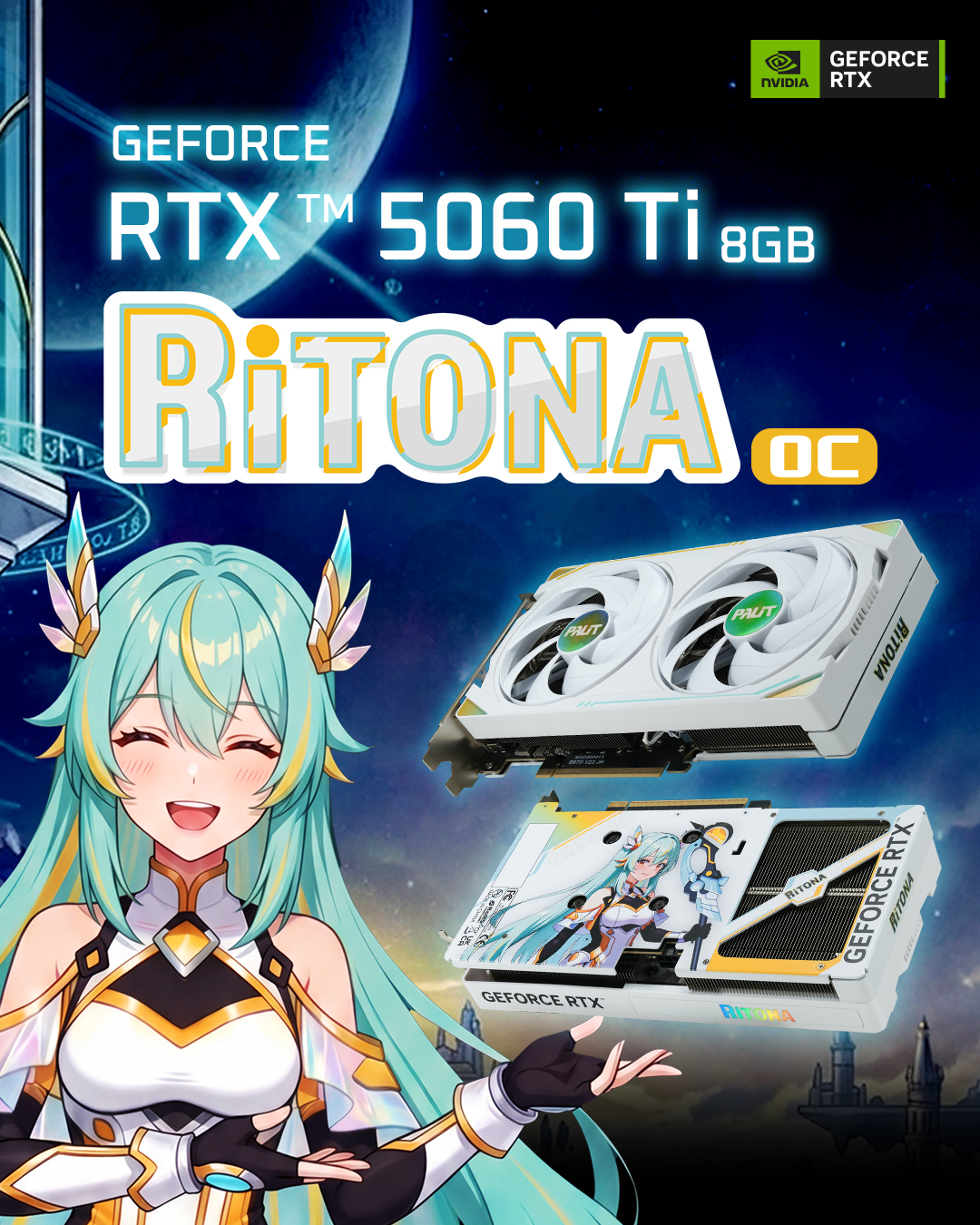
The useful engineering is less theatrical. At 233.9 mm long and 40 mm thick, the board occupies two slots and should fit cases that reject longer triple-fan cards. One conventional 8-pin connector supplies power. Palit lists 180 W graphics power and recommends a 600 W system power supply. Check the case clearance and cable headroom with the site’s GPU compatibility guide before treating “compact” as “fits everything.”
The rest of the design is familiar RTX 5060 Ti territory. The 4,608 CUDA cores, Blackwell architecture, DLSS 4 support and 448 GB/s memory bandwidth do not become faster because a smiling mascot is involved. Palit’s 2,587 MHz listed boost clock is only 15 MHz above the 2,572 MHz reference specification cited in independent testing. That difference is too small to support a performance claim without exact-model measurements.
What Palit Confirmed
Palit’s official press announcement establishes the product and the design. Its current specification page supplies the numbers below. These are manufacturer specifications, not results from my bench.
- 8GB of GDDR7 on a 128-bit interface
- 4,608 CUDA cores and a listed 2,587 MHz boost clock
- 448 GB/s memory bandwidth and 180 W graphics power
- 233.9 x 125.8 x 40 mm, using two expansion slots
- One 8-pin power connector and a recommended 600 W system supply
- Three DisplayPort 2.1b outputs and one HDMI 2.1b output
- Two 102 mm fans, a copper base, composite heatpipes and zero-RPM fan control
Palit says the fans stop under light loads, but it has not published an exact noise level or temperature result for the shipping card. The same caution applies to boost behaviour. A listed clock is a target specification, while sustained frequency depends on power, cooling, silicon and workload. Wait for a real test if acoustics matter more than the colour scheme.
The 8GB Problem Is Bigger Than the Artwork
The memory capacity is the buying decision. Tom’s Hardware compared the generic 8GB and 16GB configurations across a 21-game geomean. The 8GB card was only 2.3% slower at 1080p medium, but the deficit widened to 11% at 1080p ultra, 18% at 1440p ultra and 42% at 4K ultra.
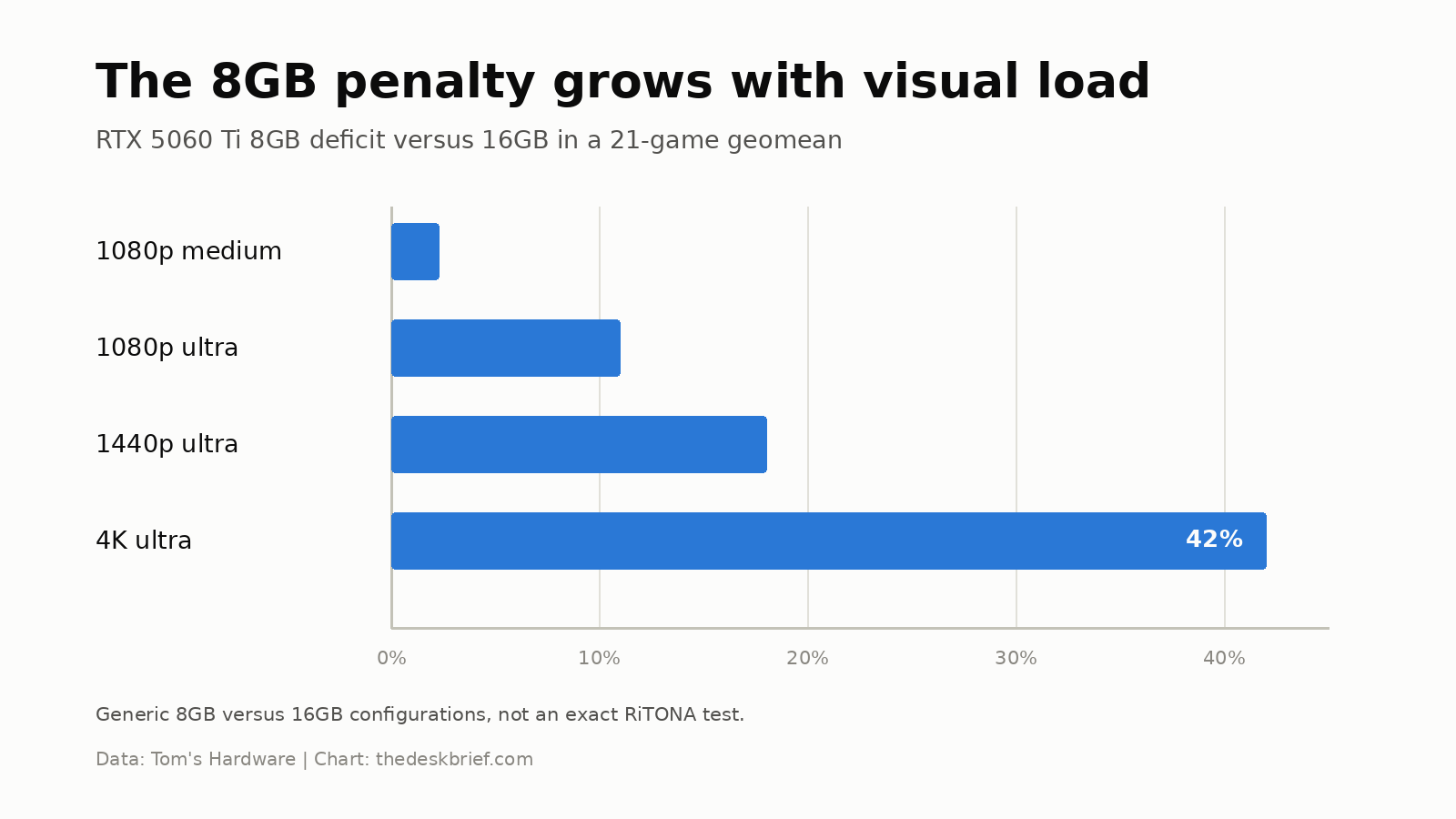
Ray tracing caused much of the pain. Tom’s six-game ray-tracing geomean put the 8GB configuration 26% behind at 1080p ultra and 39.6% behind at 1440p ultra. Raster-only differences were smaller, which is why a sensible 1080p setup can still work. The problem is not that every game instantly collapses at 8GB. It is that a US$379-class GPU can lose far more performance than its core specification suggests once memory pressure rises.
Local AI adds an even simpler objection. Eight gigabytes limits model size before speed enters the argument. The site’s Canadian GPU price study shows why capacity and price need to be judged together rather than treating every RTX badge as equivalent.
RiTONA OC vs RTX 5060 Ti 16GB
The fair comparison is the 16GB version of the same GPU, not a much slower bargain card. Core count and official power stay the same. Capacity, price and board design are what change the answer.
| Specification | Palit RiTONA OC 8GB | RTX 5060 Ti 16GB reference |
|---|---|---|
| Price | Not announced | US$429 launch MSRP |
| Memory | 8GB GDDR7 | 16GB GDDR7 |
| CUDA cores | 4,608 | 4,608 |
| Memory bandwidth | 448 GB/s | 448 GB/s |
| Listed boost clock | 2,587 MHz | 2,572 MHz reference |
| Graphics power | 180 W | 180 W reference |
| Board size | 233.9 x 125.8 x 40 mm | Varies by board partner |
| Main advantage | Compact themed two-slot design | Twice the memory capacity |
| Main drawback | 8GB ceiling and unknown price | Usually larger or less distinctive |
The 16GB configuration launched at US$429, while the generic 8GB version launched at US$379. That US$50 gap is the number Palit has to respect. A special-edition premium could make the RiTONA card cost as much as a plain 16GB board while retaining half the memory. If that happens, buy the less interesting card. You look at the artwork for a moment; the memory limit follows every demanding workload.
RTX 5060 Ti RiTONA OC Price and Availability
Palit has not announced the RTX 5060 Ti RiTONA OC price, retail date, warranty term or country list. Its September 18 release calls the debut global, but that wording is not proof of Canadian or US retail stock. VideoCardz also reported that pricing and distribution remained unconfirmed when the product page appeared.
Do not preorder from an unfamiliar importer merely to secure the artwork. Regional warranty handling, return shipping and a large reseller markup can turn a charming card into a very expensive desk ornament. The GPU price tracker is the useful baseline once listings appear. Compare the final price with a real 16GB alternative, not only with other white cards.
Who Should Buy It
Buy it for a compact white 1080p gaming build where the visible design is part of the project. The two-slot thickness, 233.9 mm length and single 8-pin connector are genuinely convenient. A builder who plays at sensible settings and accepts texture compromises may value those traits more than unused memory capacity.
The price must still be close to ordinary 8GB boards. The art, metal backplate, lighting and sticker set are the special-edition features. None provides extra gaming headroom. If the premium is modest and the theme is exactly what you want, that is a defensible aesthetic purchase rather than a value win.
Who Should Skip This
Skip it for 1440p ultra settings, heavy ray tracing, high-resolution texture packs, local AI or a GPU you expect to keep through several demanding game cycles. Independent testing already shows the 8GB configuration can fall sharply behind the same chip with 16GB. A tiny factory overclock cannot repair a capacity shortfall.
Also skip it if the backplate will face a solid case panel. Paying a themed-card premium for artwork hidden behind steel has the energy of buying concert tickets and listening from the parking lot. A plain 16GB board is duller, but it spends the budget on the part your software can use.
Frequently Asked Questions
Is the RTX 5060 Ti RiTONA OC a 16GB card?
No. Palit’s announced model has 8GB of GDDR7 memory on a 128-bit interface. The company has not announced a 16GB RiTONA version.
How large is the Palit RiTONA card?
Palit lists dimensions of 233.9 x 125.8 x 40 mm. It uses two slots and one 8-pin power connector, but case and cable clearance still need to be checked.
Has the exact card been benchmarked?
No independent exact-model hands-on review appeared in the Canadian page-one results checked on September 21, 2026. The performance figures in this guide come from generic RTX 5060 Ti 8GB and 16GB testing and are labelled that way.
Does Palit include a 16-pin power connector?
No. The specification page lists one standard 8-pin supplementary connector. Palit recommends a 600 W system power supply.
The Short Version
The RTX 5060 Ti RiTONA OC is a neat physical design wrapped around the weaker memory configuration of NVIDIA’s midrange GPU. Its compact two-slot board, ordinary 8-pin connector and white anime styling give it a clear audience. Its 8GB capacity gives that audience a clear compromise.
Wait for the price and an exact-model thermal and noise review. Buy only if the premium over a standard 8GB board is small and 1080p is the plan. If a 16GB card is close in price, take the extra memory and put a RiTONA sticker on the case. Palit already includes some.