ASUS XG Core RX 9060 XT solves the ugly part of external graphics, then introduces a harder problem: the Radeon chip inside it is clocked far below a normal desktop card. The 144 x 117 x 39 mm enclosure is genuinely compact, the 16GB memory allocation is useful, and USB4 makes more sense than another proprietary connector. None of that tells us how fast the finished box will be.
ASUS formally announced the exact XG-CORE-RX9060XT-LP-16G on November 6, 2026. It is not yet on sale anywhere as of November 9. ASUS has not announced a price, preorder date or ship date, and its exact US, Canadian, UK and Taiwanese regional pages do not offer a buy path.
This is specification analysis, not a hands-on review. I compared ASUS’s exact portable and desktop RX 9060 XT specifications, checked current regional stores and retailer results, and treated every performance claim as unproven until independent testing exists. The enclosure is portable. The uncertainty is coming along for the trip.
Table of Contents
- What ASUS has confirmed
- USB4 trades lock-in for a narrower link
- The clock targets need restraint
- XG Core versus a desktop RX 9060 XT
- Who should wait
- What ASUS still needs to publish
- Skip the XG Core if portability is not the point
- ASUS XG Core FAQ
- The Short Version
ASUS XG Core RX 9060 XT: What Is Confirmed
The exact ASUS specification page identifies an RX 9060 XT LP with 2,048 stream processors and 16GB of GDDR6 memory. That memory runs at 20Gbps on a 128-bit bus, which works out to 320GB/s of theoretical memory bandwidth. The memory subsystem matches ASUS’s desktop Dual RX 9060 XT 16GB. The clock targets emphatically do not.
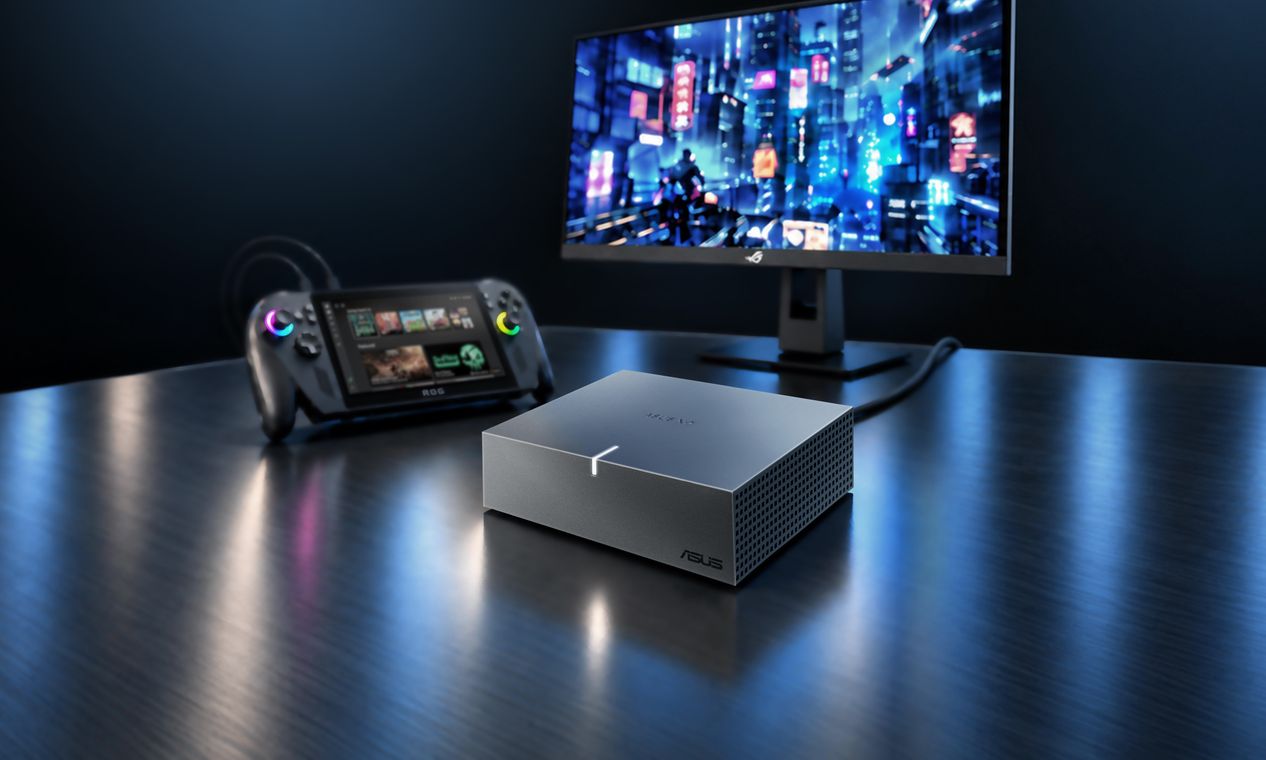
ASUS lists the following hardware for the ASUS XG Core RX 9060 XT:
- Radeon RX 9060 XT LP graphics with 2,048 stream processors
- 16GB GDDR6 at 20Gbps on a 128-bit interface
- USB4 host data at up to 40Gbps, plus a separate USB-C power input
- One HDMI 2.1b output and one DisplayPort 2.1a output
- Support for two displays and a listed maximum digital resolution of 3840 x 2160
- A 144 x 117 x 39 mm body, or roughly 0.66 litres by external dimensions
The company does not publish the weight, acoustic output, total system power draw or warranty on the global specification page. It includes a USB-C cable, USB-C adapter, USB-C DC cable and power cord, but the wording does not make the wall adapter’s output clear. Those omissions matter on a device sold around portability.
ASUS also says compatible Thunderbolt 3 systems can use the dock, alongside USB4 laptops, mini PCs, the ROG Ally X and the ROG Xbox Ally X. Compatibility still depends on firmware and external-GPU support. Our GPU compatibility guide explains why a connector that physically fits is only the beginning of that conversation.
USB4 Trades Lock-In for a Narrower Link
USB4 is the right strategic choice because it avoids the old XG Mobile trap: buying an expensive GPU that only works with a short list of ASUS computers. A standards-based 40Gbps connection gives the ASUS XG Core RX 9060 XT a much wider potential audience and makes it plausible as a dock shared between a handheld, work laptop and mini PC.
It is still a constrained link. The GPU must move game assets and rendered data through USB4 rather than sitting on a motherboard’s full PCIe slot. The practical penalty changes with the host, game, resolution, display connection and whether the finished frames return to the laptop screen. An external monitor connected directly to the dock should avoid sending finished frames back across the host link, but that does not erase every transfer bottleneck.
That is why ASUS’s broad claims about gaming, creative work and local AI are use cases, not results. Sixteen gigabytes is enough to make the box interesting for some image-generation and local-model workloads. It does not prove that a 40Gbps path and a heavily reduced GPU clock will deliver sensible performance per dollar. Anyone building around local AI should compare the eventual measurements with our ProArt GR1X analysis, where memory capacity and software support matter more than a single peak number.
The Clock Targets Need Restraint, Not Excuses
The portable card’s default game clock is 1,010MHz and its default boost clock is 1,600MHz. ASUS’s desktop Dual RX 9060 XT 16GB lists 2,620MHz and 3,230MHz for the same two targets. OC mode barely changes the portable box to 1,030MHz and 1,620MHz.
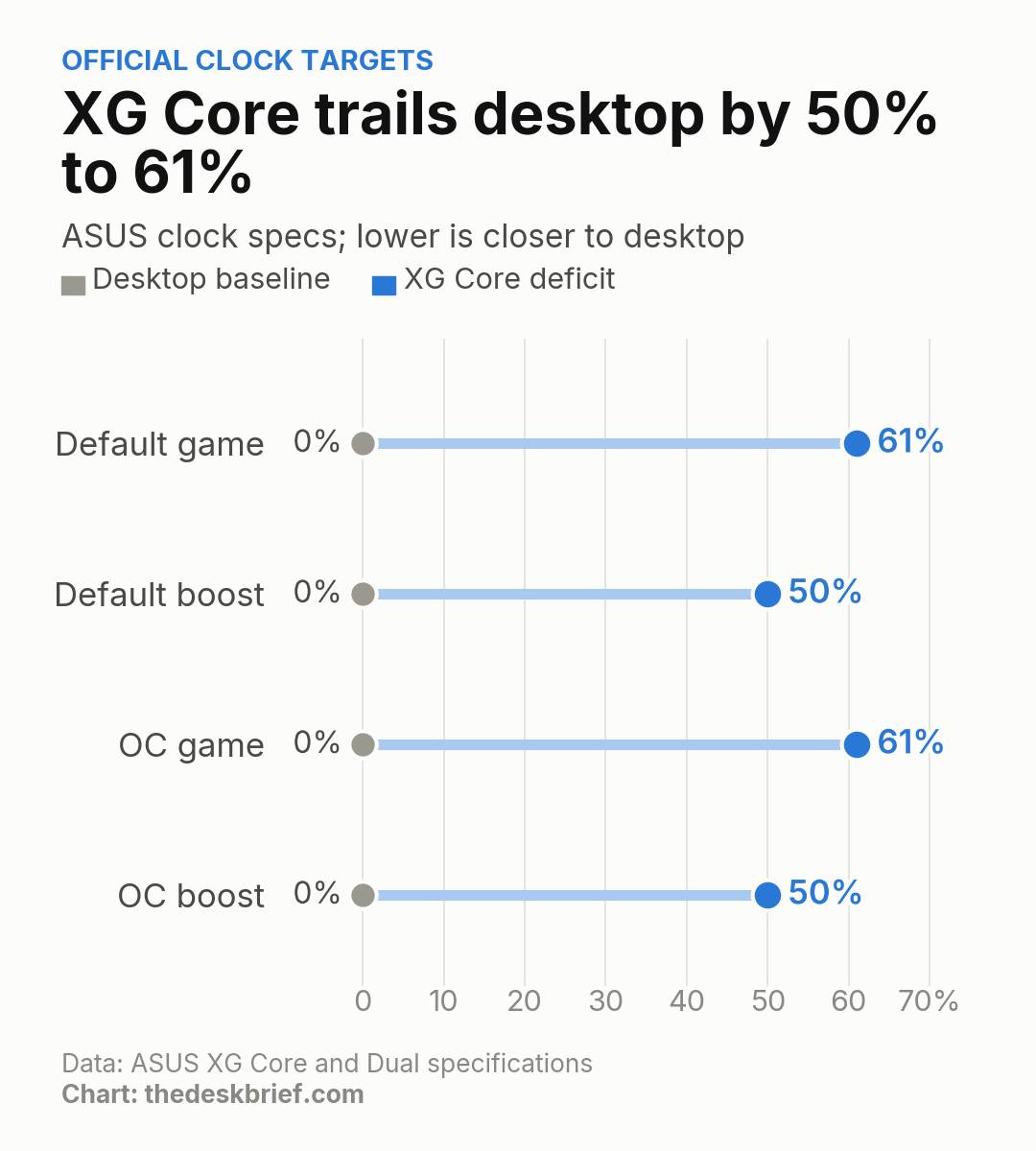
Those gaps are large enough to define the product. The portable targets sit about 50% below desktop at boost and 61% below it at the expected game clock. Basic Tutorials’ launch coverage confirms the product shape but offers no exact-model benchmark, so there is no honest way to turn the clock gap into an FPS estimate.
Lower clocks can help ASUS control heat, noise and adapter size in a small enclosure. They also make the familiar RX 9060 XT name easy to overread. This is not a desktop card placed in a silver box. It is a power-limited implementation using the same broad silicon and memory configuration.
ASUS XG Core vs Desktop RX 9060 XT
The shipping ASUS Dual Radeon RX 9060 XT 16GB is the cleanest reference because it holds the processor count, memory capacity, memory speed and bus width constant. What changes is the power and enclosure problem ASUS is trying to solve.
| Specification | ASUS XG Core | ASUS Dual RX 9060 XT 16GB |
|---|---|---|
| Release state | Announced, not shipping | Shipping desktop card |
| Price status | Not announced | No current global ASUS list price published |
| GPU and processors | RX 9060 XT LP, 2,048 | RX 9060 XT, 2,048 |
| Memory | 16GB GDDR6, 20Gbps, 128-bit | 16GB GDDR6, 20Gbps, 128-bit |
| Default game clock | 1,010MHz | 2,620MHz |
| Default boost clock | 1,600MHz | 3,230MHz |
| Host connection | USB4, up to 40Gbps | Internal PCIe 5.0 slot |
| Display outputs | 1 HDMI, 1 DisplayPort | 1 HDMI, 2 DisplayPort |
| Dimensions | 144 x 117 x 39 mm | 202 x 120 x 49 mm |
| Main advantage | Portable and no internal installation | Much higher clock targets |
| Named drawback | Unknown price and measured performance | Requires a desktop and internal power |
The XG Core occupies roughly 0.66 litres before its external power hardware, compared with about 1.19 litres for the Dual card itself. That is a useful size reduction, but volume is not the buying decision. If the eventual price approaches a complete gaming laptop upgrade or a stronger Thunderbolt 5 dock, the small box becomes a very tidy way to make the wrong purchase.
Who Should Wait for Independent Tests
Most buyers should wait. The ASUS XG Core RX 9060 XT makes the most sense for someone who already owns a compatible thin laptop or handheld, regularly works at a desk with an external monitor, and values one portable GPU across several hosts. Even that buyer needs exact-model tests for frame rates, sustained clocks, fan noise, adapter weight, sleep and wake behaviour, and host compatibility.
Price can overturn the whole recommendation because the name on the chip is a poor substitute for total system value. A modest price could make this a clever way to extend a good laptop. A premium price would put it against faster desktops and newer Thunderbolt 5 enclosures with more I/O.
What ASUS Still Needs to Publish
This page will be updated when ASUS publishes regional prices, an order date, adapter specifications, weight and warranty terms. The first independent exact-model tests also need to answer five questions: sustained GPU power, performance on USB4 versus Thunderbolt 3, external versus internal display performance, acoustics under a long load, and compatibility beyond ASUS’s named devices.
Skip the XG Core If Portability Is Not the Point
Desktop owners should skip it unless moving the GPU between machines is the entire point. A normal internal card has a wider host connection, higher official clocks and fewer compatibility layers. Buyers who only game on the laptop’s internal display should also be cautious because returned frames can add traffic to an already limited link.
Skip the preorder impulse if quiet operation matters, if you need more than two display outputs, or if your work depends on certified application support. ASUS has not published enough to settle any of those questions. Small is a specification. Silent, stable and good value are test results.
ASUS XG Core FAQ
Is the ASUS XG Core RX 9060 XT available now?
No. ASUS announced it on November 6, 2026, but did not publish a price or ship date. Exact regional product routes and major US retailer searches did not show an orderable unit when checked on November 9.
Will it work with Thunderbolt 3?
ASUS says compatible Thunderbolt 3 systems are supported. That wording is deliberately narrower than saying every Thunderbolt 3 computer will work. Firmware, operating system, external-GPU support and power behaviour still need checking on the exact host.
Does it really have 16GB of graphics memory?
Yes. ASUS lists 16GB of GDDR6 at 20Gbps on a 128-bit bus. Capacity is one of the strongest parts of the design, but it does not cancel the low clock targets or the 40Gbps host link.
Is it as fast as a desktop RX 9060 XT?
There is no exact-model testing yet. ASUS’s own clock specifications put the portable version far below its Dual desktop card, and USB4 adds another constraint. Treat equal memory and processor counts as shared ingredients, not equal performance.
The Short Version
The ASUS XG Core RX 9060 XT is the right idea with too many blank fields. USB4 compatibility, 16GB of memory and a 0.66-litre enclosure could make it a useful dock for a handheld or thin laptop. Official clocks that sit 50% to 61% below ASUS’s desktop RX 9060 XT make the familiar GPU name a poor performance promise.
Wait for the price and independent tests. If ASUS lands both well, the XG Core could be a rare external GPU that values compatibility over lock-in. Until then, it is a polished announcement with a very small footprint and a full-size list of unknowns.