The best oil filled radiator heater for most home offices and bedrooms is the De’Longhi Dragon TRD40615ECA. It combines quiet 1,500 W heat with digital temperature control, three power levels, a 24-hour timer and wheels that arrive assembled.
I didn’t lab-test these heaters. I compared current Canadian Amazon Creators API records with the manufacturers’ specifications for wattage, controls, safety, size, weight and certification. Oil-filled models warm slowly, stay quiet and keep releasing heat after the element cycles off. That makes them better for steady room heat than for warming cold fingers in two minutes.
This page contains affiliate links. If you buy through these links, we may earn a small commission at no extra cost to you. As an Amazon Associate I earn from qualifying purchases. Full disclosure.
Don’t want to read the whole article? Here are our quick picks.
1Best overall De’Longhi Dragon TRD40615ECA. Digital controls, timer and faster natural convection.
2Slimmer digital De’Longhi Radia S TRRS0715ECA. Seven fins in a lighter, narrower body.
3Best basic value Pelonis PHO15A2AGW. Simple dials with cETL-certified safety protection.
4Simple safety Comfort Zone CZ8008N. ETL-listed with tip-over and overheat shutoff.
As an Amazon Associate I earn from qualifying purchases.
Table of Contents
- Oil filled radiator heater comparison
- Best overall: De’Longhi Dragon
- Best slimmer digital model: De’Longhi Radia S
- Best basic value: Pelonis PHO15A2AGW
- Best simple safety package: Comfort Zone CZ8008N
- Best low-surface design: De’Longhi ComfortTemp
- Oil-filled vs infrared vs ceramic
- What does a radiator heater cost to run?
- Space-heater safety and certification
- How to choose
- Oil filled radiator heater FAQ
- The Short Version
Oil filled radiator heater comparison
Every main pick reaches 1,500 W, so maximum electrical input does not separate them. Controls do. A digital thermostat lets you choose a temperature and usually adds a timer. A mechanical thermostat is less precise but takes one turn of a dial and does not light a bedroom with an LED display.
| Pick | Power and fins | Controls | Manufacturer-stated safety | Weight | Buy |
|---|---|---|---|---|---|
| De’Longhi Dragon TRD40615ECA | 1,500 W, 6 enclosed fins | Digital thermostat, 3 levels, 24-hour timer | Thermal cutoff, child lock | 26.6 lb | Amazon |
| De’Longhi Radia S TRRS0715ECA | 700 to 1,500 W, 7 fins | Digital thermostat, 3 levels, 24-hour timer | Thermal cutoff, child lock | 21.4 lb | Amazon |
| Pelonis PHO15A2AGW | 600, 900 or 1,500 W | Mechanical thermostat, no timer | Tip-over, overheat, cETL | 19.0 lb | Amazon |
| Comfort Zone CZ8008N | 600, 900 or 1,500 W, 5 channels | Mechanical thermostat, no timer | Tip-over, overheat, ETL | 20.6 lb | Amazon |
| De’Longhi ComfortTemp EW7707CBCA | 1,500 W, 7 fins | Mechanical thermostat, 3 levels | Thermal cutoff, enclosed elements | 21.8 lb | Amazon |
Best overall: De’Longhi Dragon TRD40615ECA

Amazon.ca pricing and availability were refreshed November 05, 2026 at 05:31 PM EST. Product prices and availability are accurate as of the date/time indicated and are subject to change. Any price and availability information displayed on Amazon.ca at the time of purchase will apply to the purchase of this product.
The De’Longhi Dragon TRD40615ECA is the most complete everyday pick. Its six enclosed fins create a larger chimney-like surface than a flat radiator, which De’Longhi says moves warm air upward faster. The digital panel controls three power levels, room temperature, Eco mode and a 24-hour timer. Preassembled rubber-coated casters make its 26.6-pound body easier to move.
It still isn’t instant heat. The oil and steel mass must warm before natural convection spreads through a room. The upside is silence apart from relay clicks and expansion sounds. The body also keeps releasing stored heat after the thermostat turns the element off.
The negative is important: the manufacturer’s exact TRD40615ECA page lists thermal shutoff and a child lock, but not a tip-over switch or a Canadian certification mark. Don’t borrow the tip-over claim from the newer TRD50615ECA. If that feature or an explicit cETL mark is mandatory for you, choose the Pelonis instead.
Best slimmer digital model: De’Longhi Radia S

The Radia S TRRS0715ECA gives up some of the Dragon’s enclosed surface for a conventional seven-fin body that weighs about five pounds less. It still provides digital temperature control, three power settings, a 24-hour timer, Eco mode, child lock and thermal shutoff. De’Longhi states a 700 W minimum setting, useful when full output is unnecessary.
This is the better shape beside a desk or dresser when the Dragon’s deeper body is awkward. Its Smart Snap wheels are already attached, so there is no upside-down caster assembly. The compromise is slower air movement than the Dragon design and the same missing manufacturer statement for tip-over protection and Canadian certification.
Best basic value: Pelonis PHO15A2AGW

The Pelonis PHO15A2AGW is the straightforward option. One dial selects 600, 900 or 1,500 W. The second sets the mechanical thermostat. Pelonis specifies a 230-square-foot area, four casters, a carry handle, overheat protection, a tip-over switch and cETL certification for Canada.
There is no timer, remote, temperature display or child lock. That can be a virtue in a guest room where nobody wants a control tutorial, but the thermostat dial does not show a precise room temperature. At 19 pounds it is the lightest main pick. The wheels still make more sense than lifting a hot radiator.
Best simple safety package: Comfort Zone CZ8008N

The Comfort Zone CZ8008N uses a permanently sealed five-channel body, 600, 900 and 1,500 W settings, an adjustable thermostat and 360-degree casters. Its official page states tip-over protection, overheat protection and ETL listing. The exact manual also tells you to plug it directly into a wall outlet and keep three feet of space around it.
The downside is the same as Pelonis: no timer and no numbered temperature. The five-channel design also provides less emitting surface than a seven-fin radiator. It is a sensible heater for someone who values explicit safety documentation more than programming.
Best low-surface design: De’Longhi ComfortTemp

The De’Longhi ComfortTemp EW7707CBCA uses thermal slots that the manufacturer says maintain a lower surface temperature while moving heat into the room. It has seven fins, three power settings, a mechanical thermostat, thermal cutoff, enclosed elements and preassembled wheels.
Lower surface temperature does not mean cool-touch. Treat every radiator body as hot. This model also omits a timer, digital setpoint, tip-over claim and stated Canadian certification mark. It is best for someone who wants De’Longhi’s enclosed slot design without an illuminated panel, not someone shopping from a safety checklist.
Oil-filled vs infrared vs ceramic
An oil-filled radiator heats sealed oil and a metal body. The hot surfaces radiate toward nearby objects, while natural convection warms air that rises between the fins. It takes longer to feel, makes almost no operating noise, and suits a small or medium room that needs steady heat for hours. The fins remain hot, so clearance still matters.
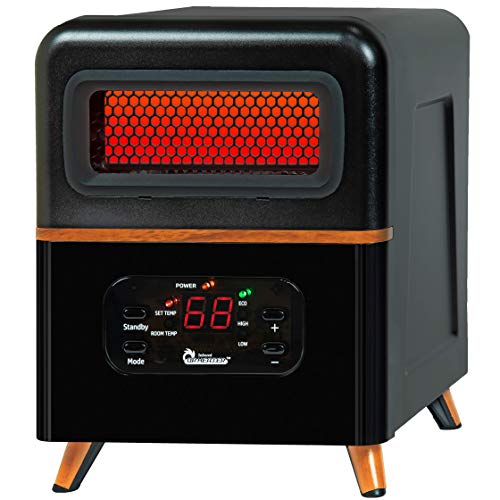
An infrared heater directs radiant energy toward people and objects, often with a fan to distribute heat. It feels faster when you sit in its path, but the fan adds noise and the warmth is less even outside that path. The Dr. Infrared Heater DR-978 was verified in stock through the Canadian Creators API. Its manufacturer lists a hybrid infrared and ceramic system, 1,000 and 1,500 W modes, a 12-hour timer, tip-over and overheat protection, and UL/cUL certification.
A ceramic heater pushes air across a PTC element. It is the fastest choice for a cold desk area, but its fan is audible and it stops feeling warm almost as soon as it turns off. For close-range office use, see our under-desk heater guide. Choose oil-filled for quiet, sustained room heat; infrared for directional warmth; ceramic for rapid spot heat.
What does an oil filled radiator heater cost to run?
The calculation is watts divided by 1,000, multiplied by hours, multiplied by the electricity rate. At full 1,500 W output, one hour uses 1.5 kWh. At 900 W it uses 0.9 kWh, and at 600 W it uses 0.6 kWh. You can change the assumptions with our electricity cost calculator.
| Region and energy rate | 600 W for one hour | 900 W for one hour | 1,500 W for one hour |
|---|---|---|---|
| Ontario off-peak, 9.1 cents/kWh | 5.5 cents | 8.2 cents | 13.7 cents |
| Quebec Rate D tier 1, 7.065 cents/kWh | 4.2 cents | 6.4 cents | 10.6 cents |
| B.C. tier 1, 11.87 cents/kWh | 7.1 cents | 10.7 cents | 17.8 cents |
| Alberta EPCOR RoLR, 12.01 cents/kWh | 7.2 cents | 10.8 cents | 18.0 cents |
| U.S. residential average, 18.16 cents/kWh | 10.9 cents | 16.3 cents | 27.2 cents |
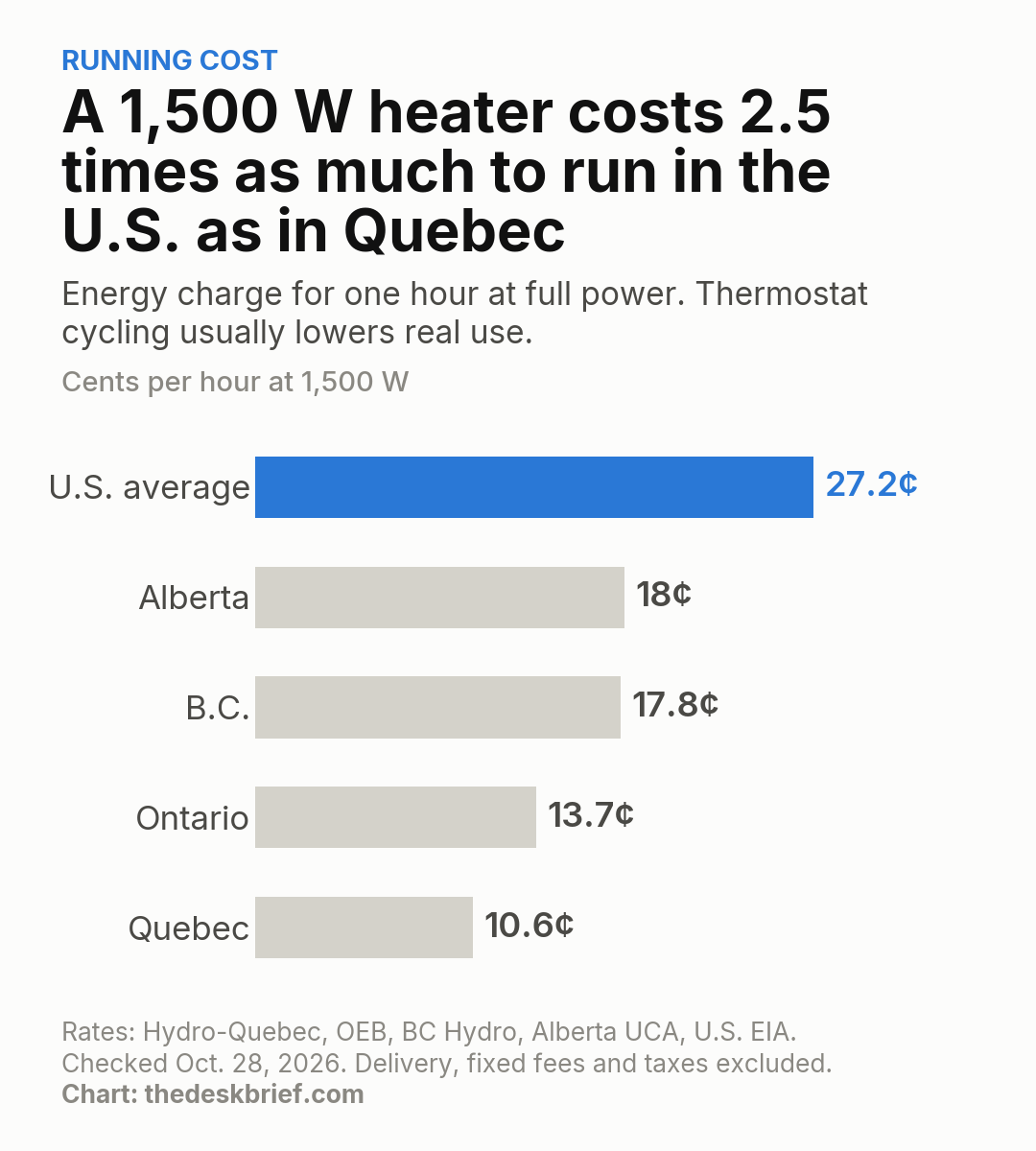
The rate inputs come from the Ontario Energy Board, Hydro-Québec, BC Hydro, Alberta’s Utilities Consumer Advocate and the U.S. Energy Information Administration. Real consumption is normally lower than full-power multiplication because the thermostat cycles the element once the room approaches its setpoint. I haven’t measured the duty cycle of these units.
Space-heater safety and certification
Health Canada says to keep a portable heater at least one metre from couches, beds, clothes and curtains, never use an extension cord or power bar, and unplug it before leaving home or going to sleep. Plug the heater directly into a sound wall outlet. Stop if the plug or outlet becomes hot, loose, discoloured or damaged.
Tip-over and overheat switches reduce risk; they don’t make unattended operation safe. Oil-filled fins can stay hot after shutdown. Keep the heater upright on a hard, level surface, don’t drape laundry over it, and don’t place it where bedding can fall onto it. Follow the exact manual’s clearance, since the Comfort Zone manual calls for three feet around the unit.
For Canada, Health Canada advises buyers to look for a recognized mark such as CSA, cUL or cETL. Pelonis states cETL for the PHO15A2AGW, and Comfort Zone states ETL for the CZ8008N. The De’Longhi pages cited here do not state a Canadian mark, so inspect the label on the exact unit or ask the manufacturer before ordering if certification is a requirement.
How to choose an oil filled radiator heater
Start with use time. A two-hour evening session benefits from digital temperature and a timer. A heater that stays in one room can use dependable dials. Then check the floor footprint and weight, not just height. Even a 19-pound radiator is awkward across thresholds, while good casters make room-to-room moves routine.
Next, separate heat output from heat delivery. All five picks top out at 1,500 W. More fins or enclosed chimney slots can improve surface area and convection, but they don’t create extra electrical power. A large, drafty room may still outrun any plug-in heater. Seal drafts and use the heater as supplemental zone heat rather than pretending it replaces a central system.
For desk-only cold, a radiator may heat more room than necessary. A foot warmer or heated mouse pad targets the problem with less power. For bed comfort, a heated blanket can warm the person rather than the entire bedroom.
Oil filled radiator heater FAQ
The Short Version
The De’Longhi Dragon is the best oil filled radiator heater here for its digital thermostat, timer and quicker-convection body. Choose the Radia S when you want a lighter digital design, Pelonis when cETL certification and tip-over protection matter more than scheduling, Comfort Zone for documented ETL safety with simple dials, or ComfortTemp for a lower-surface slot design. Whichever you buy, plug it directly into the wall and keep it clear of fabric.