The best tailbone cushion for most desk chairs is the Kieba Gel Coccyx cushion. Its rear U-shaped cutout creates clear space under the coccyx, while the firm gel-topped memory foam, non-slip base and washable cover make it practical for daily use.
I did not sit-test these cushions. I compared current Canadian Amazon Creators API records with manufacturer specifications for shape, foam, size, thickness, cover care, grip and stated user-weight guidance. A coccyx cushion is designed to reduce direct pressure on the tailbone. It does not identify why you hurt, heal an injury or replace medical assessment.
This page contains affiliate links. If you buy through these links, we may earn a small commission at no extra cost to you. As an Amazon Associate I earn from qualifying purchases. Full disclosure.
Don’t want to read the whole article? Here are our quick picks.
1Best overall Kieba Gel Coccyx. Firm memory foam, gel top and a rear cutout.
2Best hybrid Contour Kabooti. A center opening, rear channel and wedge in one shape.
3Best donut Kieba foam donut. Dense foam and a broad central opening.
4Best for travel ComfiLife Gel Enhanced. Carry handle, grippy base and car-friendly size.
As an Amazon Associate I earn from qualifying purchases.
Table of Contents
- U-shaped, donut and wedge designs
- Tailbone cushion comparison
- Best overall: Kieba Gel Coccyx
- Best hybrid: Contour Kabooti
- Best donut cushion: Kieba
- Best simple molded foam: DMI
- Best with weight guidance: 5 Stars United
- Best for car and travel: ComfiLife
- How a cushion changes seat height
- When to see a doctor
- How to choose
- Tailbone cushion FAQ
- The Short Version
U-shaped, donut and wedge tailbone cushions
A U-shaped coccyx cushion has an opening at the rear. When it is the right depth and you sit fully back, the tailbone hangs over that channel instead of pressing into foam. Most models are memory foam or molded polyurethane. This is the most direct shape for a sore tailbone at a desk or in a car.
A donut cushion is a ring with a central opening. It moves pressure away from the middle rather than only the rear. That wider opening can suit someone whose sensitive area is not limited to the coccyx, but a ring also concentrates load around its edge. It is not automatically better for tailbone pain just because it looks more specialized.
A wedge is thicker at the rear and thinner at the front. It changes pelvic angle as well as padding the chair. Some wedges add a coccyx channel, as the Kabooti does. That is a larger ergonomic change than a flat U-shaped pad. It can also make you feel as if you are sliding toward the desk. For general comfort rather than a tailbone-specific opening, see our separate office chair seat cushion guide.
Tailbone cushion comparison
| Pick | Design and foam | Manufacturer size | Cover and base | User guidance | Buy |
|---|---|---|---|---|---|
| Kieba Gel Coccyx | U-cutout, gel-topped memory foam | 18 by 14 by 3 in | Washable velour, non-slip | Not published | Amazon |
| Contour Kabooti | Center opening, coccyx channel, wedge foam | 16.75 by 15.5 by 3 in | Washable stretch cover | Not published | Amazon |
| Kieba donut | 18-inch ring, dense comfort foam | 18 in across | Washable velour, non-slip | Not published | Amazon |
| DMI Premium Coccyx | Rear cutout, molded standard foam | 17.25 by 14 by 2.75 in | Washable mesh, non-slip | Not published | Amazon |
| 5 Stars United | U-cutout, medium-firm memory foam | 18 by 14 by 3 in | Washable cover, non-slip | About 150 to 220 lb | Amazon |
| ComfiLife Gel Enhanced | U-cutout, gel-topped memory foam | 17.6 by 13.8 by 2.75 in | Washable cover, non-slip | Up to 250 lb | Amazon |
Best overall: Kieba Gel Coccyx cushion
Amazon.ca pricing and availability were refreshed November 05, 2026 at 10:06 AM EST. Product prices and availability are accurate as of the date/time indicated and are subject to change. Any price and availability information displayed on Amazon.ca at the time of purchase will apply to the purchase of this product.
The Kieba Gel Coccyx cushion is the most focused everyday choice. Its memory-foam body has a rear U-shaped opening, a gel layer across the top, and a non-slip bottom. Kieba specifies an 18 by 14-inch footprint and describes the foam as firm. The removable velour cover is machine washable.
That width fits more of a standard office seat than narrow travel pads, while the opening is visibly separate from the back edge. Use it with the channel at the rear and sit far enough back that the coccyx is over empty space. The three-inch nominal height means most people will need to lower the chair.
The negative is missing user-weight guidance. Kieba says the foam is dense and designed not to flatten, but does not publish a tested range or density number. Firm gel-topped memory foam can also feel warmer and less forgiving than molded open-cell foam.
Best hybrid: Contour Kabooti
The Contour Kabooti combines a large central oval, a channel to the rear and a three-inch wedge. Four raised corner lobes stabilize the seat, while the tapered front leaves more room under the thighs and beneath a steering wheel. Contour specifies resilient foam rather than memory foam, a machine-washable stretch cover and a carry handle.
This is the strongest choice when you are unsure whether a U-cutout or donut cushion better matches the sensitive area. The opening is hidden under an ordinary-looking cover. Its 16.75 by 15.5-inch footprint is shallower and wider than Kieba’s gel cushion.
The tradeoff is geometry. A wedge deliberately tilts the sitting surface, and the center opening is much larger than a coccyx channel alone. That can feel unstable or concentrate pressure in unfamiliar places. Contour publishes no user-weight range, and the exact U.S. ASIN was out of stock at our check, so this link has no U.S. mapping.
Best donut cushion: Kieba foam ring
The Kieba donut cushion is an 18-inch ring made from dense comfort foam. Unlike an inflatable ring, it cannot lose air and Kieba says it is built to resist flattening. A non-slip bottom and removable machine-washable velour cover cover the practical basics.
Choose a donut when you specifically want a broad central opening rather than only a rear coccyx cutout. It can move among an office chair, car or hard dining chair, although an 18-inch circle is not especially compact travel gear.
The negative is that the ring edge carries your weight around the opening. Kieba does not publish foam density, thickness or a user-weight limit on its exact product page. Canadian stock was scarce, and the U.S. API did not return the exact ASIN as orderable, so verify the chair fit before relying on this option.
Best simple molded foam: DMI Premium Coccyx
The DMI Premium Coccyx model 513-7957-0200 is the plain molded-foam option. The manufacturer’s current catalogue specifies standard foam, a 17.25 by 14 by 2.75-inch shape, breathable mesh cover and non-slip bottom. The opening runs from the rear into the cushion.
At 2.75 inches before compression, it changes chair height slightly less than the three-inch picks. The mesh cover is removable and washable. Molded foam returns faster than slow memory foam and may feel more stable when you shift position.
The compromise is a basic contour with no gel layer, carry handle or published firmness choice. DMI also gives no user-weight range. The exact U.S. ASIN was out of stock during the final API check, so there is deliberately no U.S. mapping.
Best with weight guidance: 5 Stars United
The 5 Stars United cushion is one of the few makers to state who its standard foam is designed for. The brand calls it medium-firm memory foam for users up to 220 pounds. The exact listing narrows that guidance to about 150 to 220 pounds and gives an 18 by 14 by 3-inch size, rear cutout, removable cover, grippy bottom and handle.
That guidance is more useful than claiming one firmness fits every body. This is a conventional portable U-cutout shape for standard chairs, cars and trips, with no gel layer to complicate the feel.
The negative is equally clear: shoppers well outside that range should choose a model whose size and foam are intended for them. The manufacturer page provides limited technical detail, and the exact U.S. ASIN was out of stock when checked.
Best tailbone cushion for car and travel: ComfiLife
The ComfiLife Gel Enhanced is 17.6 by 13.8 by 2.75 inches and about two pounds. Its handle, non-slip rubber bottom and compact depth make it the easiest pick to move between desk, car and airplane. A U-shaped rear cutout sits below a gel-topped memory-foam core, and the zippered cover is machine washable.
ComfiLife publishes a 250-pound maximum and warns that memory foam becomes softer with heat and less supportive with increasing weight. It also advises keeping the cushion at room temperature rather than leaving it in a hot or cold car. Those limitations are unusually candid.
The catch is the 13.8-inch depth. It can leave part of a large task-chair seat unsupported, and the gel film does not create the airflow of an open grid. This is the one overlap with our general seat-cushion guide because its cutout and portability fit the tailbone-specific purpose.
A tailbone cushion changes seat height
Every pick raises the sitting surface before foam compression. That changes your relationship with the desk, floor, backrest and armrests. Lower the chair if your feet still rest flat and your elbows remain near desk height. If lowering it puts the desk too high, the cushion may solve one pressure point and create a shoulder problem.
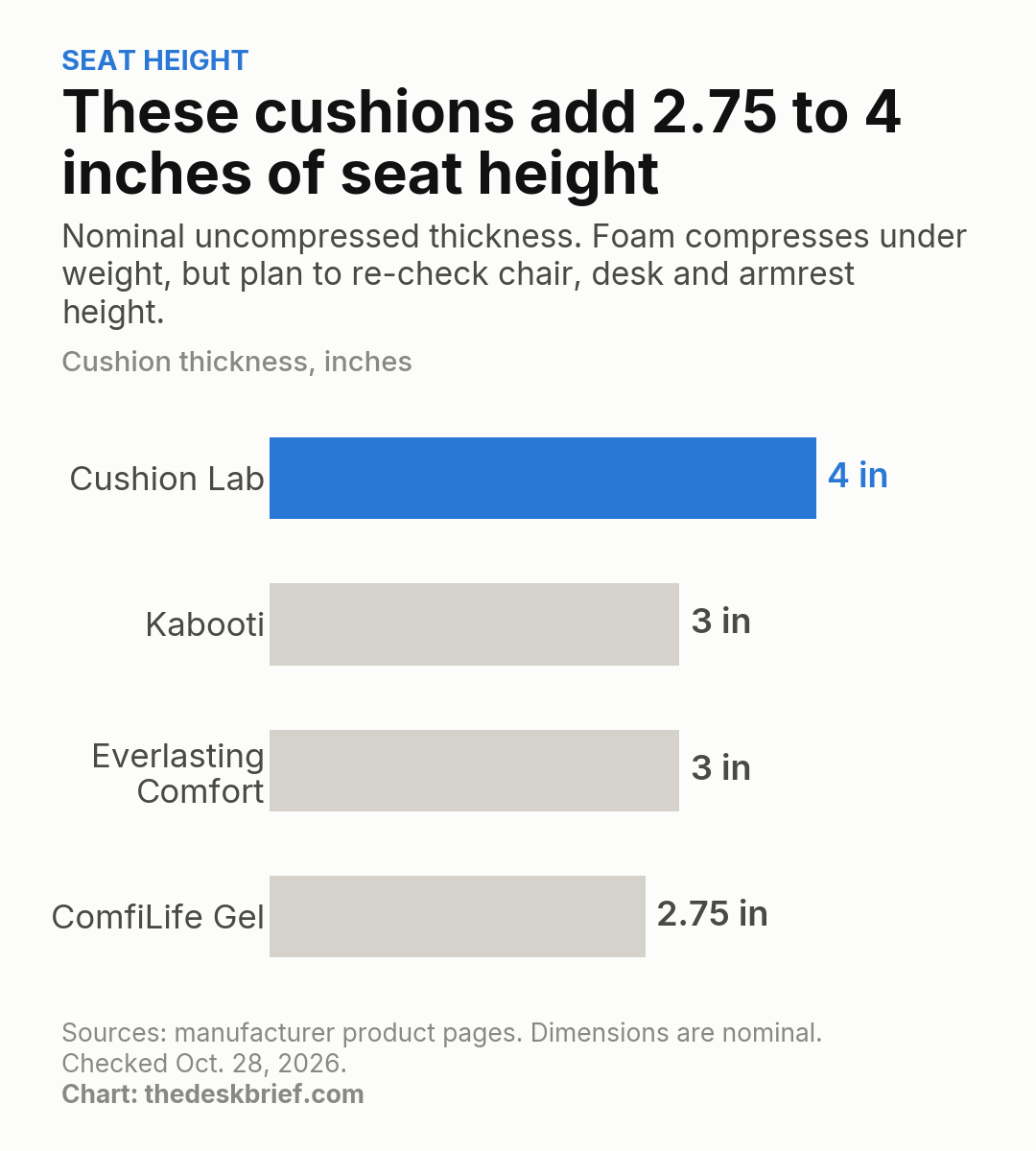
The chart includes two common general cushions to show the broader range. Nominal thickness is not the same as occupied height because foam compresses differently under each person. Recheck your keyboard and elbow position, confirm that the backrest still reaches your lower back, and make sure the front edge does not press behind your knees.
When to see a doctor for tailbone pain
Check with a doctor if the pain began after a fall or other injury, has not improved after a few weeks, affects daily activity, or comes with fever or pain elsewhere. The NHS tailbone guidance lists those reasons for medical assessment. A cushion can change contact pressure while you wait; it cannot rule out a fracture, infection or another cause.
Seek prompt medical advice for new numbness, tingling or weakness in the legs, buttocks or genital area, or loss of bladder or bowel control. HealthLink BC notes that those can be signs of a spinal injury after a tailbone impact. This guide gives product-fit information, not treatment advice.
How to choose a tailbone cushion
First, locate the pressure you want to avoid. A rear U-cutout is the simplest match for the coccyx. A donut creates a much larger central void. A wedge changes pelvic angle and should be chosen deliberately. Measure the chair’s flat usable width and depth, then compare the opening position with where your tailbone actually lands.
Next, consider firmness and weight guidance. Slow memory foam conforms more but changes with temperature. Molded foam feels springier. Gel over foam changes the top surface but does not transform the whole core. Only ComfiLife and 5 Stars United publish clear weight guidance among these picks. Missing guidance is not proof that every body will get the same support.
Then examine the complete workstation. A cushion cannot fix a chair that is too deep or a backrest that misses your waist. Our lumbar-support guide explains that part. If the existing chair lacks basic adjustment, compare ergonomic chairs before stacking accessories. A kneeling chair changes loading in a different way, but it is not a prescription for pain.
Finally, change position. Alternating between sitting and a properly adjusted standing desk can reduce uninterrupted chair time. No cushion makes motionless sitting harmless. Stop using one that brings new numbness, tingling, weakness or worsening pain.
Tailbone cushion FAQ
The Short Version
The Kieba Gel Coccyx is the best tailbone cushion here for its firm gel-topped memory foam and clear rear opening. Choose the Kabooti when you want a donut, cutout and wedge combined; the Kieba ring for a true donut; DMI for simple molded foam; 5 Stars United for stated weight guidance; or ComfiLife for car and travel. Measure the chair, reset its height, and see a doctor for pain after injury, persistent pain or neurological symptoms.