

For most of the last decade, “smart desk” meant one thing: a standing desk with cool looking memory preset button so you did not have to punch in your height every morning or a desk covered in smart gadgets. That was it. That was the whole innovation.
Currency note: Canadian dollar equivalents use the Bank of Canada daily average of 1 USD = 1.4014 CAD on July 17, 2026. Converted amounts are approximate; the original US price is shown in brackets.
In 2026, that gap between marketing language and actual capability is finally starting to close. Furniture and workspace tech showed up differently at CES this year. Not incremental, not vaporware. Real products, available now or arriving imminently, that genuinely do things your current desk cannot. Some of them are worth paying attention to. Some of them are not there yet. This piece tells you which is which.
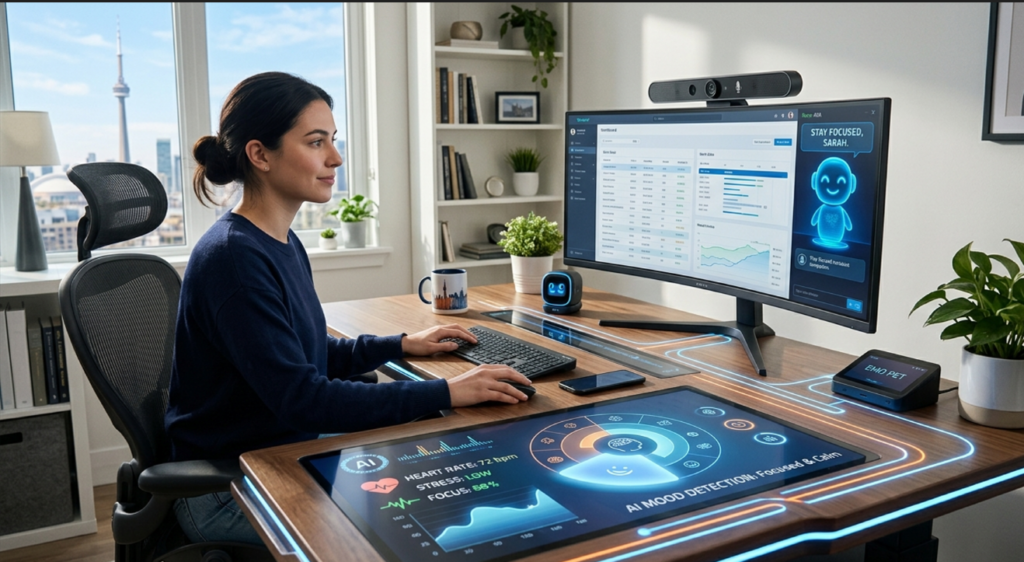
Table of Contents
So what changed in 2026?
The shift is less about any single product and more about a convergence of three things that finally became affordable at the same time: pressure-sensitive sensor arrays, low-power Bluetooth and WiFi chips small enough to embed in furniture, and app platforms capable of processing that sensor data into something actionable.
The result is a category of workspace and smart desk furniture that is aware of what you are doing. Not just height-aware. Presence-aware. Posture-aware. In some cases, fatigue-aware.
Whether that matters to you depends almost entirely on whether you have a problem these sensors can solve. And a lot of people do. According to the International Ergonomics Association, companies that implement comprehensive ergonomic programs see a 25% reduction in musculoskeletal disorders and a 16% increase in overall productivity. The issue has never been the research. It has been the gap between “set up your workstation correctly” and actually doing it, consistently, day after day. Smart desks are trying to close that gap automatically.
The products worth knowing about right now
Beflo Tenon; the benchmark for what a smart desk can actually be
The Tenon from Beflo has been reviewed extensively by TechRadar, Pro Tool Reviews, InsideHook, and others. The consensus is fairly consistent: it is the most technologically advanced standing desk currently available to consumers, and it costs accordingly.
What makes it different from a standard standing desk with a controller panel:
The Tenon has embedded presence sensors that detect when you sit down at the desk. An ambient light strip on the underside of the desktop shifts from neutral to warm when you have been sitting too long, a passive visual nudge to stand without a loud notification that interrupts focus. The control interface is a flush-mounted OLED touchscreen rather than a standard button panel. Four built-in power outlets sit under the right side of the desktop so cables run down from one point rather than sprawling across the desk. The frame uses four legs instead of the standard two, which is unusual enough to warrant explanation.
The four-leg design is about stability at standing height. Two-leg standing desks wobble noticeably when the surface carries any real load at standing height. Four legs solve that problem. The trade-off, as reviewers note, is compatibility with standard accessories. Most monitor arms, keyboard trays, and desk accessories clamp to the edge of the desktop. The Tenon’s metal skirt around the perimeter blocks most third-party clamps. Beflo sells proprietary versions of these accessories that work within their system. That is a real constraint worth knowing before buying.
The Tenon also connects to a smartphone app via Bluetooth, where you can set stand reminders, track sit and stand time throughout the day, and adjust desk height without walking to the panel. Independent review notes that the app requires a yearly subscription for some features, which some buyers find unnecessary for what is already a premium-priced product. The motor is genuinely very quiet. Multiple reviewers note you cannot hear it over ambient room noise, which matters on calls.
The bottom line on the Tenon: it is a serious product that solves real problems. It is not for someone who wants a basic sit-stand desk. It is for someone who wants their desk to function as a system. The price reflects that.
ProtoArc Smart Workspace the ecosystem concept from CES 2026
At CES 2026 in January, ProtoArc debuted a concept that takes a different approach. Rather than making a single smart desk, they showed a connected ecosystem where the chair is the control center.
The setup consists of a pressure-sensitive ergonomic chair that detects changes in how you are sitting, a dual-motor standing desk that responds to those signals, a smart lamp that adjusts brightness based on workspace activity, and a central control panel that ties it together. The idea is that when the chair senses you shifting your weight or slouching, the system does not just remind you to adjust. It adjusts things around you automatically.
As ProtoArc founder Joey He put it at the event, “workspaces today are static, even though the way people work is not.”
The honest caveat: this is still a concept. Pricing and commercial availability were not announced at CES. The existing ProtoArc smart chair, the Arc Protector Y24, is available now and gives you a preview of the direction. It uses eight posture sensors across the seat and back, four adaptive airbags for lumbar support, and a companion app with stand reminders, posture tracking, and analytics. It launched via Kickstarter in 2024 with MSRP around CA$699 (US$499). The full connected ecosystem they showed at CES is further out.
Worth watching: if the ecosystem concept ships at a reasonable price point, it represents a genuinely different approach to workspace ergonomics than anything currently available.
What the sensor data actually does
There is a reasonable question buried in all of this: what does a desk actually do with the information that you have been sitting for 47 minutes?
Right now, the answers are: remind you to stand, adjust the desk height automatically, shift ambient lighting, send a notification to your phone. Those are useful. They are not transformative.
The more interesting near-term development is what happens when workspace sensors start connecting to health platforms. Apple Health, Google Fit, and similar platforms already aggregate movement data from phones and watches. Desks that contribute posture and sitting data to that picture could meaningfully change how people understand their physical health across a full day, not just during a workout. That integration does not really exist yet in a clean, accessible form. But the hardware foundation is being laid.
The longer-term trajectory, according to multiple industry sources, is AI that learns your individual work patterns. Not generic reminders, but a system that knows you tend to slump after about 90 minutes of focused screen work and starts adjusting lumbar support before you notice it happening. That is further out. The sensors exist. The AI is not quite there yet for this specific application.
What is not worth buying yet
A few categories getting heavy marketing attention in 2026 that are not ready for real-world use:
Posture correction wearables as a desk replacement. Clip-on posture sensors (worn on your upper back) are getting a lot of coverage. They work fine as a supplementary feedback tool for someone actively trying to improve sitting habits but they do not replace the underlying problem of a poorly set up workstation. If your monitor is too low and your chair is at the wrong height, a vibrating reminder to sit straighter is treating symptoms rather than causes. Sort out your ergonomic setup first. Add a wearable later if you want the extra accountability.
AI-powered desk lighting that “detects your mood.” Several products announced this year claim to adjust color temperature and brightness based on biometric signals or detected focus states. The science on this is thin. Lighting that shifts based on time of day and detected presence is useful. Lighting that claims to respond to your emotional state is not there yet at consumer price points.
Voice-controlled desk adjustments. The feature sounds appealing but in practice introduces more friction than it removes. Saying “desk, stand” in the middle of a meeting or a phone call is awkward. A button or preset on a touchscreen is faster. The Beflo Tenon has voice control and reviewers note they use the touchscreen instead.
What this means for a typical workspace today
If you are setting up a desk from scratch and have a budget for a standing desk, this category is worth looking at rather than defaulting to a standard two-leg option. The smart features on products like the Tenon are genuinely useful, not gimmicks, and the presence sensing in particular changes how you interact with the desk in a subtle but daily way.
If you already have a functional standing desk, upgrading for smart features alone is hard to justify at current price points. The standing and sitting part works the same either way.
If you are still using a fixed-height desk and wondering whether to upgrade, the calculus has not really changed from a few years ago. A sit-stand desk with simple height presets is still the baseline worthwhile upgrade. Smart features are a nice layer on top. The foundation matters more.
The most important desk upgrade you can make before worrying about sensors and AI is still getting the basics right: your monitor at the right height, your chair properly adjusted, your keyboard at the correct position. A CA$2,000 (US$1,427) smart desk pointed at a monitor that sits 4 inches too low is still going to hurt your neck. Smart furniture does not compensate for a poorly planned workspace. It enhances a well-planned one.
What to do with all this cable management when you add a smart desk is also worth thinking through in advance. The Tenon partially solves this with built-in power outlets. Standard smart desks with added Bluetooth controllers add another cable run you will need to plan for.
The realistic timeline
By 2027, the category will look meaningfully different. The ProtoArc ecosystem concept will likely ship in some form. Multiple other manufacturers are working on similar integrated approaches. Prices will come down as the components commoditize.
By 2028 to 2029, AI-personalized ergonomics is the likely next wave: desks and chairs that learn individual patterns and adjust proactively without reminders. The hardware for this already exists. The AI layer is catching up. If you want to start building workspace automations now without waiting for the hardware, no-code tools are already capable of some genuinely useful workflows.
For now, the Beflo Tenon represents the practical ceiling of what you can buy today that actually works as advertised. The ProtoArc ecosystem represents where the category is trying to go. Everything else is somewhere between the two.
If you are shopping for a standing desk today and want the best current technology, start with the Beflo Tenon if budget allows. If budget is a constraint, a standard quality standing desk with height presets does 80% of what a smart desk does at a fraction of the price, and is still a real upgrade over a fixed-height setup. Pair it with a good ergonomic chair and the basics taken care of, and you have a genuinely strong workspace regardless of how many sensors are in the furniture.
The smart desk revolution is real. It is just moving at furniture pace, not smartphone pace. That is probably fine.