Minisforum AtomMan G1 Pro-89A6 costs just US$40 more than the shipping RTX 5060 version and doubles dedicated graphics memory from 8GB to 16GB. That is the entire pitch. The difficult part is deciding whether more VRAM is worth buying before anyone has measured what a 140W Radeon RX 9060 XT does inside this 3.8-litre chassis.
Last updated: October 22, 2026
As of October 22, 2026, the new Radeon configuration is still preorder-only and has not started shipping. Minisforum’s US store lists the exact 32GB RAM and 1TB SSD configuration at US$1,759 with estimated late-October shipping. Minisforum’s Canadian store lists it at C$2,409.90 with estimated late-November shipping. Exact-model Amazon Creators API and Newegg/Rakuten searches found no available US or Canadian retailer offer. Minisforum has not announced a precise ship date.
What we will update at launch: retail stock, regional prices, production-unit gaming results, sustained GPU clocks, fan noise and thermals. For now, this is specification analysis based on current manufacturer pages and independent launch coverage, not hands-on testing.
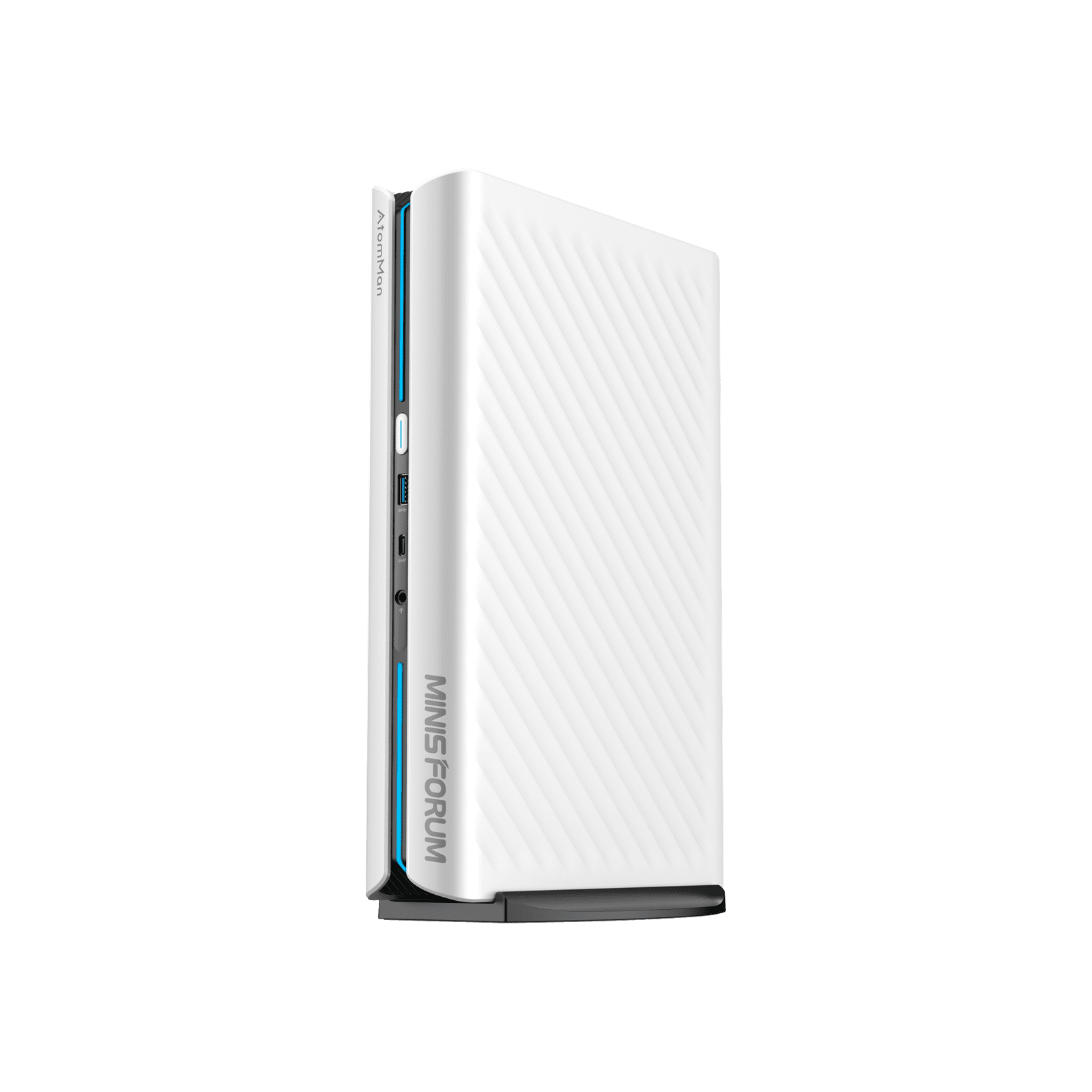
Table of Contents
- What the Minisforum AtomMan G1 Pro-89A6 changes
- 16GB is the reason to choose Radeon
- The 140W limit matters
- How the three compact PCs compare
- The rest of the machine is more practical
- Buy or wait?
- Who Should Skip This
- FAQ
- The Short Version
What the Minisforum AtomMan G1 Pro-89A6 changes
The original AtomMan G1 Pro is already on sale with an Nvidia GeForce RTX 5060. This is a new configuration of that existing computer, not a new chassis. Minisforum keeps the Ryzen 9 8945HX processor, two DDR5 SO-DIMM slots, two M.2 storage slots, 5Gb Ethernet, Wi-Fi 7 and the internal 350W power supply. The change is the graphics card.
The 89A6 replaces the 8GB RTX 5060 with a 16GB Radeon RX 9060 XT. Minisforum lists the Radeon at 140W and the Nvidia card at 145W. iTechGuides’ launch analysis found no matched independent benchmark for the Radeon configuration; the current US$1,759 price comes from Minisforum.
That makes the buying decision unusually clean. Pay US$1,759 for 16GB of VRAM and AMD’s graphics stack, or US$1,719 for 8GB and Nvidia’s CUDA, Studio and DLSS ecosystem. The US$40 difference is small enough that software support and memory needs should decide it.
16GB is the reason to choose Radeon
Sixteen gigabytes gives the Radeon model useful headroom for large texture packs, high-resolution assets, GPU rendering and some local AI workloads. It does not make the RX 9060 XT twice as fast. Capacity prevents a workload from spilling out of VRAM; it does not double shader throughput, memory bandwidth or frame rate.
The distinction matters because the Minisforum AtomMan G1 Pro-89A6 also supports up to 96GB of ordinary DDR5 system memory. That RAM is upgradeable, but it is not a unified pool that the discrete Radeon can treat as fast VRAM. If your local model needs more than 16GB on the GPU, the system can offload work to system memory, and performance can fall sharply.
For local AI first, the Beelink GTR9 Pro is the more coherent reference point because its 128GB unified pool can assign far more memory to graphics workloads. It is also a different budget: Beelink currently lists its 128GB/2TB model at US$4,349. Our RAM requirements for local AI explain why model size, context and runtime overhead matter more than an AI label on the box.
The 140W limit matters
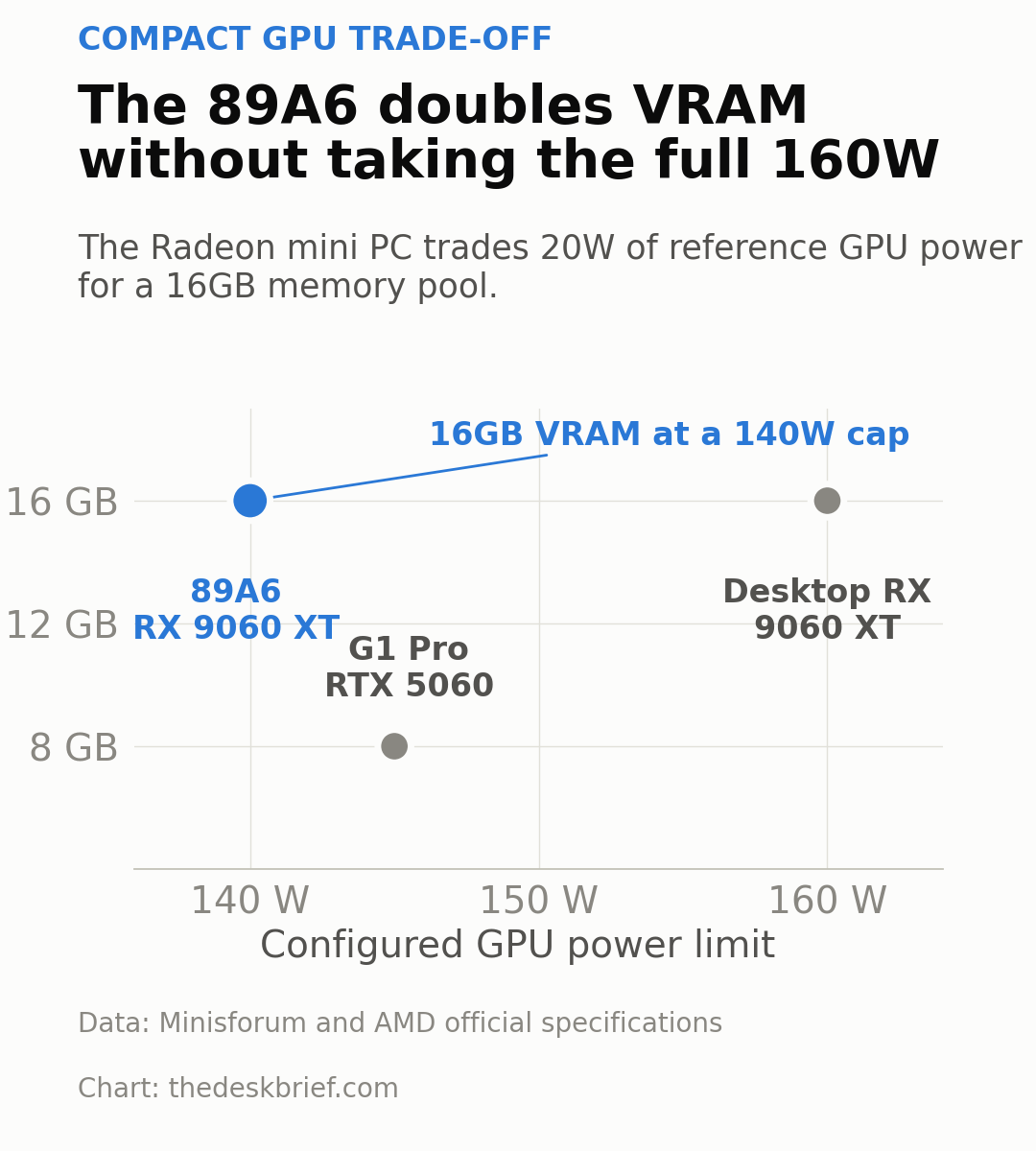
AMD specifies 160W as typical board power for the desktop Radeon RX 9060 XT 16GB. Minisforum caps its version at 140W, or 20W lower. That does not automatically translate into a fixed performance loss, but it gives the GPU less power headroom under sustained load.
The chart shows the useful trade-off. The 89A6 gets the full 16GB capacity at the lowest configured GPU power of the three reference points. That may be a sensible thermal compromise in a 3.8-litre computer. It is not evidence that the machine holds boost clocks quietly, which is why production-unit measurements matter.
How the three compact PCs compare
| Specification | AtomMan G1 Pro-89A6 | AtomMan G1 Pro RTX | Beelink GTR9 Pro |
|---|---|---|---|
| Current listed price | US$1,759 | US$1,719 | US$4,349 |
| Processor | Ryzen 9 8945HX | Ryzen 9 8945HX | Ryzen AI Max+ 395 |
| Graphics | RX 9060 XT, 16GB, 140W | RTX 5060, 8GB, 145W | Radeon 8060S, unified memory |
| System memory | 32GB included, up to 96GB | 32GB included, up to 96GB | 128GB soldered |
| Included storage | 1TB, two M.2 slots | 1TB, two M.2 slots | 2TB, two M.2 slots |
| Wired networking | 5Gb Ethernet | 5Gb Ethernet | Dual 10Gb Ethernet |
| Release state | Preorder, US late October / Canada late November | Shipping | Released, current orders delayed |
The Radeon and RTX AtomMan models are the real comparison for most buyers. Their CPU, memory ceiling, storage and network connection are effectively the same. Choose Radeon for 16GB of dedicated graphics memory. Choose Nvidia when your applications require CUDA or when DLSS and the tested RTX configuration matter more than memory capacity.
The Beelink belongs in the table because it is the site’s established compact local-AI reference, not because it is a value alternative. Its 128GB unified memory and dual 10Gb Ethernet serve a different workload. Paying roughly two and a half times as much for browser tabs and games would be a creative way to punish a bank account.
The rest of the machine is more practical
Minisforum lists two DDR5-5200 SO-DIMM slots with support for up to 96GB and two PCIe 4.0 M.2 slots that accept up to 4TB each. That is real upgrade room. A buyer can replace memory or storage later instead of treating the original 32GB and 1TB as a lifetime sentence.
The Radeon version supports two HDMI 2.1 outputs, one DisplayPort 1.4 output and one DisplayPort 2.1 output. The RTX version gets a second DisplayPort 2.1 connection. Both include 5Gb Ethernet, Wi-Fi 7 and Bluetooth 5.4. The internal 350W power supply keeps a large adapter off the floor, although it also places more heat inside the case.
Dimensions are 215 by 57 by 315 mm. That is narrow enough to reclaim desk space, but it is closer to a small console than a palm-sized office mini PC. The vertical stand is part of the design, and the front-facing USB and audio ports are sensible for a machine that will live beside a monitor.
Buy or wait?
Wait. The Minisforum AtomMan G1 Pro-89A6 has a reasonable price relative to its RTX sibling, but the Radeon configuration has not shipped and has no credible exact-configuration performance, thermal or noise measurements. A late-October estimate is close enough that there is little reward for accepting that uncertainty today.
The exception is a buyer with a workload known to fit inside 16GB of VRAM, known Radeon software support and a hard 4-litre size limit. Even then, write down the exact application and confirm its AMD support. Extra memory is useful only when the software can use the card properly.
If gaming is the priority, the shipping RTX version has already been reviewed by major outlets and costs US$40 less at Minisforum’s current listed prices. If CUDA is mandatory, the answer is even simpler. The ProArt GR1X is another unreleased compact CUDA option, but its price and exact ship date are also still missing.
Who Should Skip This
Skip the Minisforum AtomMan G1 Pro-89A6 if you need CUDA, want proven acoustic behaviour, expect a full-power 160W RX 9060 XT, or plan to replace the graphics card later. A conventional small-form-factor desktop is larger, but it offers a clearer upgrade path and fewer proprietary constraints.
Local-AI buyers who need more than 16GB of fast graphics-accessible memory should also look elsewhere. The machine’s 96GB system-memory ceiling sounds generous, but it does not turn a discrete Radeon into a unified-memory workstation.
FAQ
When will the Minisforum AtomMan G1 Pro-89A6 ship?
Minisforum’s US store estimates late October 2026, while its Canadian store now estimates late November. The company has not published an exact day. As of October 22, the configuration remains preorder-only in both countries.
Is the RX 9060 XT replaceable?
Minisforum does not advertise the graphics card as a user-upgradeable retail part. Treat the GPU as fixed unless the company publishes a supported replacement procedure.
Does 16GB make it better than the RTX 5060 model?
Not automatically. The Radeon has twice the VRAM, while the RTX model has CUDA, Nvidia Studio support and DLSS. The better configuration depends on the software and games you actually use.
Can it run local AI models?
It can run workloads supported by AMD’s software stack that fit within the available memory. No independent exact-configuration token-rate testing exists yet, so manufacturer specifications cannot answer how fast a particular model will run.
The Short Version
The Minisforum AtomMan G1 Pro-89A6 has a coherent specification sheet: US$1,759 buys a compact Ryzen 9 desktop with 16GB of VRAM, upgradeable system memory and storage, 5Gb Ethernet and no external power brick. The 140W GPU cap, missing exact-model measurements and preorder status are the reasons to wait.
Revisit it after production units ship. If the machine sustains its clocks without becoming a small white leaf blower, the extra US$40 over the RTX model could be excellent value for Radeon-friendly work. Until then, specifications are a shortlist, not a verdict.