This page contains affiliate links. If you buy through these links, we may earn a small commission at no extra cost to you. Full disclosure.
The Beelink GTR9 Pro is a 128GB Strix Halo mini PC that can run large local LLMs, but its current CA$4,349 direct price and unresolved first-revision Ethernet reports make it an enthusiast purchase, not an automatic bargain. The Amazon search is provided as a purchase option; check the retailer page for current availability. On paper it runs a 120-billion-parameter model. In practice, whether that is exciting or a slideshow depends entirely on what kind of model you feed it.
The number that changes the decision: cited tests range from about 7 tokens/s on a dense 70B model to 31 to 100 tokens/s on sparse MoE models. Model architecture matters more than the 120B label.
Currency note: historical Canadian equivalents in the review use the Bank of Canada daily average of 1 USD = 1.4014 CAD on July 17, 2026. The current CA$4,349 direct price is Beelink’s Canadian storefront price, not a conversion.
Last updated: September 16, 2026. Direct price and Ethernet revision guidance rechecked.
I have not had one on my own desk, so everything below is measured by the reviewers who did: ServeTheHome ran it as a full workstation, Notebookcheck tore it down, and hobbyists posted raw token counts. The current update adds seller pricing and Beelink support guidance, but it does not turn this into a hands-on review. Here is what the hardware is, what it is genuinely good at, and why the board revision now belongs in the buying decision.
Table of Contents
- What the Beelink GTR9 Pro actually is
- Current price, availability, and hardware revision
- The 128GB unified memory trick
- The token numbers that actually matter
- The catches: heat, drivers, and a firmware to-do list
- Beelink GTR9 Pro vs the alternatives
- Who Should Skip This
- Beelink GTR9 Pro FAQ
- The Short Version
What the Beelink GTR9 Pro actually is
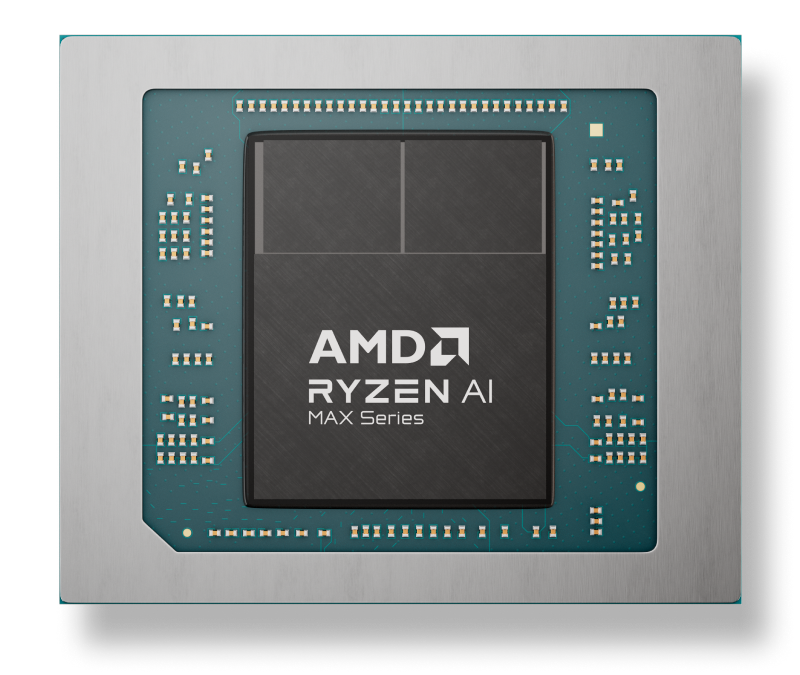
Strip the marketing and the Beelink GTR9 Pro is a delivery vehicle for one chip: AMD’s Ryzen AI Max+ 395, codenamed Strix Halo. That is 16 Zen 5 cores, 32 threads, and a Radeon 8060S integrated GPU with 40 RDNA 3.5 compute units, all sharing a single 128GB pool of LPDDR5X-8000. This is not the Ryzen AI 9 HX 370 found in less expensive mini PCs; the Max+ 395 has the larger Strix Halo GPU and memory system. The rest of the box includes a 230W internal power supply, a 2TB NVMe SSD, and a vapor-chamber dual-fan cooler that Notebookcheck found fills most of the chassis.
What separates it from the pile of near-identical Strix Halo boxes is the connectivity. ServeTheHome measured dual 10GBase-T ports on an Intel E610 controller in its first-revision review unit, plus two 40Gbps USB4 ports, HDMI 2.1, and DisplayPort 2.1. Beelink support discussions now distinguish that v1.0 Intel E610 board from a v2.2 revision using Realtek RT8127 networking. The current product page promises dual 10GbE but does not identify the controller, so ask the seller which revision is shipping. If it will live in a closet as an always-on box, configure auto power on after a power outage so it comes back on its own.
Beelink GTR9 Pro Current Price, Availability, and Revision
| Processor | AMD Ryzen AI Max+ 395, Strix Halo, 16 cores and 32 threads |
|---|---|
| Graphics | Radeon 8060S, 40 compute units |
| Memory and storage | 128GB LPDDR5X-8000 soldered, 2TB SSD, two M.2 PCIe 4.0 slots |
| Direct Canadian price | CA$4,349, reduced from CA$4,699 |
| Direct UK price | £3,999.00 including VAT, reduced from £4,299.00; 128GB / 2TB; pre-order; ships within about 35 days |
| Direct availability | Pre-sale; Beelink says orders ship within 35 days |
| Canadian retail | Compare the current direct price with established Canadian retailers |
| Board revision | v1.0 uses Intel E610; support discussions identify v2.2 with Realtek RT8127 |
Beelink’s UK store lists the 128GB / 2TB GTR9 Pro at £3,999.00 including VAT, reduced from £4,299.00, on pre-order with shipping within about 35 days.
The launch-window US$1,999 pricing used by early reviews explains their enthusiastic value verdicts. The current Canadian direct price is a different purchase. At CA$4,349, compare a complete discrete-GPU workstation, Framework Desktop, Mac Studio, and other Strix Halo systems before assuming the Beelink is the inexpensive route.
The 128GB unified memory trick
The reason anyone cares about a Beelink GTR9 Pro instead of a normal desktop is the memory model. Like Apple Silicon, Strix Halo gives the CPU, GPU, and NPU one shared pool. You can hand up to 96GB of that 128GB to the GPU on Windows, or a more generous 110GB on Linux. A 70-billion-parameter model that would need two CA$2,803 (US$2,000) graphics cards to hold in VRAM fits here in one box that draws about 120W under load.
The catch is bandwidth, and it’s a big one. That memory tops out around 256 GB/s on paper, and runaihome’s testing measured roughly 215 GB/s in real mixed workloads. That sounds fast until you learn an RTX 5090 moves 1,792 GB/s. Token generation is bandwidth-bound: the chip has to read the model’s weights for every single token it produces. So the GTR9 Pro can hold enormous models that a gaming GPU can’t, but it reads them roughly eight times slower. That trade defines everything about how it performs.
The token numbers that actually matter
Here’s where the box copy gets sneaky. Yes, the GTR9 Pro runs a 120-billion-parameter model. Notebookcheck clocked GPT-OSS 120B at around 31 tokens per second while the box sat at 120W, and a tuned Linux setup pushes that past 55 tokens per second per runaihome. That’s genuinely usable, real-time chat speed from a puck on your desk.
But GPT-OSS 120B is a Mixture-of-Experts model. It has 120 billion weights total and activates only a small fraction of them per token, so the memory system only has to read a few billion parameters each pass. Feed the same box a dense 70-billion-parameter model like Llama 3.3, where every weight fires on every token, and Hardware Corner’s numbers drop to 5 to 9 tokens per second. That’s slower than you can comfortably read. Same hardware, same quantization, a 10x difference driven entirely by the model’s architecture.
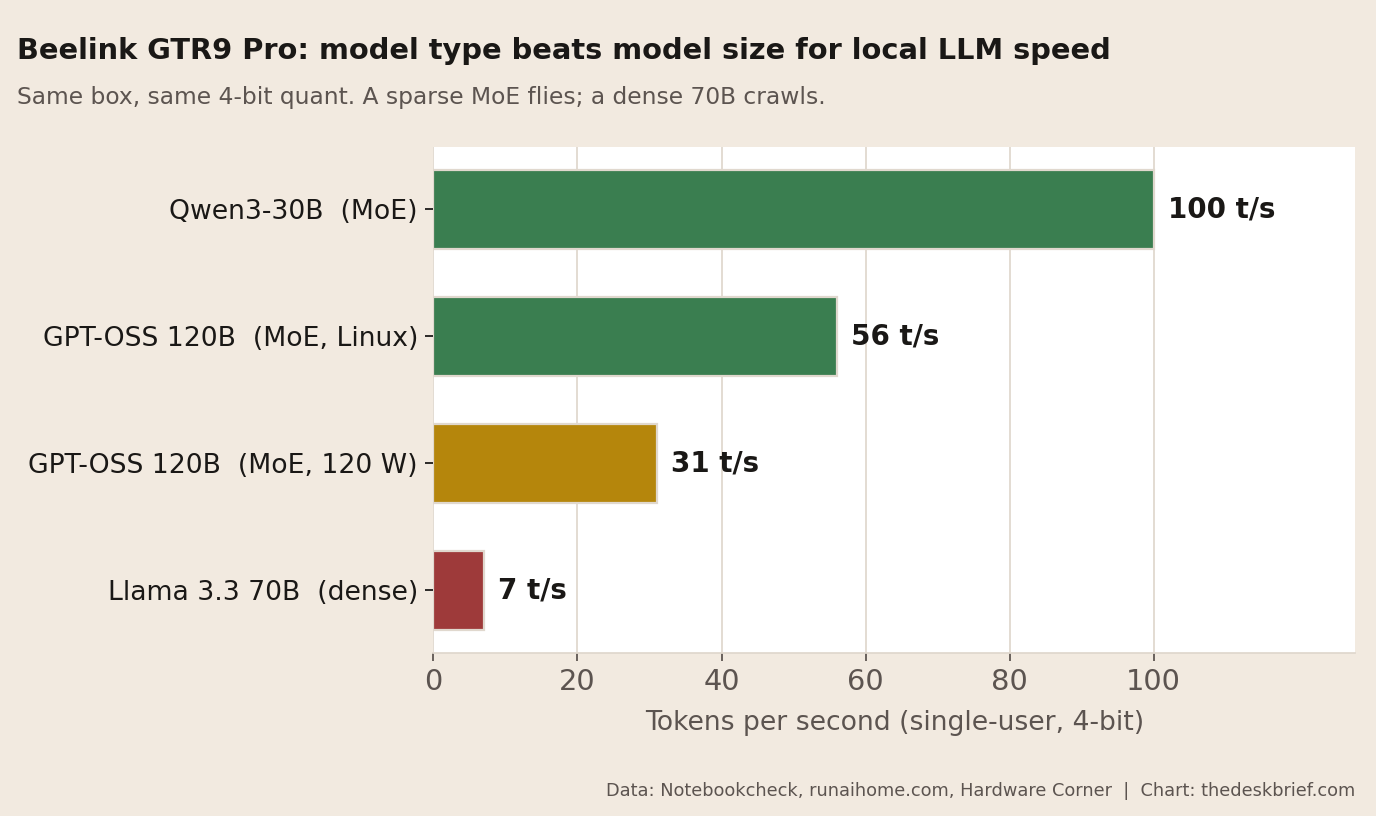
The practical takeaway: this machine loves sparse MoE models and small dense ones. A 30-billion-parameter MoE like Qwen3-30B-A3B screams along near 100 tokens per second. If your workflow lives on today’s open MoE releases, the GTR9 Pro is technically compelling, but the current Canadian price still has to survive the alternatives. If you’re wedded to a big dense 70B, buy it knowing you’re getting a patient assistant, not a fast one.
The catches: heat, drivers, and a firmware to-do list
The most concerning report comes from ServeTheHome’s v1.0 testing, where the Intel E610 10-gigabit NICs crashed under sustained load. Beelink support now recommends Intel NVM firmware 1.30 or newer, preferably 1.31, plus Linux ixgbe driver 6.4.4 or newer for high-load Linux dropouts. Reports in the same support thread say those steps do not fix every Windows or v1.0 unit, and Beelink routes unresolved cases through warranty support. Do not call the issue solved. Confirm the board revision and test both ports under sustained load while the return window is open.
Noise is the second question mark. Notebookcheck’s controlled teardown measured a reasonable 36 to 41 dBA under a 120W LLM load, which is quiet for the wattage. But at least one hands-on reviewer reported fan noise hitting an unpleasant 52 dBA, which suggests the cooling behavior depends heavily on ambient temperature and how hard you’re pushing it. And ServeTheHome flagged general BIOS and firmware rough edges that need cleaning up. None of this was a dealbreaker at the early US$1,800 to US$1,999 street price, but it is harder to excuse at CA$4,349 direct, but it’s the reason I’d treat an early unit as an enthusiast purchase, not an appliance.
Beelink GTR9 Pro vs the alternatives
Compared with AMD’s Ryzen AI Halo developer box, previously listed around CA$5,604 (US$3,999), the CA$4,349 GTR9 Pro still costs less and adds dual 10GbE. It is no longer the less-than-half-price decision early street pricing suggested. Against Lenovo’s Yoga AI mini PC, which pairs a slower Panther Lake chip with narrower memory bandwidth, the Beelink wins on raw inference throughput, but current availability and support still belong in the comparison.
The real competition is a used discrete GPU. A single 24GB card will destroy this box on any model that fits in 24GB of VRAM, running several times faster. The GTR9 Pro only pulls ahead when the model is too big for consumer VRAM, which is exactly the 70B-and-up territory where its huge memory pool becomes the only affordable option. If you’re weighing a box like this against NVIDIA’s RTX Spark approach, the deciding question is always the same: how big are your models, and are they sparse or dense?
Who Should Skip This
Skip the GTR9 Pro if your models fit in a 16GB or 24GB graphics card, because a GPU you might already own will run them faster and cheaper. Skip it if you mainly run big dense models and expect snappy replies; 7 tokens per second on a dense 70B will test your patience daily. Skip it if you need a plug-and-forget appliance today, because the NIC and firmware reports mean an early unit still wants an owner who reads release notes.
Buy it when you specifically need 128GB of GPU-addressable memory, strong MoE performance, and dual 10GbE in one compact box, and only after the current price beats the complete alternatives you can actually buy. That is a real use case. It is no longer enough to call it the most affordable route without checking.
Beelink GTR9 Pro FAQ
How much does the Beelink GTR9 Pro cost?
Beelink’s Canadian storefront listed the 128GB and 2TB configuration at CA$4,349, reduced from CA$4,699, on August 29. It was a pre-sale with shipping stated within 35 days. Compare the delivered direct price with established Canadian retailers rather than relying on the launch-window US$1,999 figure.
Can you run local LLMs on the Beelink GTR9 Pro?
Yes, and reasonably fast, but only because GPT-OSS 120B is a Mixture-of-Experts model that activates a fraction of its weights per token. A dense model of the same size would run far slower on the same hardware.
Is the Beelink GTR9 Pro worth it?
It can be worth it for large private MoE models that need more than consumer-GPU VRAM and for buyers who need dual 10GbE. At CA$4,349 direct, it is not an automatic value pick. Skip it when your models fit in a 16GB or 24GB graphics card, when dense 70B speed matters, or when you need appliance-like networking without checking the board revision.
Is the Beelink GTR9 Pro good for gaming?
The Radeon 8060S handles 1080p gaming well, but that’s not why this box exists. If gaming is your priority, a desktop with a discrete GPU at this price is a smarter buy. This is an inference machine that can game, not the reverse.
Windows or Linux for local AI on this box?
Linux, if you’re comfortable with it. You can allocate 110GB to the GPU versus 96GB on Windows, and the tuned Linux token rates on GPT-OSS 120B ran noticeably higher in testing. If you’d rather not tinker, running a home AI agent on Windows still works fine.
The Short Version
The Beelink GTR9 Pro remains a technically distinctive Strix Halo box: 128GB of unified memory, dual 10GbE, and vapor-chamber cooling. Sparse MoE models reach 31 to 100 tokens per second in cited testing, while dense 70B models fall near 7. The buying verdict changed because Beelink now lists it at CA$4,349 direct, and unresolved v1.0 Ethernet reports make the board revision important. Buy it for a specific large-model and networking workflow after comparing complete alternatives. Do not buy it expecting a cheap, fast dense-70B appliance.
Sources: ServeTheHome’s GTR9 Pro review, Notebookcheck’s teardown, and runaihome’s Strix Halo LLM benchmarks.
Editorial rating: 3.5 out of 5. The GTR9 Pro is a distinctive compact system for large local models, sparse MoE workloads, and dual-10GbE workflows that benefit from 128GB of GPU-addressable memory. Its high price, slow dense-model output, and board-revision networking concerns make it a specialist purchase.
Current offer checked August 30, 2026: CA$4349.00, available for preorder. Prices and availability can change.