An RTX Spark mini PC should be the easiest way to put 128GB of CUDA-friendly unified memory on a desk. The awkward part is choosing one before the manufacturers publish prices, complete specifications or independent performance results.
None of the six compact desktops in this roundup has shipped anywhere as of October 26, 2026. Microsoft’s Surface RTX Spark Dev Box is available for US preorder at US$5,999.99 and is due to ship in November. ASUS says the ProArt GR1X will arrive later this year, Dell calls its Creator Edition Desktop “coming soon,” and Acer, HP and MSI have not announced a manufacturer ship date. That makes this an early specification comparison, not a review.
My current pick is to wait. The same 20-core Grace CPU, 6,144-core Blackwell GPU and 128GB memory ceiling appear across the serious options, so price, cooling, storage and support will decide the winner. I compared current manufacturer pages and regional order status, then used the shipping Beelink GTR9 Pro as the available-today reference. No hands-on testing is claimed here. What we will update at launch: final configurations, regional prices, stock, noise, sustained performance and software compatibility.
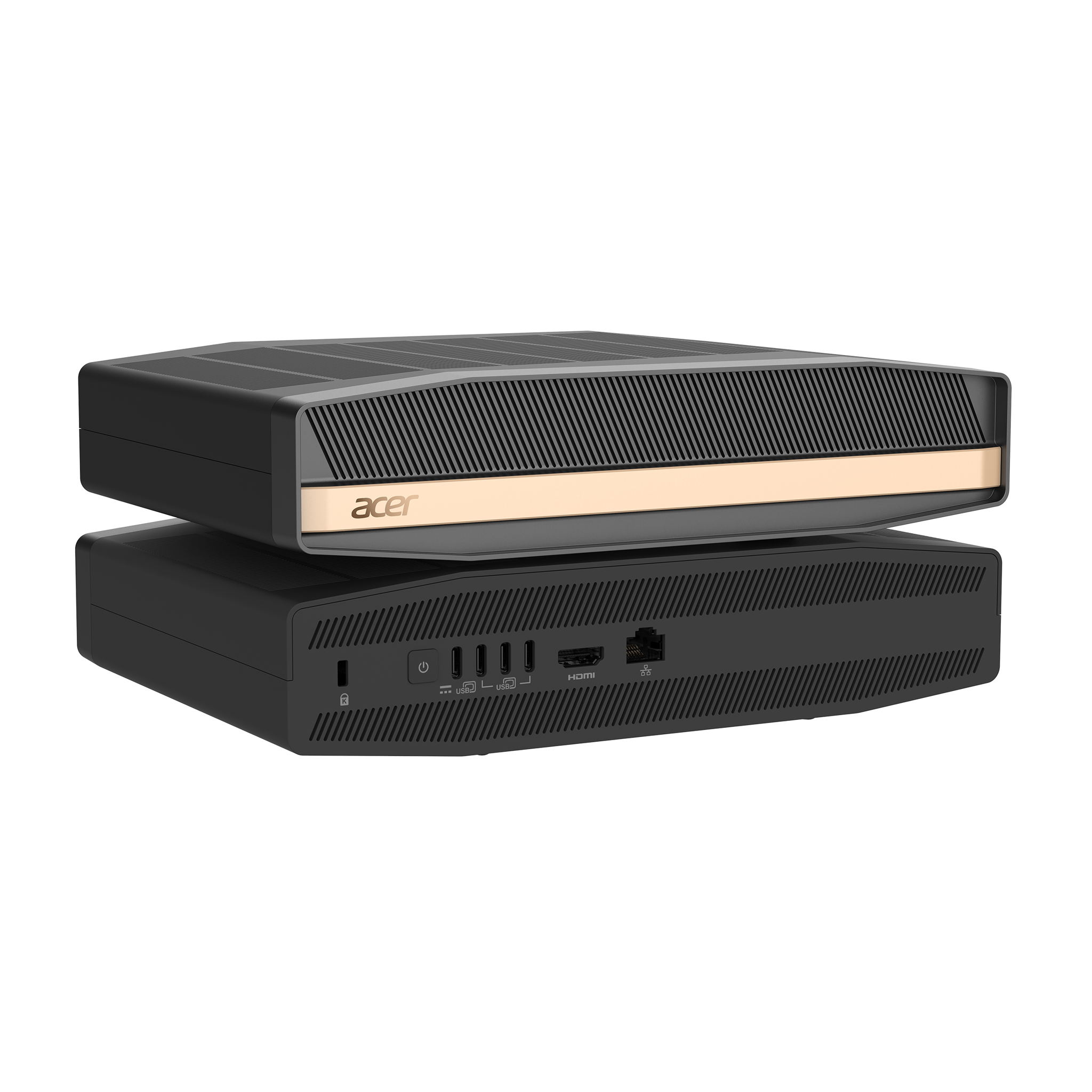
Table of Contents
- All six models compared
- The same chip does not make the same PC
- Best RTX Spark mini PC picks so far
- The Surface price changes the decision
- Compact is doing suspiciously broad work
- Windows on Arm is still part of the purchase
- The available alternative
- Who should skip this launch
- What we will update at launch
- RTX Spark mini PC FAQ
- The Short Version
All Six Models Compared
NVIDIA’s desktop RTX Spark specification fixes the important silicon numbers: a 20-core Grace CPU, 6,144-core Blackwell RTX GPU, 140 W thermal design power and up to 128GB of LPDDR5X unified memory. It also lists CUDA, fifth-generation Tensor cores, fourth-generation ray-tracing cores, DLSS 5 and Windows 11 support. Manufacturers still choose the chassis, storage, ports, cooling and memory configuration.
The table separates published facts from blanks. “Not announced” is not an invitation to guess, especially when a compact computer may end up costing more than a conventional workstation.
| Model | Memory | Storage | Useful distinction | Manufacturer price | Buy or status |
|---|---|---|---|---|---|
| Acer SFF RTX Spark | Up to 128GB | Not announced | Shown as a design, not a finished retail configuration | Not announced | Not listed |
| ASUS ProArt GR1X | 64GB or 128GB | PCIe 5.0 and 4.0 M.2 slots | 1.1-litre chassis, 10GbE, four USB-C ports | Not announced | Coming later in 2026 |
| Dell Creator Edition Desktop | Up to 128GB | Up to 4TB | Dell claims support for models up to 200 billion parameters | Not announced | Coming soon |
| HP OmniDesk with RTX Spark | Not announced | Not announced | Compact, always-on desktop is the only confirmed detail | Not announced | Not listed |
| Microsoft Surface RTX Spark Dev Box | 128GB | Removable 2TB PCIe 5.0 SSD | Developer-ready Windows image and 100 W thermal envelope | US$5,999.99 | Microsoft preorder |
| MSI EdgeMesa N AI+ | Up to 128GB | One NVMe SSD, up to 4TB | 140 W cooling, 10GbE and four 20Gbps USB-C ports | Not announced | Retailer preorder only |
| Beelink GTR9 Pro reference | 128GB | 2TB; two M.2 slots support up to 16TB | Shipping AMD Ryzen AI Max+ 395 alternative | Varies by region | Beelink store |
Four of the six announced systems give enough detail to compare. HP has named a product without publishing even a memory ceiling, while Acer still describes its machine as a design. They count as announced models, but they do not belong on a serious shortlist yet. A logo and a case render are not a configuration.
The Same Chip Does Not Make the Same PC
The desktop N1X platform removes the usual CPU and GPU shopping exercise. Every listed desktop is expected to use the full 20-core CPU and 6,144-core GPU rather than the cut-down laptop configuration. The useful questions move outward: Can the cooling system hold 140 W for an hour? Does the SSD throttle beside the chip? Can you replace it without dismantling a small aluminium puzzle box?
Memory capacity needs similar care. Unified memory means the CPU and GPU share one pool; it does not turn all 128GB into dedicated VRAM. Windows, applications, the model, its context cache and any creative workload all compete for that capacity. NVIDIA’s one-petaflop figure is also an FP4 claim that uses sparsity. It does not predict tokens per second, Blender render time or gaming performance by itself.
The desktop platform’s main advantage is still real: a local AI workload can address far more memory than the 16GB on an RTX 5080 or 32GB on an RTX 5090. That matters when a model simply does not fit on a discrete gaming card. It does not prove the smaller GPU is faster, and it certainly does not make US$5,999.99 disappear from a credit-card statement.
Best RTX Spark Mini PC Picks So Far
Best documented design: ASUS ProArt GR1X
The ASUS ProArt GR1X has the best balance of published detail and compact hardware. ASUS lists 64GB and 128GB memory options, PCIe 5.0 and 4.0 M.2 storage slots, Wi-Fi 7, 10GbE, HDMI 2.1 and four 20Gbps USB-C ports in a 150 by 150 by 51 mm chassis. It weighs 1.48 kg and uses a 240 W adapter.
The second storage slot is its practical win. MSI publishes only one M.2 slot, while Microsoft’s removable 2TB drive is useful but not the same as internal expansion. ASUS still has two large blanks: price and a firm date. The site’s earlier ProArt GR1X analysis reaches the same verdict from the single-product angle. The hardware looks sensible; buying it before price and measured noise exist does not.
Best for a managed developer desk: Microsoft Surface Dev Box
Microsoft is the only company selling certainty. The Surface product page gives a US$5,999.99 price, 128GB of memory, a removable 2TB PCIe 5.0 SSD, a November shipping window and a developer-focused Windows 11 Pro image. Visual Studio Code, WSL and PowerShell 7 arrive preconfigured. Enterprise security and Intune support may matter more to a company than saving several hundred dollars on a bare system.
For an individual buyer, the price is brutal. The device is also physically wider than the square ASUS and MSI boxes, and Microsoft lists a 100 W thermal envelope rather than the platform’s 140 W desktop maximum. That may help acoustics or may reduce sustained performance. Only testing can settle it. See the site’s Surface RTX Spark Dev Box breakdown for the product-specific risks.
Best network and cooling specification: MSI EdgeMesa N AI+
MSI’s specification page confirms the full 140 W design, a vapour chamber with dual turbo fans, 10GbE, Wi-Fi 7, four 20Gbps USB-C ports and HDMI 2.1b. Its 152 by 147 mm footprint is almost identical to ASUS. MSI also publishes up to 128GB of LPDDR5X-9600 memory and one NVMe SSD up to 4TB.
The single storage slot is the obvious compromise. MSI also lists two different volume figures across its pages, 1.17 litres in the specification table and 1.3 litres in current marketing. That discrepancy is small, but it is a reminder that pre-release pages move. Retailer preorders do not replace an MSI price or ship date, so this remains a wait.
The unfinished options: Dell, Acer and HP
Dell confirms up to 128GB, up to 4TB and support for models up to 200 billion parameters, but it does not publish dimensions, ports, memory tiers or price. The model was previously shown under XPS branding, so buyers should wait for an exact retail configuration instead of treating early coverage as a specification sheet.
Acer calls its SFF RTX Spark a design and promises up to 128GB, with availability to be announced later. HP says the OmniDesk is an always-on compact desktop and that more details will arrive closer to availability. Neither is ready for a recommendation. They are names to monitor, not products to budget around.
The Surface Price Changes the Decision
Microsoft’s US$5,999.99 preorder gives the market its first real anchor. At that price, an RTX Spark mini PC is not a casual replacement for a tower. It competes with workstations, shipping 128GB Ryzen AI Max systems and a large amount of rented cloud compute. The local box wins when privacy, predictable access or repeated large-model work matters enough to justify owning the capacity.
The ASUS, Dell and MSI models may cost less because they do not bundle Microsoft’s managed developer setup. They may also cluster near the same price because the N1X package and 128GB of fast soldered memory are expensive. No manufacturer has supplied the numbers needed to choose between those possibilities. A lower-memory 64GB ASUS or MSI configuration could be the value option, but only if the workload fits and the discount is substantial.
Compact Is Doing Suspiciously Broad Work
The published dimensions reveal a difference that the phrase “compact desktop” hides. ASUS and MSI use about 225 square centimetres of desk area. Microsoft’s 326.5 by 172 mm body needs about 562 square centimetres, or 2.5 times the ASUS footprint. The shipping Beelink reference sits between them at 324 square centimetres.
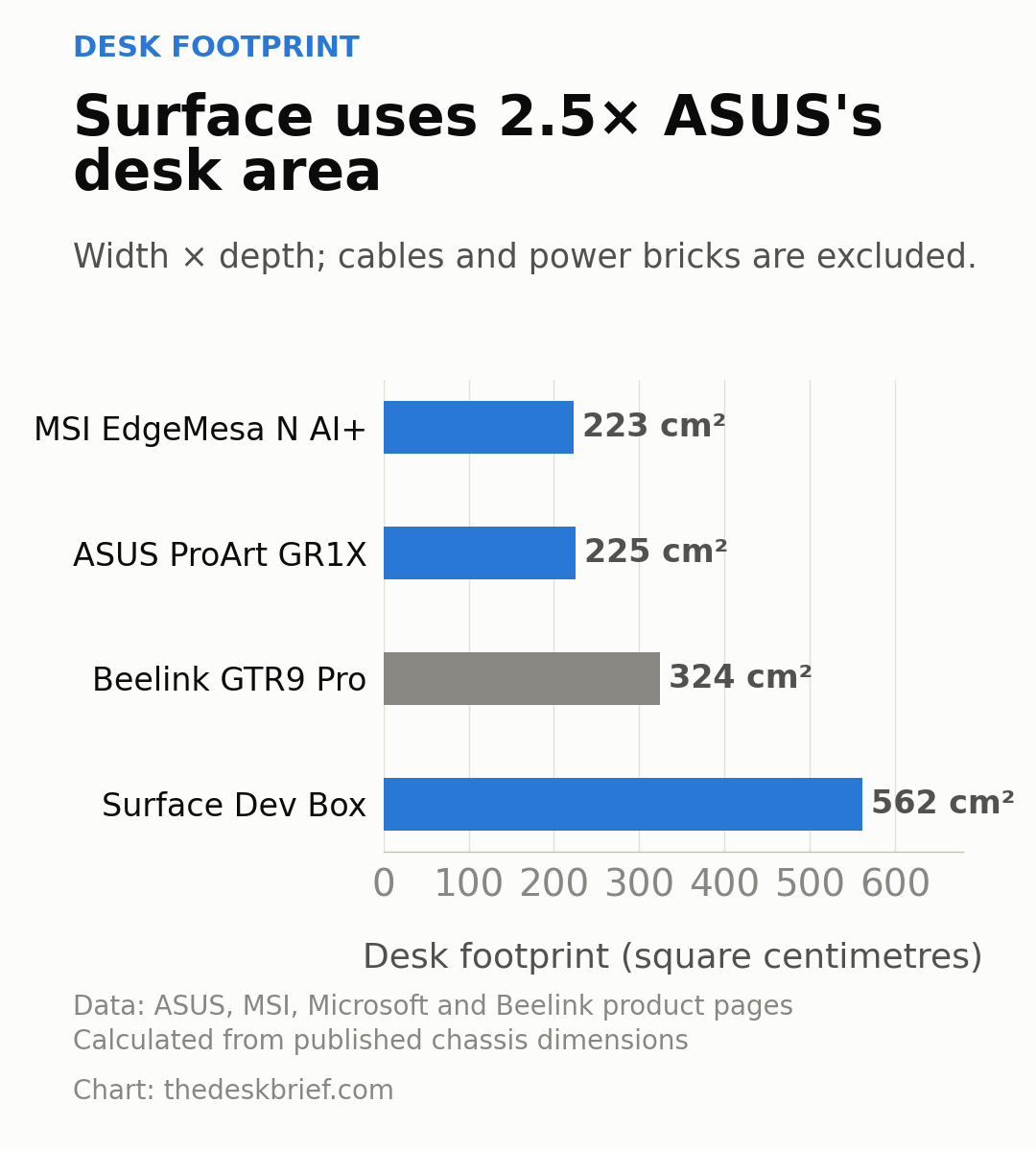
Footprint is not the whole size story. Microsoft’s box is only 42.9 mm tall with its foot, while the Beelink is 90.8 mm tall. Volume, airflow direction and cable placement matter under a monitor shelf. The chart measures width times depth because that is the part of the desk each chassis occupies; it excludes cables and the external power adapters used by ASUS and MSI.
Windows on Arm Is Still Part of the Purchase
RTX Spark uses an Arm-based Grace CPU. Native CUDA and native versions of major creative applications give it a much stronger starting point than older Windows on Arm machines, and Dell says x86 applications can run through Prism emulation. That does not make every driver, plug-in, anti-cheat system or specialist business tool native.
Buy for a named workflow, not the promise that Windows is Windows. Confirm the exact model runner, quantization tool, plug-in, capture device, VPN client and corporate security software you need. Emulation can rescue ordinary applications, but it cannot conjure an Arm driver for an unsupported peripheral. A US$5,999.99 development box is a particularly expensive place to discover that the office scanner has opinions about processor architecture.
The Available Alternative
Beelink’s GTR9 Pro is already shipping with a Ryzen AI Max+ 395, 128GB of LPDDR5X-8000 memory and a 2TB SSD. Its two M.2 slots support up to 16TB in total, and it includes two 40Gbps USB4 ports, 10GbE and Wi-Fi 7. It is larger than the ASUS and MSI designs but offers the capacity and expansion buyers are waiting for today.
The trade-off is software, not just silicon. AMD’s integrated Radeon GPU does not provide native CUDA, which can rule it out for a workflow built around NVIDIA libraries. For model serving through software that supports both platforms, it deserves a live benchmark comparison rather than automatic dismissal. The site’s Ryzen AI Halo versus RTX Spark comparison explains where the platform choice changes the answer.
If CUDA is mandatory, wait for an RTX Spark desktop price and an exact-model review. If it is optional, test the workload on a shipping AMD system before paying for a promise. The cheaper answer is often a little less glamorous and much easier to return.
Who Should Skip This Launch
Gamers should not preorder these desktops as replacements for a conventional GeForce tower. NVIDIA markets gaming support, but no independent desktop N1X results establish frame rates, latency or compatibility across a broad library. The unified-memory advantage targets workloads that need capacity, while a discrete GPU keeps faster dedicated memory and an easier upgrade path.
Buyers who run 8B or 14B local models also do not need 128GB. A smaller GPU or an existing computer may already do the job. Skip the first wave if replaceable RAM, a socketed CPU, several internal drives or PCIe expansion matters. These are appliances with workstation ambitions, not tiny towers waiting for a future graphics card.
Finally, skip any model whose maker still withholds the configuration you need. Acer and HP have not published enough to compare. Dell needs a proper specification page. ASUS and MSI need prices and dates. Paying early does not make missing information arrive faster.
What We Will Update at Launch
This page will track US, Canadian and UK or European manufacturer prices as they appear, plus exact memory and SSD configurations. The first useful independent tests should cover sustained 140 W performance, fan noise, storage temperatures, idle power, memory bandwidth, local-model throughput and Windows on Arm compatibility.
The winner may change quickly. ASUS currently has the strongest published hardware layout, Microsoft has the only official preorder and MSI has the clearest cooling claim. Dell could undercut all three, while Acer or HP could publish a configuration that turns a concept into the sensible choice. Until then, “not announced” remains the most honest cell in the table.
RTX Spark Mini PC FAQ
Can I buy an RTX Spark mini PC now?
You can preorder the Microsoft Surface RTX Spark Dev Box in the US for US$5,999.99, with shipping due in November 2026. Retailer preorders for MSI configurations have also appeared, but MSI has not announced a manufacturer price or ship date. ASUS, Dell, Acer and HP are not shipping their exact desktop models as of October 26.
Which model looks best before reviews?
The ASUS ProArt GR1X has the strongest preliminary design because it combines 64GB or 128GB options, two M.2 slots, 10GbE and four USB-C ports in a 1.1-litre chassis. It is not the best purchase yet because ASUS has not announced a price or firm ship date.
Is 128GB of unified memory the same as 128GB of VRAM?
No. The CPU and GPU share the 128GB pool, and the operating system and applications consume part of it. The GPU can address far more memory than a 16GB or 32GB discrete card provides, but the usable amount is below the advertised total and depends on the workload.
Should I buy the Surface Dev Box or wait?
Wait unless the preconfigured developer environment, Microsoft support and a November delivery are worth US$5,999.99 to your team. Individual buyers should see ASUS, Dell and MSI pricing plus independent sustained-performance tests before committing.
The Short Version
The RTX Spark mini PC wave is real, but the buying decision is not ready. ASUS has the best published layout, Microsoft has the only complete price and preorder, and MSI has the clearest 140 W cooling design. Dell, Acer and HP still owe buyers basic specifications.
Wait for prices and independent testing. A 128GB unified-memory pool can solve local AI problems that discrete gaming cards cannot fit, but every announced box uses the same core platform and none has shipped. The first company to combine sane pricing, quiet sustained performance and reliable Arm software support wins. Today, the cheapest correct purchase is patience.