Ryzen AI Halo vs RTX Spark is really two comparisons hiding inside one search. AMD’s Ryzen AI Halo and NVIDIA’s DGX Spark are compact desktop AI systems you can buy, while RTX Spark is the related N1 and N1X laptop platform announced for fall 2026.
Compared on July 31, 2026. Prices are US retail figures.
For most developers choosing a desktop box, Ryzen AI Halo is the better value. It costs US$3,999, runs Windows or Linux, has a stronger x86 CPU and supports straightforward storage upgrades. DGX Spark costs US$4,699 and earns its premium when CUDA software, high-batch LLM serving or two-box clustering matters more than flexibility.
The US$700 saving isn’t enough to make AMD the automatic winner. Independent results show DGX Spark can be far faster in demanding inference workloads. Buying the cheaper machine and then discovering that your production stack expects CUDA is an expensive kind of savings.
Once the hardware decision is made, the best local LLM guide maps current models to chat, coding, writing, documents, and agents.
Table of Contents
- RTX Spark and DGX Spark naming
- Specifications that change the decision
- Real LLM throughput
- CPU, software and development
- Power, cooling and thermals
- Availability and ownership costs
- Which one should you buy?
- Who should skip both?
- Comparison FAQ
- The Short Version
Ryzen AI Halo vs RTX Spark and DGX Spark naming
NVIDIA reused the Spark name across portable and desktop products, which explains the mixed queries. DGX Spark is a 150 mm square desktop based on the GB10 Grace Blackwell Superchip. RTX Spark laptops use the N1 family and aren’t simply portable DGX Spark units.
If you want a laptop, start with our comparison of all announced RTX Spark models. The rest of this article compares Ryzen AI Halo with DGX Spark, the two like-for-like desktop systems. Our companion RTX Spark laptop price guide tracks confirmed laptop pricing separately.
The specifications that change the decision
| Specification | AMD Ryzen AI Halo | NVIDIA DGX Spark |
|---|---|---|
| US retail price | US$3,999 | US$4,699 |
| Processor | Ryzen AI Max+ 395, 16 cores and 32 threads | GB10, 20-core Arm CPU |
| Graphics | Radeon 8060S, 40 RDNA 3.5 compute units | Blackwell GPU with fifth-generation Tensor Cores |
| Unified memory | 128GB LPDDR5x, 256 GB/s | 128GB LPDDR5x, 273 GB/s |
| Storage | 2TB M.2 SSD, standard 2280 slot | 4TB NVMe M.2 with self-encryption |
| Networking | 10GbE, Wi-Fi 7 | 10GbE, Wi-Fi 7, 200 Gbps ConnectX-7 |
| Operating system | Windows 11 or Linux | DGX OS based on Linux |
| Chip TDP | 120W platform TDP | 140W GB10 TDP |
In the Ryzen AI Halo vs RTX Spark matchup, memory capacity is a tie. AMD’s official product page lists 128GB of unified memory, while its detailed specification sheet states LPDDR5x-8000, 256 GB/s of bandwidth, a 2TB SSD and a 120W TDP. NVIDIA lists the same memory capacity, slightly higher 273 GB/s bandwidth, 4TB of storage, a 140W GB10 TDP and a 240W external power supply.
Both companies say their systems can run models with up to 200 billion parameters. That is a capacity claim, not a promise that every 200B model will be fast or useful. Quantization, context length, runtime and available memory after system overhead all change the experience.
Real LLM throughput favors DGX Spark under load
StorageReview’s independent comparison ran both systems with vLLM at batch size 64. In its GPT-OSS 120B tests, DGX Spark reached 701 tokens per second in the equal input and output workload versus 222 for Halo. The prefill-heavy result widened to 2,760 versus 314, while the decode-heavy result was 305 versus 127.
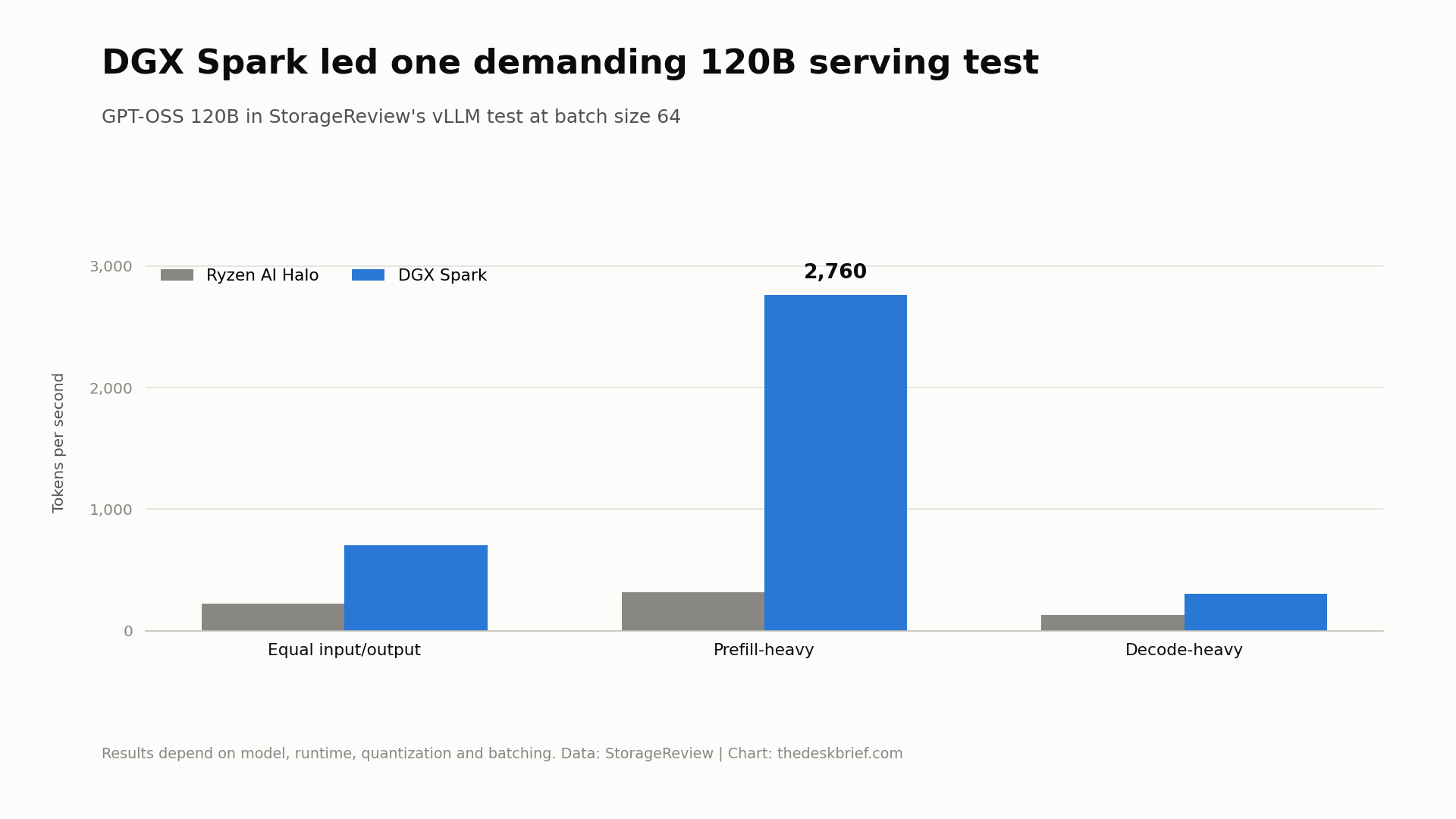
That isn’t a universal eightfold lead. StorageReview also found much narrower decode differences with smaller models: DGX Spark was within roughly 11 percent on Mistral Small 24B and 12 percent on Llama 3.1 8B. The right reading is that NVIDIA’s advantage grows with some large, highly batched serving jobs, not that every prompt finishes several times faster.
CPU, software and daily development
Halo’s Ryzen AI Max+ 395 is the more conventional workstation processor. It has 16 Zen 5 cores, 32 threads and an x86 software environment. StorageReview found Halo ahead in its CPU testing, which matters when preprocessing, compilation, data work and ordinary desktop applications share the machine with AI jobs.
AMD also gives you Windows 11 or Linux. That makes Halo easier to justify as a single development workstation for someone who needs Windows applications and local ROCm inference. Our Ryzen AI Halo overview covers the platform on its own terms.
DGX Spark’s answer is NVIDIA’s mature AI software ecosystem. CUDA, TensorRT-LLM, NIM and a Linux-first DGX environment reduce friction for teams already deploying to NVIDIA infrastructure. Its 200 Gbps ConnectX-7 interface can also join two Spark systems for models up to 405 billion parameters, a capability Halo’s 10GbE connection doesn’t match.
Power, cooling and thermals
The Ryzen AI Halo vs RTX Spark power comparison favors Halo on the published ceilings. AMD specifies a 120W TDP, while NVIDIA specifies a 140W TDP for GB10 and supplies a 240W adapter for the complete system. Power-supply capacity isn’t the same as measured wall consumption, so it would be misleading to call DGX Spark a 240W machine in normal use.
There isn’t a reliable apples-to-apples temperature dataset in the reviewed sources. Both compact systems use active cooling, and NVIDIA publishes a 29 dB sound-pressure figure under maximum GPU stress at a 25°C ambient temperature. AMD doesn’t publish a directly comparable stress-noise figure on the specification page, so we can’t honestly declare a thermal or acoustic winner.
Availability and ownership costs
Ryzen AI Halo is available in the US through Micro Center at US$3,999. DGX Spark is available through NVIDIA and partners at US$4,699. Regional supply, support terms and taxes can make the real gap different outside the US.
Halo’s standard M.2 2280 storage path is a practical advantage if 2TB isn’t enough. DGX Spark starts with 4TB and adds specialized networking, so part of its higher price buys capability rather than just benchmark speed. Neither system is cheap enough to purchase around a single demo.
Which one should you buy?
Buy Ryzen AI Halo if you want the best all-round local AI workstation for the money. Windows support, a faster general-purpose CPU, 128GB of unified memory and a US$700 lower price make it the sensible choice for most individual developers and small teams. Its cost is weaker peak throughput in some large batched inference jobs and a software stack that still isn’t as broadly optimized as CUDA.
Buy DGX Spark if your work already depends on NVIDIA tooling, if high-concurrency LLM serving is the priority, or if the ConnectX-7 path to a two-system setup has real value. You pay more, accept a Linux-only environment and give up Halo’s x86 versatility. In return, the independent throughput data shows a machine that can pull decisively ahead when the workload suits it.
For everyone else, Ryzen AI Halo wins this comparison. DGX Spark is the faster specialist; Halo is the easier computer to live with.
Who should skip both systems?
Skip both if your main workload fits comfortably in a conventional GPU workstation, if you need easy GPU replacement, or if cloud instances are only an occasional expense. Unified-memory mini systems trade expansion for density. A US$3,999 to US$4,699 purchase makes sense only when local model capacity, privacy or steady usage pays for that compromise.
Ryzen AI Halo vs RTX Spark FAQ
Is RTX Spark the same as DGX Spark?
No. RTX Spark is NVIDIA’s laptop platform built around N1 and N1X processors. DGX Spark is a compact GB10 desktop, and it is the proper direct rival to Ryzen AI Halo.
Which system is faster for large language models?
DGX Spark was faster in most of StorageReview’s high-concurrency vLLM tests and dramatically faster in one GPT-OSS 120B prefill workload. Smaller-model decode results were much closer, so your model and runtime should decide the purchase.
Can Ryzen AI Halo run Windows?
Yes. AMD supports Windows 11 and Linux on Halo. DGX Spark uses NVIDIA’s Linux-based DGX OS.
The Short Version
Ryzen AI Halo vs RTX Spark searches usually call for a Halo versus DGX Spark desktop comparison. Halo saves US$700 and offers Windows, x86 CPU strength and easier storage expansion, so it is our pick for most developers. DGX Spark is worth the premium for CUDA-first workflows, heavy batched inference and ConnectX-7 clustering.