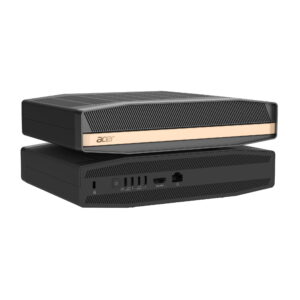
The AMD Ryzen AI Halo is a 128GB unified-memory mini PC built for running large AI models locally. AMD lists the 128GB box at US$3,999, which is US$700 below the DGX Spark’s US$4,699 retail price. Current retailer offers can be higher, though, so that list-price advantage does not describe every box available to order. It ships with Windows or Linux.
Last updated: September 25, 2026. Now available: AMD confirmed Ryzen AI Halo systems began shipping through Micro Center on July 6, and current Windows and Linux listings are orderable through Newegg. Tom’s Hardware reviewed the retail system, while StorageReview measured its AI-serving and storage performance against the DGX Spark.
Price note: AMD’s official US list price is US$3,999. Current Newegg marketplace offers checked September 25, 2026 were US$4,899.99 for Windows 11 Pro and US$4,699.99 for Linux, so compare the live price and seller terms before buying.
I’ve been paying close attention to this category, partly because I already covered the NVIDIA Spark hardware on this site, and partly for a selfish reason: the laptop that runs my local AI models has 8GB of VRAM. Eight. Every interesting model released in the past year laughs at that number. Unified memory machines are the first real answer for people like me, so let’s take the AMD Ryzen AI Halo apart properly, including the parts AMD would rather leave out of the headline.
For model choices that fit different unified-memory tiers, see the best local LLM guide.
Why 128GB of Unified Memory Is the Whole Story
On a normal PC, your GPU has its own small pool of fast memory, and a model either fits in it or spills into system RAM and slows to a crawl. Unified memory tears that wall down. The CPU and GPU share one big pool, so the GPU can address nearly all of the 128GB. Models that would need a stack of consumer graphics cards suddenly fit in a box the size of a sandwich.
That’s the pitch, and it’s genuinely true. AMD says the Ryzen AI Halo handles models up to around 200 billion parameters locally. Fitting a model and running it quickly are two different things, though, and that gap is where this whole product category gets interesting. Hold that thought.
The Spec Sheet That Matters
Inside the 150 x 150 x 45mm chassis (yes, it’s basically a stack of coasters that weighs just over a kilogram) sits the Ryzen AI Max+ 395: 16 Zen 5 cores, a Radeon 8060S integrated GPU with 40 RDNA 3.5 compute units, and a 50 TOPS XDNA 2 NPU. The 128GB of LPDDR5X-8000 memory feeds all of it at 256 GB/s. You get a 2TB NVMe drive at AMD’s US$3,999 official list price, plus 10GbE Ethernet, Wi-Fi 7, HDMI 2.1b, and three USB-C data ports. The whole thing sips 120W through a fourth USB-C port. Full details are in AMD’s announcement coverage on TechPowerUp.
The detail I like most: it ships in two variants with identical hardware, one with Windows 11 Pro and one with a Linux developer image. More on why that matters in a minute.
This page contains affiliate links. If you buy through these links, we may earn a small commission at no extra cost to you. Full disclosure.
Current Newegg marketplace offers checked September 25, 2026: Windows 11 Pro at US$4,899.99 and Linux at US$4,699.99. Both were sold by Halfmoon Tech Store rather than Newegg itself, so check the seller, return policy, and warranty path at checkout. Prices and availability can change.
AMD Ryzen AI Halo vs DGX Spark: The Real Numbers
I don’t have either machine on my desk, so I’ll lean on people who do. StorageReview’s testing put both boxes through vLLM serving benchmarks, and the results are lopsided in a way the price gap doesn’t capture. Running GPT-OSS 120B at batch size 64, the Halo produced 222 tokens per second against the Spark’s 701. On Llama 3.1 8B it was 407 versus 1,330. Switch to FP4 quantization, where NVIDIA’s Blackwell silicon has dedicated hardware, and the gap blows out to more than 13x.
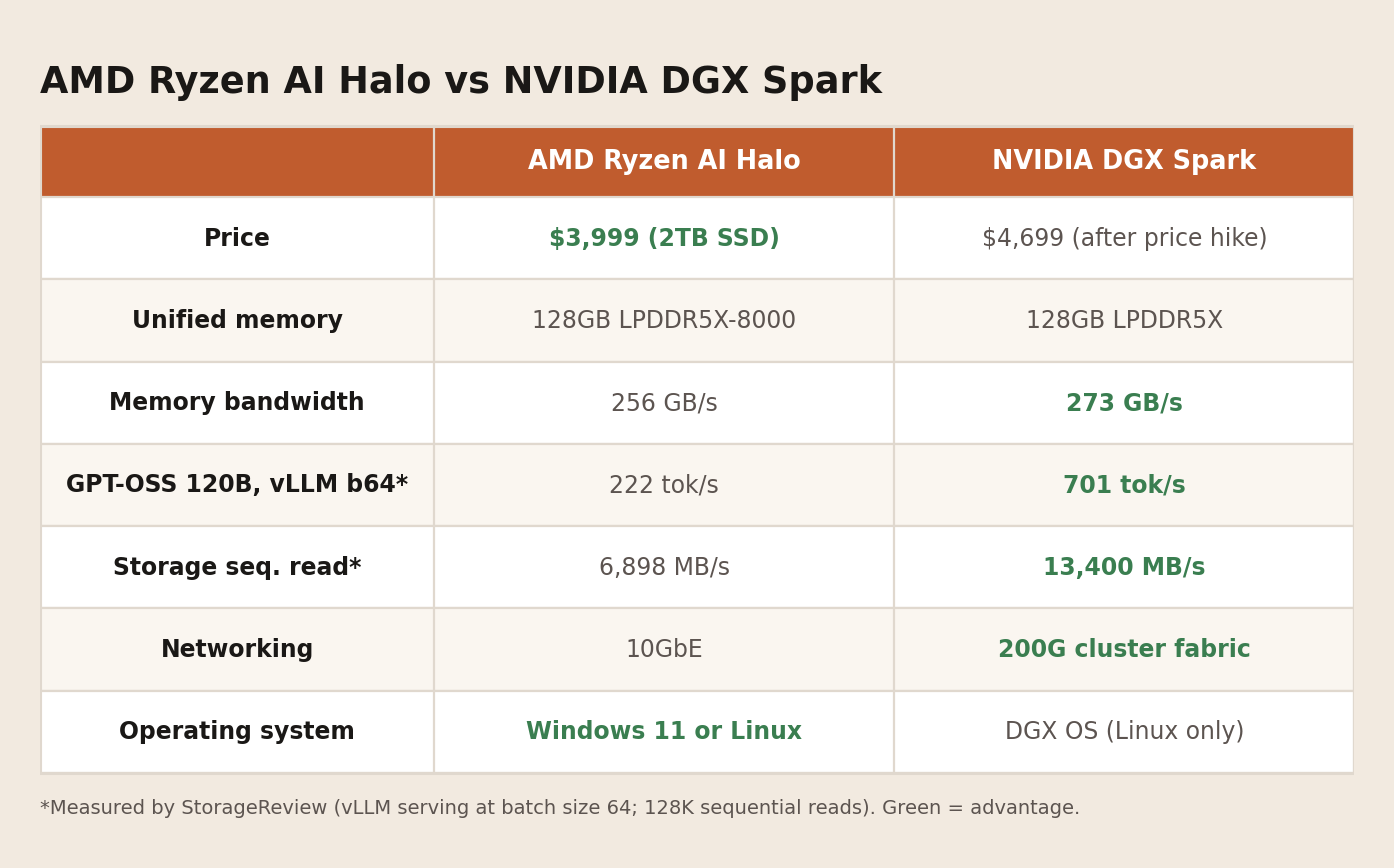
Before you close the tab: those are server-style numbers, measured with dozens of simultaneous requests. That’s the workload the Spark was built for, and it’s not how most home users run models. If it’s just you chatting with a model, generation speed is mostly limited by memory bandwidth, and there the two boxes are neighbors: 256 GB/s for the Halo, 273 GB/s for the Spark. For single-user local AI, the practical experience is far closer than the benchmark chart suggests.
A rough rule of thumb for this class of machine: divide memory bandwidth by model size. A 70B model quantized to 4-bit weighs about 40GB, so 256 GB/s gives you a ceiling in the neighborhood of 6 tokens per second. That’s usable reading speed, not magic. The same math applies to the Spark, which is exactly why neither of these boxes replaces a rack of real GPUs. They replace not being able to run the model at all.
The Catches Nobody Puts in the Headline
First, that bandwidth number is the ceiling on everything. 256 GB/s is enormous for an integrated GPU and unimpressive next to a discrete card; a desktop RTX card moves memory several times faster. Big models fit, but they stroll rather than sprint.
Second, software. NVIDIA’s CUDA ecosystem has a fifteen-year head start, and most AI tooling treats it as the default. AMD’s ROCm support has improved a lot, and the popular runtimes (llama.cpp, LM Studio, Ollama) run fine on this hardware, but you will eventually hit a research project or a quantization format that assumes NVIDIA. Buying the AMD Ryzen AI Halo means occasionally being second in line.
Third, the storage is half as fast as the Spark’s. StorageReview measured about 6,900 MB/s sequential reads against roughly 13,400 MB/s, which you’ll feel every time a 60GB model loads into memory. And fourth, there’s no answer to the Spark’s 200G cluster fabric. Two Sparks can be linked to run even bigger models; the Halo’s single 10GbE port ends that conversation. If any of these four points made you wince, that’s useful information about which machine you need.
The Windows Thing Actually Matters
Here’s the argument I find most persuasive, via Tom’s Hardware: this is the only machine in the category that’s a normal computer. The DGX Spark runs NVIDIA’s DGX OS, a specialized Linux. A Mac Studio runs macOS. The AMD Ryzen AI Halo is a regular x86 PC that happens to have 128GB of unified memory, so the Windows variant runs your existing software, your games (the Radeon 8060S is the strongest integrated GPU AMD has ever shipped), and your AI stack on one box.
For a developer who lives in Linux anyway, that’s a shrug. For someone who wants one desktop that does everything and also runs a serious home AI agent, it’s arguably the whole reason to pick AMD here. When this box eventually stops being your AI machine, it’s still a killer general-purpose PC. A used DGX Spark is a paperweight with a great story.
Should You Wait for the 192GB Version?
AMD has announced a Ryzen AI Max+ PRO 495 variant with 192GB and support for 300B+ parameter models. AMD still labels its 192GB Halo “Coming Soon”, with no price or direct order link as of September 25, 2026. Partner systems have begun appearing, but AMD’s own 192GB box is not a current retail alternative yet.
My take: if 128GB covers the models you actually want to run today, the current Halo is the one you can buy, but compare its checkout price against the Spark rather than assuming the US$700 list-price gap. If your required model will not fit inside 128GB, wait until a 192GB system has a real price and order button. Buying hardware for the workload you have, not the one you imagine, has never once failed me.
Who Should Skip This
Skip it if your models fit in 16GB or 24GB, because a used RTX 4090 or a mid-range gaming desktop will generate tokens several times faster for less money. Skip it if you’re serving models to a team or building anything multi-user; StorageReview’s concurrency numbers show that’s the Spark’s home turf, and the price difference won’t matter to a business. Skip it if you’re already comfortable in the Apple ecosystem and bandwidth is your bottleneck, since a Mac Studio out-muscles both of these on that front. And obviously skip it if local AI is a curiosity rather than a habit. Even AMD’s US$3,999 list price is a lot of money for a hobby you might have until October, and current marketplace offers can cost more. If you’re not sure which camp you’re in, my Spark hardware comparison covers the NVIDIA side of the fence.
FAQ
Can the AMD Ryzen AI Halo really run 200B parameter models?
Yes, with quantization, and that’s AMD’s own claim rather than an independent one. A 200B model compressed to 4-bit fits in roughly 110GB, which squeaks under the 128GB ceiling. It will run. It won’t be quick, because at that size the 256 GB/s memory bus becomes the speed limit.
Is it faster than the DGX Spark?
No. In StorageReview’s vLLM testing the Spark was 2x to 13x faster depending on model and quantization, with the biggest gaps in FP4 workloads where Blackwell has dedicated hardware. The Halo’s case is price, Windows support, and being a usable general-purpose PC, not raw inference speed.
Can you game on it?
The Windows 11 variant is a normal x86 PC, and the Radeon 8060S with 40 compute units is the most capable integrated GPU AMD has shipped. It’s no desktop RTX card, but it’s a real gaming-capable chip, which is more than either the Spark or a Mac can say about your Steam library.
What ports and storage does it come with?
A 2TB NVMe SSD is included at AMD’s US$3,999 official list price, alongside 10GbE Ethernet, Wi-Fi 7, Bluetooth 5.4, HDMI 2.1b, and three USB-C data ports. Power comes in over a separate USB-C port at 120W, so there’s no external brick drama.
The Short Version
The AMD Ryzen AI Halo is the flexible pick in a category that did not have a normal Windows option. At AMD’s US$3,999 list price it is US$700 cheaper than the DGX Spark, includes 2TB of storage, and doubles as an everyday Windows machine. Current Newegg marketplace offers are higher and can erase that price advantage. The Spark remains meaningfully faster for serious serving work, the CUDA ecosystem is still the safer bet for bleeding-edge tooling, and AMD’s own 192GB Halo is still marked “Coming Soon.” If you want 128GB of unified memory on a Windows or Linux desk today, compare the live prices and seller terms before choosing between them.