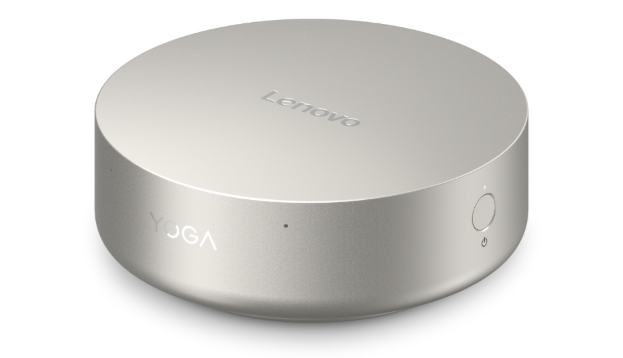
The Lenovo Yoga AI Mini PC packs 64GB of memory, 16 CPU cores, and a claimed 180 TOPS of AI compute into a 600 gram aluminum puck, and Lenovo says it can run language models up to 80 billion parameters. On paper, that’s the most interesting desk object of the summer. Then come the catches. It costs 17,999 yuan, roughly CA$3,714 (US$2,650). It’s sold only in China, through JD.com. And once you do the memory math, the 80 billion parameter claim slides from headline to punchline.
This page contains affiliate links. If you buy through these links, we may earn a small commission at no extra cost to you. Full disclosure.
Last updated September 22, 2026: Tom’s Guide published a full production-unit review on August 17. That confirms shipping hardware in at least one market, but the 64GB China configuration and global Yoga Mini i are still different products with uneven regional availability.
Currency note: Canadian dollar equivalents use the Bank of Canada daily average of 1 USD = 1.4014 CAD on July 17, 2026. Converted amounts are approximate; the original US price is shown in brackets.
I haven’t touched one, and unless Lenovo changes its mind about a global release, I won’t. But the spec sheet is public, the numbers are checkable, and this machine lands squarely in the unified memory mini PC category I’ve been tracking on this site all year. So let’s take it apart from the desk of someone who was genuinely ready to want it.
To judge what should actually run within those memory limits, use the best local LLM guide.
Table of Contents
- Two Machines Are Wearing the Same Badge
- Lenovo Yoga AI Mini PC Specs: The Numbers That Matter
- The Memory Bandwidth Problem
- What CA$3,714 (US$2,650) Buys You Instead
- The Parts I Genuinely Like
- Who Should Skip This
- FAQ
- The Short Version
Two Machines Are Wearing the Same Badge
First, the confusing part, because Lenovo made this needlessly hard. There are two nearly identical pucks. The global Yoga Mini i is now real retail hardware in the United States: Best Buy lists a 16GB Core Ultra 5 model at US$999.99, while a 32GB Core Ultra X7 configuration is also listed. Lenovo Canada lists the Yoga Mini i as coming soon, but no matching Best Buy Canada, Amazon.ca, or Canada Computers listing appeared in the August 29 check.
The Lenovo Yoga AI Mini PC covered here is still the China-only variant. It pairs the top chip with 64GB of LPDDR5X, a 1TB PCIe 4.0 SSD, and a 17,999 yuan price, which Notebookcheck’s launch coverage converts to about CA$3,714 (US$2,650). I found no announcement extending that 64GB version to Canada or the United States. The global retail listings do not change this article’s verdict because they cover 16GB and 32GB systems, not the 64GB AI model.
Lenovo Yoga AI Mini PC Specs: The Numbers That Matter
The Core Ultra X7 358H is Intel’s new Panther Lake silicon, and it’s a genuinely modern chip. Per Notebookcheck’s spec database, you get four performance cores boosting to 4.8GHz, eight efficiency cores, and four low power cores, for 16 threads total, running at 25W base power with an 80W turbo window, built on Intel’s 18A process. Graphics come from the integrated Arc B390 with 12 Xe3 cores. The NPU is rated at 50 TOPS. Here’s the full picture:
- CPU: Intel Core Ultra X7 358H, 16 cores (4P + 8E + 4LP), up to 4.8GHz, 25W base
- GPU: integrated Intel Arc B390, 12 Xe3 cores
- Memory: 64GB LPDDR5X, soldered, so what you buy is what you keep
- Storage: 1TB PCIe 4.0 SSD
- Ports: two Thunderbolt 4, USB-C 3.2 Gen 2, USB-A 3.2 Gen 2, HDMI, 2.5G Ethernet, 3.5mm jack
- Wireless: Wi-Fi 7 and Bluetooth
- Size: 0.65 liters, about 600 grams
- Price: 17,999 yuan (about CA$3,714 (US$2,650)), China only
About that 180 TOPS. Lenovo gets there by adding the CPU, GPU, and NPU together, which is the marketing convention this whole category has agreed to use. The NPU alone contributes 50 of those TOPS. Neither number tells you how fast a large language model will actually generate text on this box, because compute isn’t where the bottleneck is.
The Memory Bandwidth Problem
Here’s the part the product page skips. Panther Lake feeds its memory through a 128-bit bus at LPDDR5X-9600 speeds, which works out to roughly 154 GB/s of theoretical bandwidth. When it’s just you chatting with a local model, generation speed is approximately memory bandwidth divided by model size, the same rule of thumb I leaned on in my AMD Ryzen AI Halo breakdown. The GPU has to read every single weight for every token it generates, and no NPU marketing number changes that.
Now run the numbers on Lenovo’s own claim. An 80 billion parameter model quantized to 4 bits weighs about 45GB, so yes, it fits in 64GB with room left for context. But pushing 45GB through a 154 GB/s pipe gets you roughly 3 tokens per second before any overhead. That’s technically “running” an 80B model the same way I’m technically “running” when I jog to the fridge. A 13B to 24B class model is the honest ceiling for daily use here, and to be fair, those models are excellent these days.
For contrast, the Ryzen AI Max+ 395 machines I covered earlier this month feed 128GB of unified memory at 256 GB/s. That’s two thirds more bandwidth and double the capacity. The Arc B390 is a capable little GPU, but for local AI work it’s a delivery driver assigned to a single lane road.
What CA$3,714 (US$2,650) Buys You Instead
This is where the Lenovo Yoga AI Mini PC runs into real trouble, because the competition isn’t hypothetical. Liliputing’s roundup of Ryzen AI Max+ 395 mini PCs with 128GB of unified memory lists the Bosgame M5 at CA$3,362 (US$2,399) with a 2TB SSD, the Framework Desktop at CA$3,995 (US$2,851) with 1TB, and the GMKtec EVO-X2 with Ryzen AI Max+ 395, 128GB memory, and a 2TB SSD at CA$4,204 (US$3,000). Every one of them doubles the Lenovo’s memory. Every one of them moves data faster. The most affordable one undercuts it by CA$350 (US$250).
The 128GB GMKtec EVO-X2 remains the more relevant local-AI comparison. Check the GMKtec EVO-X2 on Amazon.
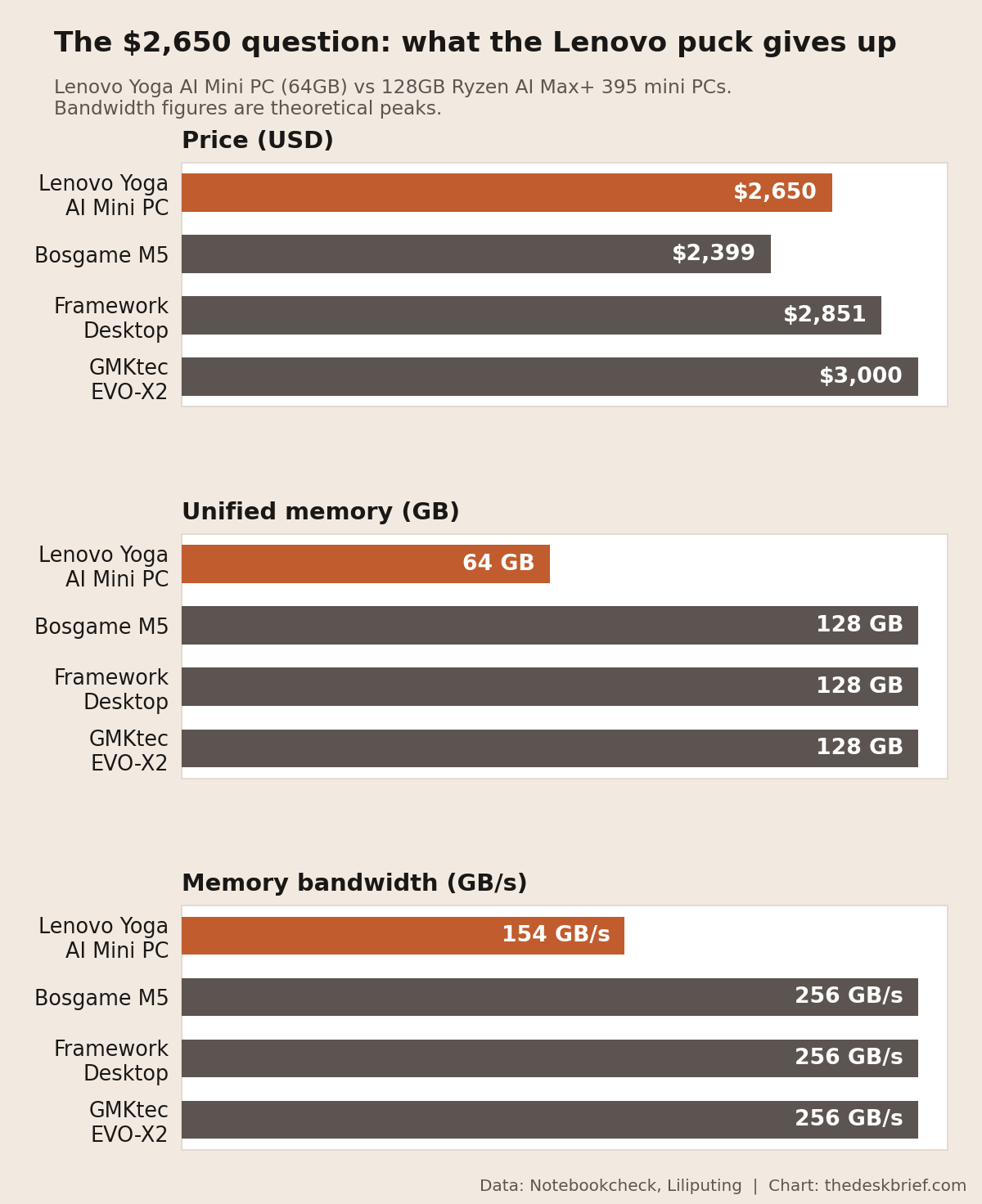
And with RAM prices doing what they’ve been doing, 128GB of LPDDR5X at those prices is arguably the best part of those deals. The Lenovo counters with a smaller, prettier, quieter box that sips a quarter of the power. That’s not nothing. But it’s still a CA$3,714 (US$2,650) machine losing the exact argument it was built to make.
The Parts I Genuinely Like
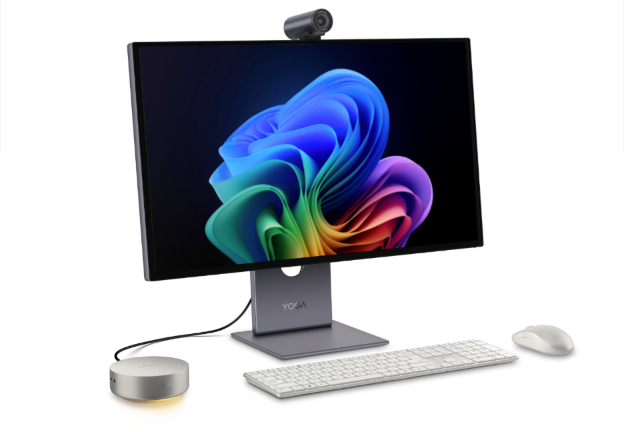
Credit where it’s due, because the physical product is charming. It’s 0.65 liters and 600 grams, small enough to disappear behind a monitor or ride along in a laptop bag as a portable desktop. The aluminum shell looks like something Apple would charge more for, and the light ring that greets you when you sit down is a gimmick I’d absolutely leave enabled. Dual Thunderbolt 4, 2.5G Ethernet, and Wi-Fi 7 cover every dock, NAS, and network situation a home office can realistically produce.
That’s also why the CA$981 (US$699.99) global Yoga Mini i is the version most people should actually be watching. For office work, media, and the smaller 7B to 14B models I walked through in my home AI agent setup guide, 32GB is plenty, and a 25W chip in a silent puck is a lovely thing to work next to. The sensible product here was never the CA$3,714 (US$2,650) one.
For a more conventional compact desktop, our Minisforum M2 Pro guide covers another small-PC tradeoff.
Who Should Skip This
Skip the Lenovo Yoga AI Mini PC if local LLMs are your main reason for buying, full stop. The bandwidth ceiling turns big models into a demo instead of a tool, and demos get old by Tuesday. Skip it if you live outside China, because importing means paying freight and duties on top of CA$3,714 (US$2,650), eating the warranty risk, and dealing with a Chinese Windows image. And skip it if you already own any 128GB Strix Halo box. This isn’t an upgrade from those; it’s a sidegrade in a nicer jacket.
FAQ
Can you buy the Lenovo Yoga AI Mini PC outside China?
Not officially. The 64GB Yoga AI Mini PC launched through JD.com at 17,999 yuan, and Lenovo has not announced a global release for that configuration. The separate Yoga Mini i is shipping in the United States with 16GB or 32GB, and Lenovo Canada lists it as coming soon. Those listings are not the 64GB model reviewed here.
Can it really run 80 billion parameter models?
It can load them, which is what the claim technically means. An 80B model at 4-bit quantization needs about 45GB, and that fits in 64GB. Generating text is another story: at roughly 154 GB/s of memory bandwidth, expect around 3 tokens per second, which is slower than most people read. Models in the 13B to 24B range are the realistic daily drivers.
Is it better than a Ryzen AI Max+ 395 mini PC for local AI?
No. A Bosgame M5 at CA$3,362 (US$2,399) gives you 128GB of unified memory at 256 GB/s, double the capacity and much more bandwidth for less money. The Lenovo Yoga AI Mini PC wins on size, power draw, and looks, and loses on everything that makes a local model fast.
What’s the difference between the Yoga Mini i and the Yoga AI Mini PC?
They share the 0.65 liter chassis and Panther Lake platform. The Yoga Mini i is the global 16GB or 32GB model, now sold in the United States and listed as coming soon in Canada. The Yoga AI Mini PC is the China-only 64GB version with a 1TB SSD and a price around CA$3,714 (US$2,650). The memory is soldered, so the names are not interchangeable when you compare price or local-AI capacity.
The Short Version
The Lenovo Yoga AI Mini PC is a lovely object making a promise its memory bus can’t keep. The 80 billion parameter claim is technically true and practically a slideshow, and at CA$3,714 (US$2,650) it sits CA$350 (US$250) above a Strix Halo box with double the memory and far more bandwidth. If local AI is the goal, buy the 128GB machine. If you want a portable alternative, the RTX Spark laptop roundup tracks the announced 128GB systems. If you just want a superb tiny desk PC, watch the global Yoga Mini i instead: it is shipping in the United States and is now officially listed as coming soon in Canada. The puck is cute. The math isn’t.
Editorial rating: 2.5 out of 5. The 64GB Yoga AI Mini PC is compact and attractive, but its memory bandwidth makes the headline 80-billion-parameter claim impractical for daily use. Its China-only availability and high import cost make faster 128GB Strix Halo systems the better local-AI purchase.