The Radeon RX 9050 is not for sale through a qualifying Canadian retailer as of August 29, 2026. Its US$279 introductory price applies to Latin America and Asia-Pacific/Japan, AMD has not announced Canadian pricing or a release date, and TechSpot’s independent 10-game average puts the RTX 5050 20% ahead at 1080p.
Last updated September 22, 2026: The Radeon RX 9050 launched regionally on July 28. TechSpot’s full independent review followed on August 18. Canadian retail stock is still absent, so the buying recommendation remains regional.
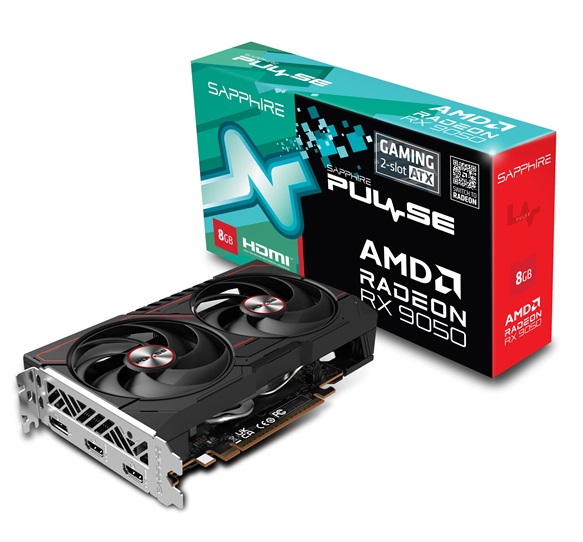
That does not make AMD’s smallest RDNA 4 card useless. It has 8GB of GDDR6, a modest power target, and genuinely compact partner designs. It does make importing one the wrong bet. AMD’s own product page still labels the pictured card as not available for purchase, and searches of Newegg.ca, Amazon.ca, Canada Computers, and Best Buy Canada returned no qualifying RX 9050 listing.
Checked August 29, 2026. All prices are in US dollars. We do not have this card and have not tested it.
Table of Contents
- My recommendation
- Confirmed specifications
- What the early testing says
- RX 9050 versus RTX 5050
- Price and availability
- Who should skip this
- Frequently asked questions
- The Short Version
Radeon RX 9050: my recommendation
If you need a budget GPU now, buy the RTX 5050 at or near its official US$249 starting price. NVIDIA’s card is available in North America, costs less on paper, and now leads both the early GDM comparison and TechSpot’s independent review. That recommendation may change if Canadian RX 9050 stock arrives at a meaningful discount. It should not change before then.
If your current card still runs the games you play, spend nothing. Track actual Canadian listings with our Canadian GPU price tracker and use the broader GPU buy-or-wait guide before replacing working hardware. AMD needs to undercut the RTX 5050 clearly, not match it, for this launch to become interesting.
What AMD has confirmed
The official AMD specification page lists 16 RDNA 4 compute units, 1,024 stream processors, 16 ray accelerators and 32 AI accelerators. The reference specification reaches up to 2,600 MHz and carries 8GB of 18 Gbps GDDR6 on a 128-bit bus, good for up to 288 GB/s. AMD also lists 32MB of Infinity Cache, 92W typical board power, one 8-pin connector and a 450W minimum power-supply recommendation.
The retail card is the 8GB model. PCWorld says an AMD representative confirmed that the 4GB version is reserved for complete systems, not individual retail sale. Four gigabytes on a new gaming desktop would be a bad compromise anyway, especially when modern textures already push 8GB cards.
Partner cards won’t all match AMD’s reference numbers. Sapphire’s PULSE board raises boost clock to 2,760 MHz and typical board power to 100W. It is a two-slot, 200mm-long card with two HDMI 2.1b outputs and one DisplayPort 2.1a output. Sapphire recommends a 650W power supply, far above AMD’s 450W reference guidance, so check the exact board rather than shopping by GPU name alone.
What the early Radeon RX 9050 testing says
We haven’t tested either card. The first detailed numbers came from Japanese outlet GDM, as reported by Tom’s Hardware. GDM compared an ASRock RX 9050 Challenger with a factory-overclocked Gigabyte RTX 5050 Windforce OC in a Ryzen 7 9800X3D system.
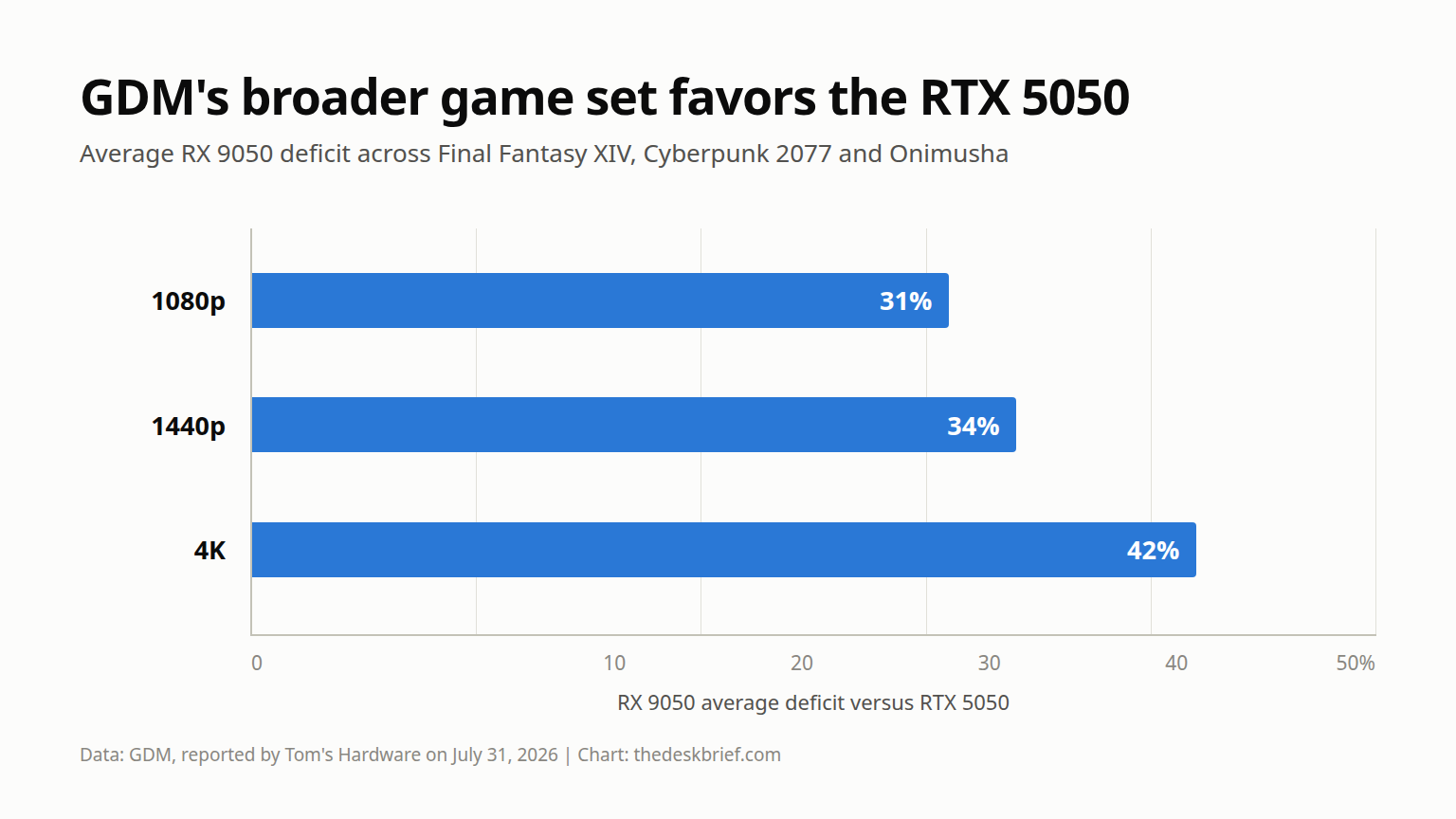
In GDM’s broader three-game group of Final Fantasy XIV, Cyberpunk 2077 and Onimusha, Tom’s Hardware calculated average RX 9050 deficits of 31 percent at 1080p, 34 percent at 1440p and 42 percent at 4K. The result wasn’t uniform. Rainbow Six Siege X narrowed the gap, and unusual DOOM results swung wildly between cards as resolution changed. That volatility is exactly why these numbers are preliminary evidence, not a final ranking.
GDM also recorded lower total-system power draw with AMD: about 8W less at idle and about 35W less under load. That is a real advantage for a compact machine, but it is not a clean GPU-only board-power measurement.
The stronger evidence now comes from TechSpot’s independent 10-game review. At 1080p, the RX 9050 averaged 49 FPS, compared with 59 FPS for the RTX 5050 and 60 FPS for the older RX 7600. That makes the RTX 5050 20% faster and the RX 7600 22% faster in that test set. At 1440p, the RX 9050 and RTX 5050 both averaged 33 FPS, while the RX 7600 reached 35 FPS. Different cards and test suites can move the percentages, but both published comparisons agree that US$279 is too high.
RX 9050 versus RTX 5050
| Decision point | AMD Radeon RX 9050 | NVIDIA RTX 5050 |
|---|---|---|
| Official or reported starting price | US$279 introductory price, reported by PCWorld | US$249 official starting price |
| Current launch market | Latin America and Asia-Pacific/Japan; Canada not announced | North American retail availability |
| Memory | 8GB GDDR6, 128-bit, up to 288 GB/s | 8GB GDDR6, 128-bit |
| Reference power | 92W typical board power; partner cards vary | 130W maximum at stock settings |
| Early 1080p evidence | 31 percent behind in GDM’s broader three-game group | Faster in the same preliminary comparison |
| Honest drawback | Costs more in the launch report and lacks Canadian availability | Higher power draw and real cards can sell above US$249 |
NVIDIA’s official RTX 5050 launch information confirms 2,560 CUDA cores, 8GB of GDDR6 on a 128-bit bus, a 130W maximum and a US$249 starting price. CUDA cores and AMD stream processors aren’t directly comparable, so the table doesn’t pretend they are. Actual game results matter more than shader counts across different architectures.
The RX 9050’s best argument is efficiency in a small system. Sapphire’s compact board is only 200mm long, AMD’s reference power figure is low, and GDM’s system consumed less power. The RTX 5050’s argument is harder to ignore: lower official price, established availability and better preliminary performance. Efficiency doesn’t rescue a slower card that also costs more.
The price and availability problem
PCWorld reports a US$279 introductory price for the 8GB Radeon RX 9050 after speaking with AMD, but says the initial release is limited to Latin America and Asia-Pacific/Japan. AMD did not share plans for other markets. As of August 29, AMD’s product page still does not offer a purchase path, and Newegg.ca, Amazon.ca, Canada Computers, and Best Buy Canada show no qualifying listing.
Importing adds shipping, possible duties, awkward returns and regional warranty questions to a card that already loses the price comparison. I would reconsider if Canadian street pricing lands at least 20 to 25 percent below comparable RTX 5050 cards. Until that happens, the sensible AMD move is to wait, not pay a first-week premium for scarcity.
Who Should Skip This
Skip it if you’re shopping in Canada today, need dependable 1440p performance, care about mature independent thermal and noise measurements, or can buy an RTX 5050 for less. Also skip the 4GB system-only variant unless the complete PC is extremely cheap and your games are light. Memory capacity is not where a new 2026 desktop should cut corners.
The card may fit a narrow buyer later: someone building a compact 1080p PC who values lower power, finds a well-cooled 8GB model at a deep discount and prefers AMD’s software stack. That buyer needs a real local listing and independent testing first. Neither exists yet.
Frequently Asked Questions
Is the Radeon RX 9050 available in Canada?
No. As of August 29, 2026, AMD has not announced a Canadian release date or official Canadian price, and the four checked Canadian retailers have no qualifying listing. The initial 8GB launch covers Latin America and Asia-Pacific/Japan.
When did the Radeon RX 9050 come out, and when will it reach Canada?
The RX 9050 launched on July 28, 2026 in selected Latin American and Asia-Pacific/Japan markets at a reported US$279 introductory price. AMD has not published a Canadian release date. A partner product page is not proof of local stock, so wait for an actual Canadian retailer listing.
Is the RX 9050 faster than the RTX 5050?
Not at 1080p in the available comparisons. TechSpot’s 10-game average was 49 FPS for the RX 9050 and 59 FPS for the RTX 5050, a 20% lead for NVIDIA. At 1440p, both averaged 33 FPS in the same suite.
Does the RX 9050 have 4GB or 8GB?
The individual retail card has 8GB of GDDR6. AMD told PCWorld that the 4GB version is a system-only part intended for prebuilt computers.
Should Canadians import one?
No. The regional US$279 launch price is already above NVIDIA’s US$249 starting price, before shipping, duties or warranty friction. Wait for Canadian stock and independent reviews.
The Short Version
The Radeon RX 9050 is a compact 8GB RDNA 4 card with low reference power and credible 1080p potential. It is still region-limited, absent from the checked Canadian retailers, and 20% slower than the RTX 5050 in TechSpot’s 1080p 10-game average. Buy the RTX 5050 if you need a card now. Otherwise, keep your current GPU and wait for a Canadian listing and a meaningful AMD discount.
Editorial rating: 2.5 out of 5. The Radeon RX 9050 is a compact, low-power 8GB card with credible 1080p potential. Its limited regional launch, absent Canadian stock, higher price, and weaker measured performance than the RTX 5050 make waiting or buying the NVIDIA alternative the better choice.