
GPU prices in 2026 have quietly detached from the numbers on the launch slides, and the GeForce RTX 5080 is the cleanest example. It shipped at CA$1,400 (US$999). In July 2026 you will pay somewhere between CA$1,822 (US$1,300) and CA$2,032 (US$1,450) for the same card, in the same box, with the same silicon. Nothing about the product got better. The memory soldered around the chip got more expensive, and that cost landed on your invoice.
Currency note: Canadian dollar equivalents use the Bank of Canada daily average of 1 USD = 1.4014 CAD on July 17, 2026. Converted amounts are approximate; the original US price is shown in brackets.
This is not a one-card problem. Across NVIDIA’s RTX 50 series and AMD’s Radeon RX 9000 line, street prices this month sit anywhere from 18% to 74% above where the cards launched. AMD has already warned its board partners that another increase of 10% to 15% is coming. If you have been sitting on a build you started planning six months ago, the real question stopped being which GPU to buy. It became whether to buy one at all right now.
Below is where those prices actually stand, what pushed them there, and the short list of buyers who should stop waiting. Every figure comes from retail listings or a price tracker I checked this week, and each source is named where it appears.
For current listings, use our GPU prices tracker for Canada. It checks qualifying in-stock NVIDIA and AMD cards at five retailers every day, including dedicated RTX 5090 and RTX 5070 results.
Table of Contents
- Why GPU prices climbed again in 2026
- What the cards actually cost right now
- The best value in a bad market
- Buy now or wait
- Who Should Skip This
- GPU prices FAQ
- The Short Version
Why GPU prices climbed again in 2026
The graphics chip itself is not what got expensive. The memory bolted to it did. On a modern high-end card, VRAM now eats a large share of the whole bill of materials, according to PC Game Check’s breakdown of the shortage. When that component doubles in price, the finished card follows.
And it did double. DRAM contract prices jumped roughly 80% in the first quarter of 2026 alone, with year-over-year increases running well above 100%. The cause is not gamers. It is the data center. Hyperscalers like Microsoft, Google, Meta, and Amazon are buying high-bandwidth memory for AI accelerators as fast as fabs can make it, and that demand pulled wafer capacity away from the ordinary GDDR that goes on gaming cards.
NVIDIA reportedly trimmed RTX 50 series supply by around 20%, and by 30% to 40% on some models, through the first half of the year. Less supply into a market that will pay anything, and the result writes itself. The same squeeze is hammering system memory too, which is why RAM prices have tripled over a similar window. GPUs and DIMMs are drinking from the same well, and the well is being drained by AI.
What the cards actually cost right now
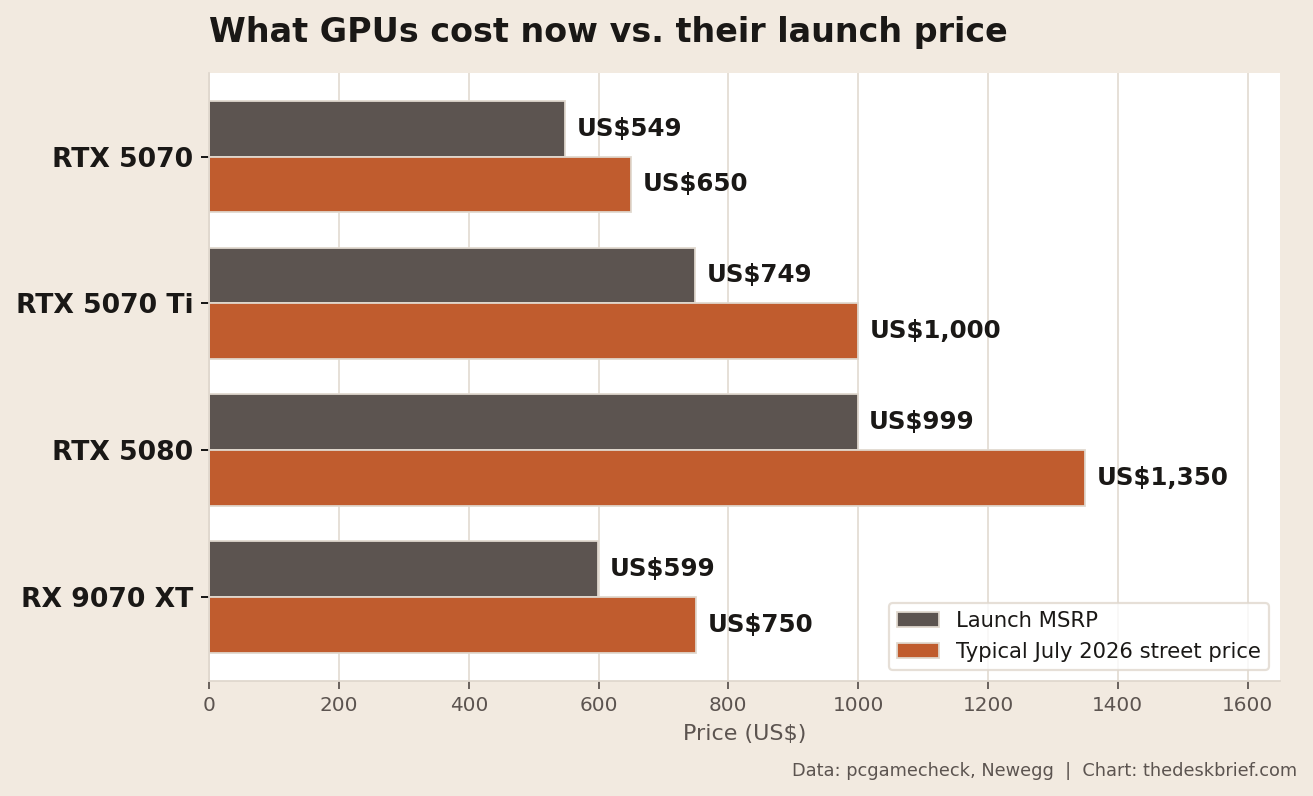
Here is the gap between the launch MSRP and what you actually pay in July 2026. NVIDIA’s RTX 5070 launched at CA$769 (US$549) and now starts around CA$911 (US$650). The RTX 5070 Ti launched at CA$1,050 (US$749) and trades between CA$1,261 (US$900) and CA$1,822 (US$1,300), with typical listings in the CA$1,401 (US$1,000) to CA$1,682 (US$1,200) band and marketplace outliers pushing past CA$1,962 (US$1,400). The RTX 5080 left the factory at CA$1,400 (US$999) and now runs CA$1,822 (US$1,300) to CA$2,032 (US$1,450).
AMD is not immune, though its floor is lower. The Radeon RX 9070 launched at CA$769 (US$549) and can still be found from about CA$785 (US$560) to CA$981 (US$700). The RX 9070 XT launched at CA$839 (US$599) and, on a good day, is still available at that price, but climbs to nearly CA$1,386 (US$989) depending on the model and the week.
For reference, here is what your money buys on the RTX 5070 Ti, per Newegg’s buyer FAQ, since it sits at the center of most upgrade decisions:
- 16GB of GDDR7 memory on a 256-bit bus
- 8,960 CUDA cores
- 300W board power
- Launch MSRP of CA$1,050 (US$749), typical July 2026 street price near CA$1,401 (US$1,000)
The best value in a bad market
At MSRP, the RTX 5070 Ti is the easy pick. It lands close to the RTX 5080 in real games for three-quarters of the price. The problem is that almost nobody pays MSRP anymore, and once both cards are marked up, the math gets murkier. TechTimes clocked the RTX 5080 at roughly 39% more money than the 5070 Ti during a recent Prime Day while delivering only about 17% more performance. That is a bad trade at any price, and a worse one at these.
So the value play is simple: buy the most affordable card that clears the resolution you actually run, and refuse to stretch a tier. If a CA$911 (US$650) RTX 5070 or a CA$839 (US$599) RX 9070 XT handles your monitor, that is the smart buy, not the CA$1,892 (US$1,350) card two rungs up. Save the difference or put it toward the memory and storage that got expensive at the same time.
On the AMD side, timing matters more than usual. TweakTown reports that AMD plans to lift Radeon RX 9000 pricing by 10% to 15% in the second half of 2026, possibly as early as this month, because it bundles the GPU die and memory together before shipping to partners. If you want an RX 9070 XT near its CA$839 (US$599) launch price, that window is closing, not opening.
Buy now or wait
The instinct in a spike is to wait it out. This time, waiting has a cost you should see clearly. PC Game Check’s reporting puts meaningful price relief no earlier than late 2027, and possibly 2028, because that is when new memory fabrication capacity is scheduled to come online. Waiting for GPU prices to fall means waiting years, not weeks.
That reframes the decision. If your current card still runs your games at your resolution, waiting is free and you should do it. If your card just died, or you are building a first machine and need one to function, buy now and buy the value tier. The deal you are hoping for is not scheduled to arrive, and AMD’s coming increase means today’s prices are more likely a floor than a ceiling.
There is one more path worth naming. If the GPU is mostly for light local AI work rather than gaming, a unified-memory box can sidestep the discrete-card market entirely. A mini PC like the Beelink GTR9 Pro or one of the RTX Spark laptops pools system memory for models in a way a mid-range gaming card cannot, and you are not competing with gamers for GDDR supply.
Who Should Skip This
Skip the upgrade if you already own something like an RTX 4070 or an RX 7800 XT and it clears your games. Paying a 40% markup for 15% to 20% more frames is the worst kind of purchase, the kind you regret the moment prices normalize. Your current card did not get slower because a new one launched.
Skip the top tier if you are buying on a budget and telling yourself the RTX 5080 is “future-proof.” Nothing about paying CA$1,962 (US$1,400) for a CA$1,400 (US$999) card is future-proof. And skip the whole waiting game if your plan is to hold out for 2022 prices, because that pricing is not coming back on the timeline anyone credible is forecasting.
GPU prices FAQ
Why are GPU prices so high in 2026?
Memory, not the graphics chip. AI data center demand for high-bandwidth memory pulled fab capacity away from the GDDR used on gaming cards, and VRAM now makes up a large share of a card’s cost. DRAM contract prices rose about 80% in a single quarter, and cards priced accordingly.
Will GPU prices drop later in 2026?
Not meaningfully. Analysts cited by PC Game Check put real relief no sooner than late 2027, when new memory capacity comes online. AMD is actually raising Radeon prices in the second half of 2026, so the near-term direction is up, not down.
Is the RTX 5070 Ti or RTX 5080 the better buy?
The RTX 5070 Ti, in most cases. It runs about 85% to 90% of the RTX 5080’s gaming performance, and the 5080’s roughly 39% price premium buys only about 17% more speed. Only pick the 5080 if you find it close to its CA$1,400 (US$999) MSRP while the 5070 Ti stays marked up.
Are AMD GPUs cheaper than NVIDIA right now?
At the low end, yes. An RX 9070 XT can still be found near its CA$839 (US$599) launch price, undercutting comparable NVIDIA cards. That edge is temporary, though, because AMD has told partners a 10% to 15% increase is coming in the second half of 2026.
The Short Version
GPU prices are 18% to 74% over MSRP because AI demand made memory scarce, and the fix is years out. The RTX 5080 that launched at CA$1,400 (US$999) now costs CA$1,822 (US$1,300) to CA$2,032 (US$1,450), while the RTX 5070 Ti sits near CA$1,401 (US$1,000) against a CA$1,050 (US$749) sticker. AMD’s RX 9070 XT is the current value floor near CA$839 (US$599), but a 10% to 15% AMD increase is landing this half.
If your card still works, wait, because waiting is free and the market will not punish you for it soon. If you genuinely need a card now, buy the most affordable one that clears your resolution and ignore the tier above it. And if the goal is local AI rather than gaming, a unified-memory mini PC dodges the discrete-GPU market and its GDDR tax altogether.