The best paper shredder for most home offices is the Aurora AU1225MA. It combines a 12-sheet rating, P-4 micro-cut output, a 40-minute stated runtime and a five-gallon pullout bin without approaching the price of the largest Fellowes model. The Amazon Basics eight-sheet cross-cut shredder is enough for occasional mail.
Every recommendation below was in stock at Amazon.com when checked on October 4, 2026. This comparison uses published capacity, particle size, duty cycle, bin size and safety features. It is research-based and does not claim hands-on testing. Prices and availability can change.
By Ryan Billings | Updated October 4, 2026.
Best Paper Shredders at a Glance
Disclosure: As an Amazon Associate I earn from qualifying purchases. Retail links are sponsored and do not change the price you pay.
| Pick | Amazon price | Cut | Sheets | Runtime | Bin |
|---|---|---|---|---|---|
| Amazon Basics 8-sheet | US$37.02 | P-4 cross-cut | 8 | 3 min | 3.7 gal |
| Aurora AU1225MA | US$114.28 | P-4 micro-cut | 12 | 40 min | 5 gal |
| Fellowes 79Ci | US$269.99 | P-4 cross-cut | 16 | 20 min | 6 gal |
| Fellowes LX220 | US$289.99 | P-4 micro-cut | 20 | 30 min | 8 gal |
Quick decision: Choose the Aurora AU1225MA for regular home-office shredding. Buy the Amazon Basics eight-sheet model if your workload is a few statements and envelopes at a time.
How to Choose a Paper Shredder
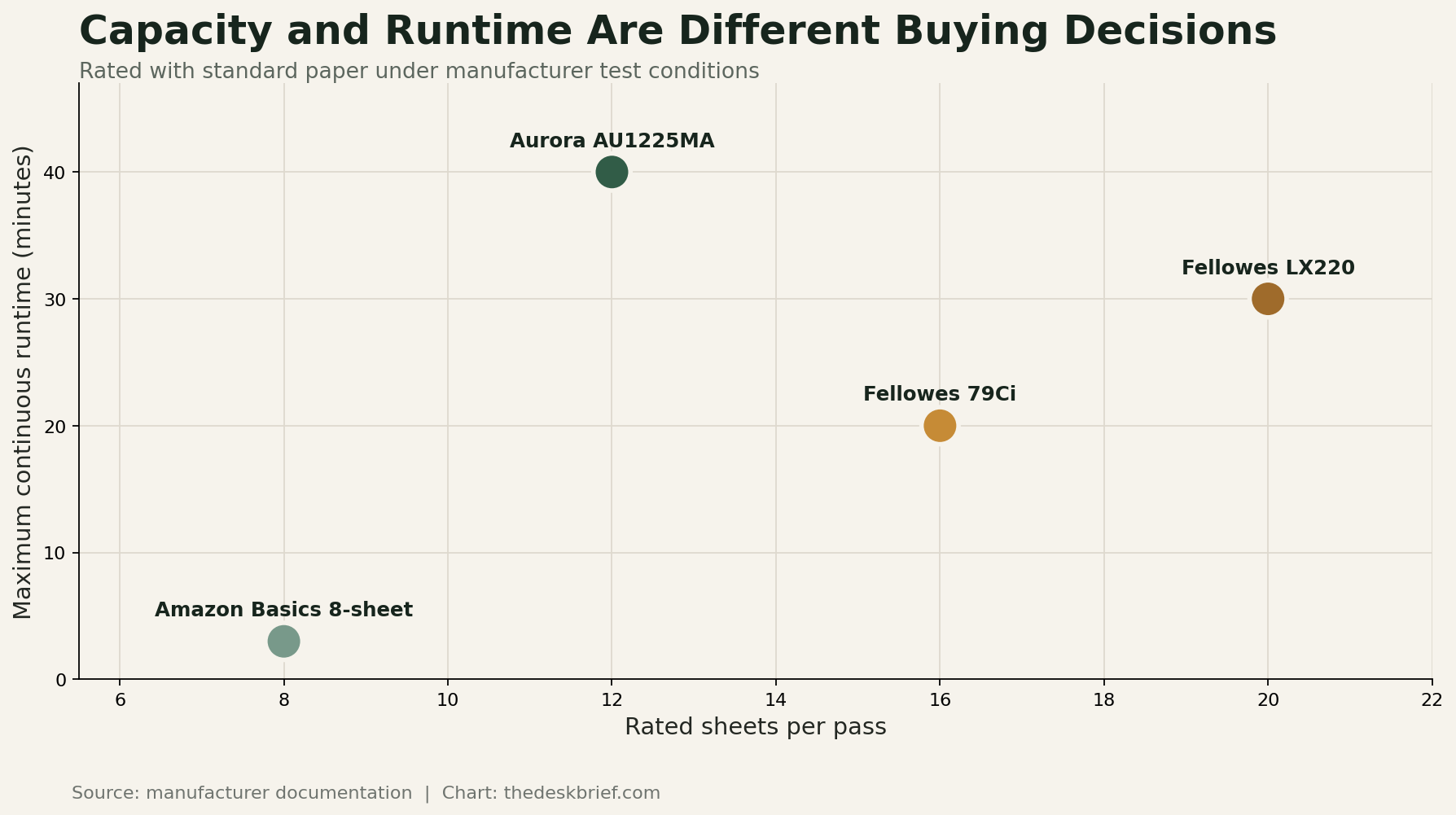
Start with duty cycle, not the largest number printed on the box. Sheet capacity describes one pass under specified paper conditions. Runtime tells you how long the motor can operate before cooling. An eight-sheet machine with a three-minute limit suits daily mail. It becomes irritating when clearing a filing cabinet because a thermal shutdown can require a 30-minute wait.
Cut type affects both security and bin efficiency. Strip-cut machines create long ribbons and should be avoided for financial or identity documents. Cross-cut and micro-cut models reduce paper in two directions. The four picks here are rated P-4, but their particle dimensions differ. Micro-cut pieces usually pack more tightly and are harder to reconstruct, though the label alone does not make a machine appropriate for classified or regulated destruction.
Bin design matters after the motor stops. A pullout bin is cleaner than lifting a heavy cutting head off a wastebasket. Casters help with a 20- to 35-pound machine. Safety locks or touch sensors are worthwhile around children and pets, but the correct procedure remains unplugging the shredder before clearing or cleaning it.
Best Overall: Aurora AU1225MA
The Aurora AU1225MA at Amazon was in stock at US$114.28 when checked. Aurora rates it for 12 sheets, 40 minutes of continuous operation and P-4 micro-cut pieces measuring 5/32 by 15/32 inch. Its five-gallon pullout basket is rated to hold approximately 300 shredded sheets.

That combination is unusually balanced. A 12-sheet pass is manageable for ordinary paper stacks, while the long runtime is better suited to periodic record cleanup than a three- or five-minute personal shredder. The machine also accepts CDs, DVDs, credit cards and small paper clips. Casters and bin-full, overload, overheat and door-open indicators reduce the usual housekeeping friction.
Micro-cut does not mean silent, maintenance-free or impossible to jam. Feed fewer than the rated maximum when paper is thick, folded or humid, and oil the cutters according to the manual. Aurora lists a one-year limited warranty on the official AU1225MA specification page. Buyers prioritizing longer cutter coverage may prefer Fellowes despite the price.
Best Budget Pick: Amazon Basics Eight-Sheet Cross-Cut
The Amazon Basics eight-sheet shredder at Amazon was in stock at US$37.02. It is a P-4 cross-cut machine rated for eight sheets of 20-pound paper, with a 3.7-gallon bin and a three-minute continuous runtime followed by a 30-minute cooldown.

Those limits are acceptable when the job is a handful of bank statements, expired cards or addressed mail. The shredder also accepts staples and small paper clips. A forward mode helps pull material through, and reverse helps back out an overloaded stack. At under nine pounds, it is much easier to move than the premium picks.
The short duty cycle is the entire story. Three minutes disappears quickly when old files are involved, and the top-lift bin is less pleasant to empty than a drawer. The published C276-A manual and specifications list a 30-minute cooldown. Buy this paper shredder for light maintenance, not an annual archive purge.
Best Jam Prevention: Fellowes Powershred 79Ci
The Fellowes Powershred 79Ci at Amazon was in stock at US$269.99. It is rated for 16 sheets, a 20-minute run followed by 30 minutes off, P-4 cross-cut pieces and a six-gallon pullout bin. Fellowes adds its Jam Proof system, SafeSense touch detection, quieter operation and energy-saving controls.

This is the best paper shredder here for someone more bothered by jams than particle size. The machine measures the stack before accepting it and can power through some difficult feeds. SafeSense stops shredding when a hand touches the paper opening. It also handles credit cards, CDs, staples, paper clips and unopened junk mail according to Fellowes.
The downside is value. It costs more than twice the Aurora while producing longer cross-cut particles and offering half the stated runtime. The official 79Ci specification sheet lists a two-year product warranty and lifetime cutter warranty for that version. Pay the premium for the anti-jam and safety systems, not raw throughput.
Best for a Shared Small Office: Fellowes LX220
The black Fellowes LX220 at Amazon was in stock at US$289.99. It raises capacity to 20 sheets, uses P-4 micro-cut, runs for up to 30 minutes and has an eight-gallon pullout bin. An indicator system reports bin level, runtime and whether the current paper stack leaves capacity unused.

This is the throughput choice when several people share one machine. The larger bin and 20-sheet rating reduce interruptions, while casters make its 23.25-inch-tall body easier to reposition. Fellowes lists paper, credit cards, staples and paper clips as acceptable. It specifically excludes adhesive labels, cardboard, optical discs and laminates.
Do not buy it for a quiet corner that destroys six pages per week. It is large, expensive and still requires a 15-minute cooldown after its rated 30-minute run. The official LX220 specification sheet lists a two-year product warranty and seven-year cutter warranty. Its value appears only when the extra capacity gets used.
What P-4 Does and Does Not Mean
P-4 is a particle-size classification, not a promise that every model creates identical pieces or meets your organization’s disposal policy. The Aurora and LX220 use smaller micro-cut pieces than the cross-cut picks, even though all four are described as P-4. Compare the stated cut dimensions when the material is sensitive.
Businesses handling legal, medical, financial or government records should follow their applicable retention and destruction requirements rather than buying from a consumer roundup alone. A certified shredding service can provide locked collection and documented destruction for large archives. That may be cheaper than feeding thousands of sheets through a personal machine.
Maintenance and Placement
Empty the bin before shredded paper reaches the cutters. Follow the manufacturer’s oil or lubricating-sheet instructions, especially for micro-cut models with more cutting edges. Never use aerosol lubricant or canned air around a shredder. Unplug the unit before reaching near the feed slot or removing jammed fragments.
Place the machine where air can circulate and paper can enter vertically. Do not hide a ventilated motor inside a tight cabinet. If the office is being reorganized, the work-from-home setup guide and cable-management guide can help keep its cord out of walkways. A shredder is not a footrest, despite its persuasive rectangular shape.
Who Should Skip a Paper Shredder
Skip ownership if you destroy documents only once or twice per year. A reputable local service can handle a box quickly without taking permanent floor space. Skip these four models for continuous departmental use, magnetic media or materials prohibited by their manuals. Remove adhesive labels and plastic windows unless the manufacturer explicitly permits them.
Continue Building the Small Office
This guide is part of The Desk Brief’s small-office equipment series. After comparing paper shredders, continue with photo scanners. Each guide uses the same Amazon-stock and manufacturer-specification checks.
Frequently Asked Questions
Is micro-cut better than cross-cut?
Micro-cut creates smaller particles, normally improves bin density and makes reconstruction harder. Cross-cut is sufficient for much ordinary personal paperwork and may cost less. Compare the actual particle dimensions and your disposal requirements rather than relying only on the marketing term.
How many sheets should I feed at once?
Use fewer than the maximum when sheets are folded, heavy, damp or mixed with staples. Capacity ratings typically assume standard paper in controlled conditions. Smaller stacks reduce motor load and jams, even when the machine advertises automatic jam prevention.
Do paper shredders need oil?
Many cross-cut and micro-cut shredders require periodic lubrication, but the schedule and approved product vary. Follow the manual for the exact model. Do not substitute aerosol lubricants, cooking oil or general-purpose sprays.
The Short Version
The Aurora AU1225MA is the best paper shredder for most home offices because its 40-minute runtime, 12-sheet rating, P-4 micro-cut and pullout bin form the strongest practical package. Amazon Basics is the budget choice for short jobs. Fellowes 79Ci justifies its premium with stronger jam prevention and touch safety, while the LX220 is the large shared-office pick with a 20-sheet rating and eight-gallon bin.