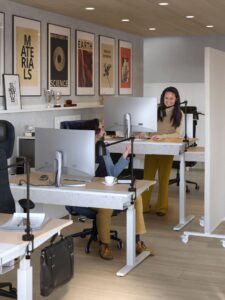
Walking pad vs treadmill is really a choice between movement during ordinary life and a machine built for exercise. A walking pad is low, compact, and usually limited to about 4 mph. A treadmill is longer, heavier, and designed to support running, incline work, and faster structured sessions.
Quick answer: Choose a walking pad if you want to walk slowly while working, live in a small space, or need something that can slide under furniture. Choose a treadmill if you want to run, train on a meaningful incline, or make the machine your main cardio equipment. A treadmill asks more of your room and budget because it does more.
This comparison describes typical home machines, not every product that borrows either name. Retailers are loose with the terminology, so the belt, rails, speed rating, and intended use matter more than the label.
Table of Contents
- Quick Comparison
- Walking Pad Pros and Cons
- Treadmill Pros and Cons
- When a Walking Pad Is Better
- When a Treadmill Is Better
- Can You Run on a Walking Pad?
- What About Under-Desk Treadmills?
- The Bottom Line
Walking Pad vs Treadmill: Quick Comparison
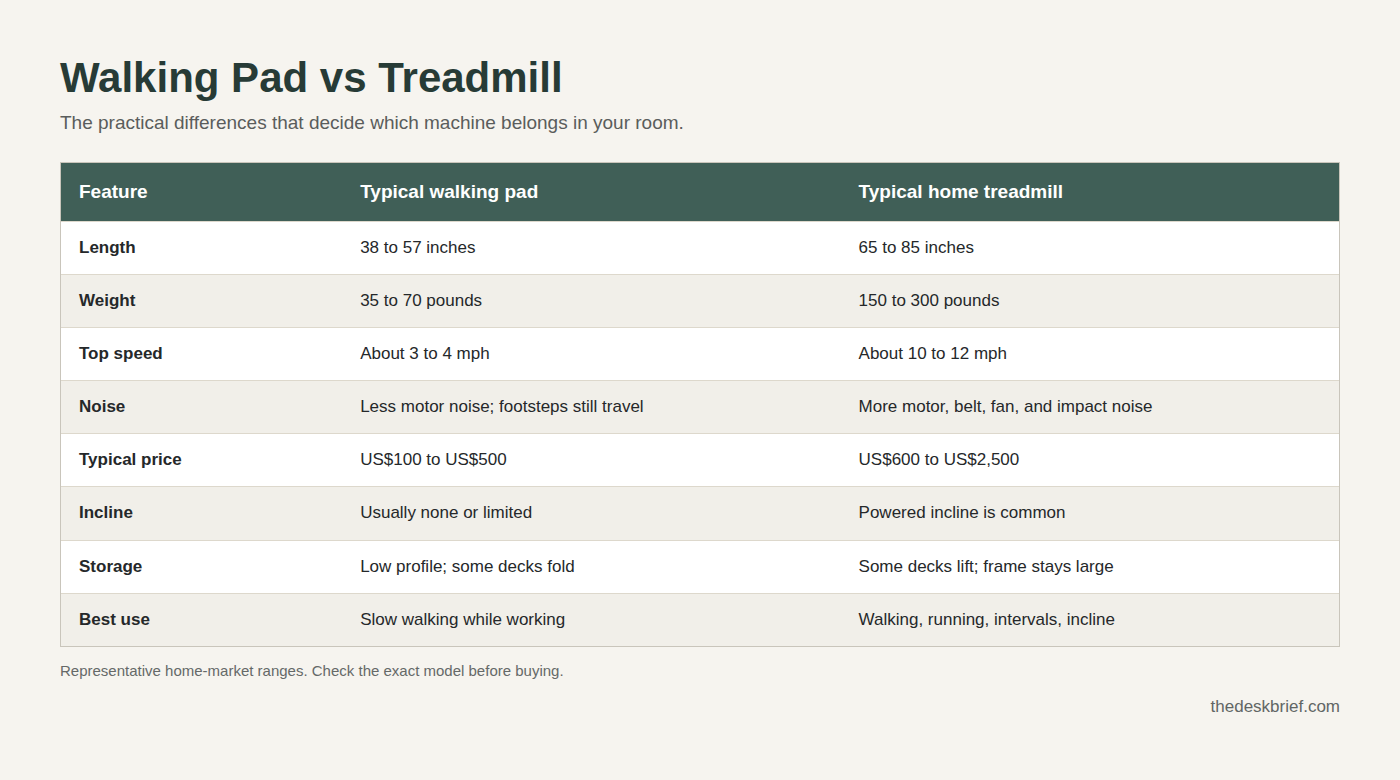
The walking pad vs treadmill table uses representative home-market ranges, not promises for every model. Some premium walking pads are heavier than cheap treadmills, and a folding treadmill still occupies far more volume than a pad.
| Feature | Typical walking pad | Typical home treadmill |
|---|---|---|
| Length | 38 to 57 inches | 65 to 85 inches |
| Weight | 35 to 70 pounds | 150 to 300 pounds |
| Top speed | About 3 to 4 mph | About 10 to 12 mph |
| Noise | Less motor noise, but footsteps still travel through floors | More motor, belt, fan, and running impact noise |
| Typical price | US$100 to US$500 | US$600 to US$2,500 |
| Incline | Usually none; a few have fixed or powered incline | Powered incline is common |
| Storage | Low profile; some decks fold in half | Some decks fold upward, but the frame remains large |
| Best use | Slow walking while working or watching TV | Walking, running, intervals, and incline workouts |
Walking Pad Pros and Cons
A walking pad fits a routine that already exists. Put one under a height-adjustable desk and a status meeting can become twenty minutes of easy movement. Roll it toward a television and the same thing happens without reserving a separate workout block.
- Smaller footprint: It can fit in a home office that has no room for fixed rails.
- Lower deck: Most standing desks can accommodate the added height.
- Easier storage: Transport wheels and a thin frame make same-floor moves realistic.
- Lower entry price: Basic models regularly cost a fraction of a conventional treadmill.
The weaknesses are equally practical. Short belts give you less room to drift, there’s usually nothing to grab if you lose balance, and small motors aren’t designed for fast or endless sessions. Remote controls can also become single points of failure. If the remote dies and the machine has no useful onboard buttons, the entire product can become a very heavy floor mat.
Walking pads aren’t silent. Motor sound may be modest, but footfall vibration can travel through wood framing and into the room below. A floor mat helps with protection and some vibration. It can’t repeal apartment construction.
Treadmill Pros and Cons
A conventional treadmill gives you a longer belt, fixed handrails, higher speed, more stable construction, and usually powered incline. Those features matter when the goal is fitness rather than background movement. A proper treadmill also makes progression easier because pace and incline can change as your conditioning improves.
- Built for running: Longer decks and rails support a faster gait.
- Better training range: Higher speeds and powered incline allow intervals and hill work.
- More substantial frame: Added mass generally improves stability.
- On-machine controls: Speed, incline, stop, and programs remain accessible without a tiny remote.
You pay for that capability twice. In walking pad vs treadmill pricing, the larger machine costs more and claims a permanent part of the room. A “folding” treadmill usually lifts its deck toward the console; it doesn’t turn into something that slides under a sofa. Delivery, assembly, and a future move can become projects of their own.
When a Walking Pad Is the Better Choice
For walking pad vs treadmill use in a small home office, pick the pad when workday movement is the actual objective. It’s the cleaner fit for email, reading, casual calls, and television at roughly 1 to 2 mph. Our best walking pad guide compares current models by deck height, storage dimensions, capacity, and price.
Small apartments are the other obvious case. A folding-deck model can occupy a closet corner instead of half a spare room. Measure the storage route, not just the final gap. Wheels are useful across a floor, but they do nothing on stairs.
The desk must rise by the height of the treadmill deck while keeping your elbows comfortable. If a full standing desk isn’t an option, a stable standing desk converter may create enough height. Add the converter and deck measurements before buying either one.
Don’t turn desk walking into another fixed posture. The Canadian Centre for Occupational Health and Safety recommends changing position and avoiding prolonged standing. Short walking blocks mixed with sitting and ordinary standing are more realistic than trying to walk through an entire shift.
When a Treadmill Is the Better Choice
Buy a treadmill when you want the machine to challenge you. Running, sustained brisk walking, steep incline work, and structured intervals all benefit from a larger deck and fixed controls. A pad with a 35-inch belt and no rails is the wrong place to chase a personal best.
A treadmill is also the more credible one-machine solution for a household with different goals. One person can walk while another runs, assuming the motor, deck, and user rating fit both. That flexibility can justify the cost and floor space.
Don’t buy one merely because it looks more serious. If you dislike scheduled workouts and only want to stop sitting through every meeting, the extra capability won’t create extra use. A smaller machine within reach often beats better equipment in another room.
Can You Run on a Walking Pad?
No, not on a typical low-profile walking pad. Most top out near 3.7 or 4 mph, their belts are too short for a running stride, and they lack fixed handrails. Trying to outrun the rated speed doesn’t turn a compact desk appliance into a treadmill.
Some “2-in-1” products reach 6 to 7.5 mph after a rail folds upward. Treat those as compact treadmills and use them only in the configuration the manufacturer approves. Even then, a 15-inch-wide belt is less forgiving than the wider deck on a conventional running machine.
What About Under-Desk Treadmills?
“Under-desk treadmill” is a use category, not a reliable engineering category. Most products sold under that name are rigid walking pads. A few are heavier treadmill bases designed for longer work sessions, and some 2-in-1 models add a folding rail for faster use away from the desk.
The middle ground can be useful if you want one compact machine for desk walking and a faster post-work session. It also adds hinges, rails, and compromises. Our best under-desk treadmill guide focuses on that work-first category. A manual walking pad removes the motor, but most budget manual belts rely on steep incline and rails, which makes them poor under-desk tools.
The Bottom Line
The walking pad vs treadmill decision shouldn’t be close once the intended activity is clear. For slow movement during work, choose a walking pad and spend the savings on a desk that reaches the right height. For running, incline training, or a primary cardio machine, make room for a treadmill.
If both sound excessive, don’t buy either yet. Take two ten-minute walks outside or through the building during the times you expect to use the machine. If that routine survives for two weeks and weather or work keeps interrupting it, you have found a real problem for indoor equipment to solve.