The Microsoft 365 price increase that filled inboxes and IT newsletters this month mostly isn’t yours to worry about. If you pay for Microsoft 365 out of your own pocket, as a freelancer or a household, your bill did not move on July 1. The hike lands on business subscriptions, and even there it is smaller and more selective than the “up to 33%” headlines made it sound.
Currency note: Canadian dollar equivalents use the Bank of Canada daily average of 1 USD = 1.4014 CAD on July 17, 2026. Converted amounts are approximate; the original US price is shown in brackets.
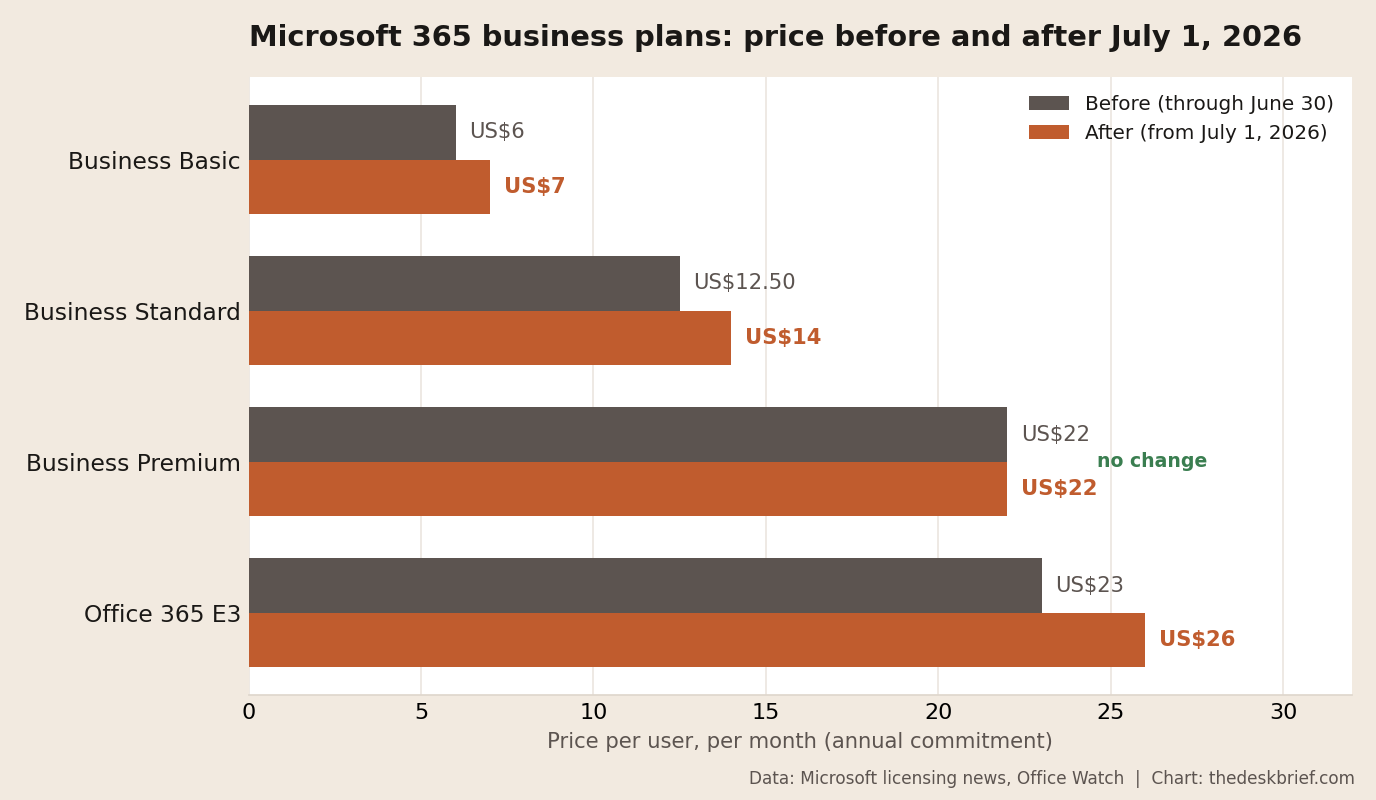
Here is the part those headlines skipped. Business Basic went from CA$8 (US$6) to CA$10 (US$7) per user each month. Business Standard climbed from CA$17.52 (US$12.50) to CA$20 (US$14). Business Premium, the plan most serious small teams actually run, didn’t change at all. So before you rage-cancel anything, it’s worth seeing exactly which line on your invoice moved, by how much, and whether there’s a cheaper way to sit through it.
I pulled these figures from Microsoft’s own licensing pricing notice and cross-checked them against two independent write-ups fetched this week, Office Watch and PCWorld, because a price story is only as good as its sources. Every number below is per user, per month, on an annual commitment, in US dollars unless noted.

Table of Contents
- What actually changed on July 1
- Who the Microsoft 365 price increase actually hits
- The real cost to a small home-office team
- Microsoft 365 vs Google Workspace, tier for tier
- How to keep paying the old price
- Microsoft 365 price increase FAQ
- The Short Version
What actually changed on July 1
Microsoft raised the sticker price on most of its commercial plans and left the consumer ones alone. This is the largest change to its business pricing since 2022, and only the second time it has touched the business suites since Office 365 launched in 2011. The company frames it as paying for the roughly 1,100 features it shipped over the past year, most loudly the Copilot assistant it now bundles into the suite, plus new security and management add-ons.
Here is the full list of what moved, per user per month on an annual plan:
- Business Basic: CA$8 (US$6) to CA$10 (US$7) (about 16% more)
- Business Standard: CA$17.52 (US$12.50) to CA$20 (US$14) (about 12% more)
- Business Premium: CA$31 (US$22), unchanged
- Office 365 E3: CA$32 (US$23) to CA$36 (US$26)
- Microsoft 365 E3: CA$50 (US$36) to CA$55 (US$39)
- Microsoft 365 E5: CA$80 (US$57) to CA$84 (US$60)
- Frontline F1: CA$3.15 (US$2.25) to CA$4 (US$3) (about 33%, the source of the scary headline)
The “up to 33%” figure everyone quoted comes from that F1 frontline plan, a CA$1.05 (US$0.75) jump on a plan built for shift and deskless staff. If you run a normal desk-based team, the number that matters to you is the CA$1 (US$1) or CA$2.10 (US$1.50) move on Basic and Standard. Business Premium holding at CA$31 (US$22) is the quiet story here: the gap between Standard and Premium just narrowed, which makes Premium the better-value tier it wasn’t a month ago.
Who the Microsoft 365 price increase actually hits
The Microsoft 365 price increase is a commercial-only event. Microsoft confirmed in its own notice that “there are no changes to consumer pricing” in this round. If you’re on Microsoft 365 Personal at CA$14.00 (US$9.99) a month or Family at CA$18.20 (US$12.99) for up to six people, nothing on your bill changed on July 1. Those consumer plans did jump in the 2025 Copilot repricing, but that’s a separate, older story, and if it stings you can still request the Copilot-free “Classic” versions at the old rate.
The people who actually pay more are small businesses on Basic and Standard, which happens to be exactly the plans a two-to-ten-person home operation signs up for. Even then, the increase isn’t immediate. Existing customers keep their current price until the next renewal after July 1. Renew your annual term on July 15 and you’re locked at the old rate for another year, new Copilot features included. The bill only changes when your anniversary comes around.
The real cost to a small home-office team
Percentages make this sound worse than it is, so run the actual dollars. A solo consultant on Business Standard goes from CA$210 (US$150) a year to CA$235 (US$168). A five-person studio on Standard moves from CA$1,051 (US$750) a year to CA$1,177 (US$840), an extra CA$126 (US$90). A three-person shop on Basic climbs from CA$303 (US$216) to CA$353 (US$252), about CA$50 (US$36) more across the whole team for the year.
That is real money, but it is roughly one client lunch spread over twelve months, not a reason to tear out your email overnight. The smarter reaction is to treat the renewal as a prompt to check whether you’re on the right plan at all. Plenty of small teams pay for Standard and use nothing that Basic lacks, and plenty of Copilot licenses sit unused. This is the same buy-now-or-wait math we ran on GPU prices: the cost of doing nothing is often lower than the cost of a panic move.
Microsoft 365 vs Google Workspace, tier for tier
If the increase has you eyeing the exit, the obvious rival is Google Workspace, and the pricing symmetry is almost funny. On annual billing, Google’s Business Starter is CA$10 (US$7), Business Standard is CA$20 (US$14), and Business Plus is CA$31 (US$22). That is dollar-for-dollar identical to Microsoft’s new Basic, Standard, and Premium tiers. The days when switching saved you an obvious pile of cash are gone.
So the decision stops being about price and goes back to fit. Google’s most affordable tier gives you 30GB of pooled storage against Microsoft’s 1TB per user on Basic, which is a real gap if your team hoards files. Microsoft still wins if anyone needs the desktop Word, Excel, and Outlook apps rather than browser versions, since Google has no true desktop equivalent. Google wins on simplicity and on Meet-first teams. Switching an established team also carries a migration cost in hours that rarely shows up in the per-seat comparison, so a CA$1 (US$1) change almost never justifies it.
How to keep paying the old price
There are a few honest ways to blunt this, and none of them involve leaving Microsoft. The cleanest is timing: if your renewal is close, renew before your anniversary date to lock the current price for another full term. You still get every new feature; you just delay the higher rate.
The second is right-sizing. Audit who actually needs Business Standard versus Basic before you renew, and strip Copilot add-ons nobody opens. If your team lives in a browser and rarely touches the desktop apps, Basic at CA$10 (US$7) covers most of it. The third, for anyone whose workflow is lighter than a full Office suite, is to look sideways at the free and low-cost stack. Some of the no-code tools we cover quietly replace paid subscriptions you’ve been renewing on autopilot, and a household that only needs documents and mail can often drop to a free tier entirely. The point isn’t to fight the CA$1 (US$1); it’s to stop paying for seats and features you never use.
Microsoft 365 price increase FAQ
Does the Microsoft 365 price increase affect Personal and Family plans?
No. Microsoft’s notice states there are no changes to consumer pricing in this round. Microsoft 365 Personal stays at CA$14.00 (US$9.99) a month and Family at CA$18.20 (US$12.99). Only the commercial plans went up on July 1.
How much did Microsoft 365 Business Standard go up?
Business Standard rose from CA$17.52 (US$12.50) to CA$20 (US$14) per user per month on an annual commitment, about a 12% increase. Business Basic went from CA$8 (US$6) to CA$10 (US$7), and Business Premium held flat at CA$31 (US$22).
Can I avoid the higher price?
Partly. Existing customers keep the old rate until their next renewal after July 1, so renewing before your anniversary locks the current price for another term. You can also downgrade to a plan that fits your real usage, which often saves more than the increase costs.
Is Google Workspace cheaper now?
Not really. Google Workspace Business Starter, Standard, and Plus are CA$10 (US$7), CA$20 (US$14), and CA$31 (US$22) on annual billing, which matches Microsoft’s new Basic, Standard, and Premium prices almost exactly. Pick on features and storage, not headline price.
The Short Version
The Microsoft 365 price increase is real but narrow. It hit business plans on July 1: Basic is now CA$10 (US$7), Standard is CA$20 (US$14), and enterprise E3 and E5 climbed a few dollars each. Business Premium at CA$31 (US$22) didn’t move, and neither did any consumer plan, so freelancers and families can ignore the headlines. Small teams pay an extra CA$1 (US$1) to CA$2.10 (US$1.50) per seat, which works out to tens of dollars a year, not hundreds.
If you want to soften it, renew before your anniversary to lock the old rate, drop Standard to Basic where the extras go unused, and remember that Google Workspace now costs the same per tier, so switching buys you a different ecosystem rather than a discount. Treat the renewal as a reason to audit your seats, not a reason to panic.