DDR4 is still good in 2026 for an existing AM4 or LGA 1700 PC, a repair, or a genuinely cheaper budget build. Do not buy it for a Ryzen 7 9800X3D, any other Ryzen 7000 or 9000 desktop chip, or Intel Core Ultra 200S: those platforms require DDR5.
Canadian pricing makes the decision unusually concrete. On August 29, the lowest qualifying 32GB DDR4-3600 kit in our tracker was CA$302.99, versus CA$589.99 for DDR5-6000. That CA$287 gap is a 94.7% premium over DDR4. It does not make old memory faster. It makes reuse rational again when the processor and motherboard still meet your needs.
This is not a nostalgia project. Gigabyte launched two new B450 motherboards in August 2026, eight years after the chipset arrived, because old platforms remain commercially useful. The useful question is not whether DDR4 works. It is whether the savings are large enough to pay for the limits you are accepting.
Last updated: August 29, 2026. Canadian prices and current platform compatibility rechecked.
Table of Contents
- Is DDR4 still good in 2026 for a new build?
- Which CPUs still support DDR4?
- What current testing actually found
- Where DDR4 still makes sense
- Why new B450 boards do not make AM4 new again
- DDR4 vs DDR5: the honest platform table
- Who Should Skip This
- FAQ
- The Short Version
Is DDR4 still good in 2026 for a new build?
Yes, but only when the platform saves real money. The best DDR4 build in 2026 is not a high-end system wearing last-generation memory. It is an inexpensive machine built around parts you already own, discounted hardware, or a clearly cheaper CPU and motherboard bundle.
Intel’s 12th, 13th, and 14th-generation desktop chips are the cleanest bridge because models such as the Core i5-14600K can run on either a DDR4 or DDR5 motherboard. Intel’s 14th Gen product brief confirms broad support for both memory standards and compatibility with 600-series and 700-series chipsets. The catch is physical: a DDR4 stick cannot go into a DDR5 slot, so changing memory later usually means changing the motherboard too.
AMD’s AM4 route is cheaper and less flexible. A Ryzen 5000 chip can still make an excellent everyday workstation or gaming PC, especially if you own the board and RAM already. But you are buying the final chapter of that socket, not the first chapter of a platform you can grow for years. The decision belongs beside our 2026 PC build-or-wait math, not inside a benchmark vacuum.
Which CPUs Still Support DDR4 in 2026?
| CPU platform | Memory support | DDR4 buying answer |
|---|---|---|
| AMD Ryzen 5000 / AM4 | DDR4 | Good for reuse, repair, and budget builds |
| AMD Ryzen 7000 and 9000 / AM5 | DDR5 only | No DDR4 motherboard option |
| Ryzen 7 9800X3D | DDR5 only | A “9800X3D DDR4” build is impossible |
| Intel Core 12th, 13th, and 14th Gen / LGA 1700 | DDR4 or DDR5, chosen by motherboard | Useful bridge for a reused DDR4 kit |
| Intel Core Ultra 200S | DDR5 only | No DDR4 motherboard option |
AMD specifies DDR5 and socket AM5 for the Ryzen 7 9800X3D. AMD’s Ryzen 5 5600 page specifies DDR4 and AM4, while Intel’s Core Ultra 200S datasheet lists DDR5. That is why a search for “9800X3D DDR4” has a short answer: the CPU and memory cannot share a motherboard.
What current testing actually found
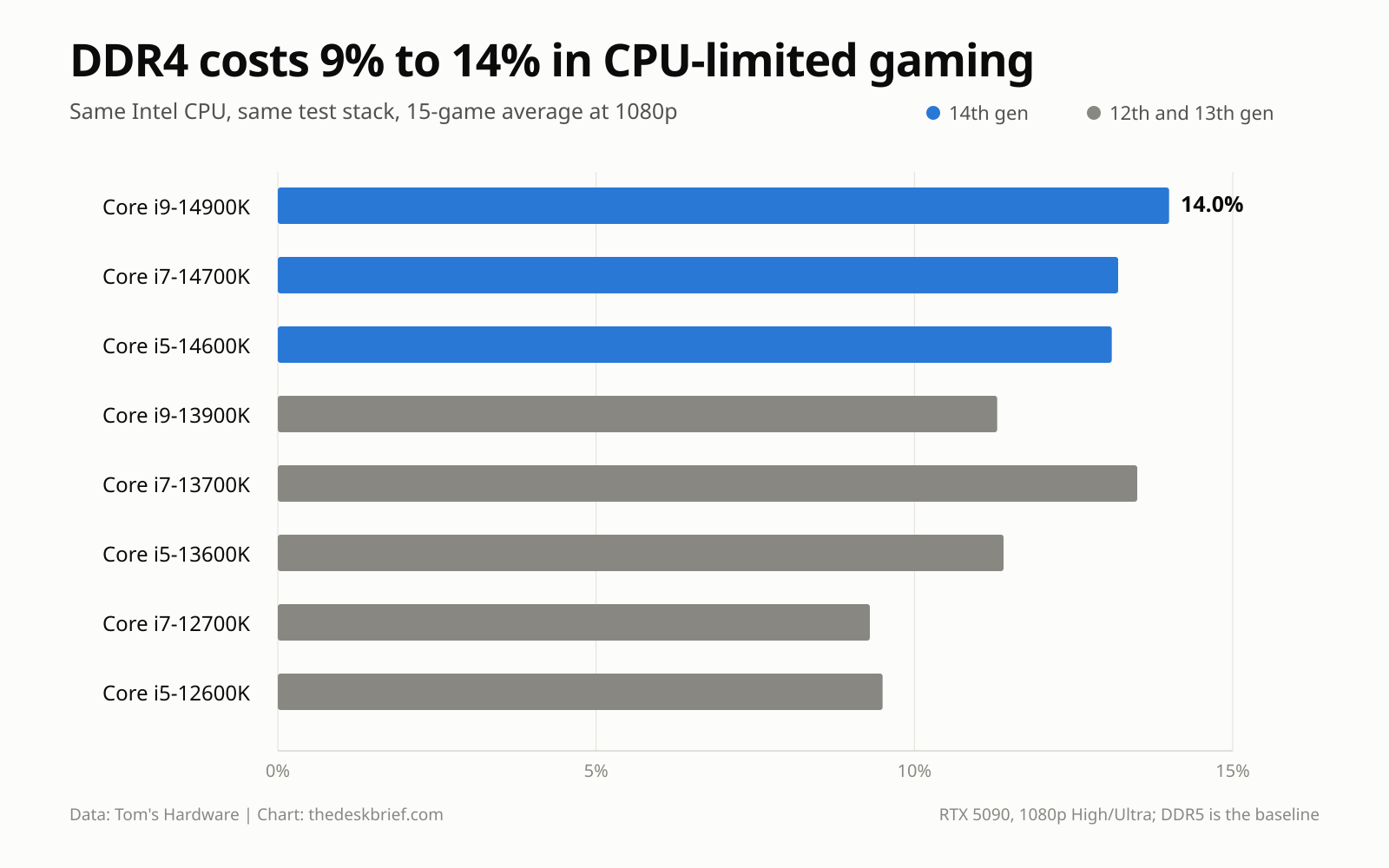
The performance loss is real, and it grows with faster processors. Tom’s Hardware tested eight Intel CPUs across 15 games using an RTX 5090 at 1080p. With the CPU held constant, the DDR4 systems were 9.3% to 14% slower on average than their DDR5 counterparts.
The newer chips lost more. The Core i9-14900K was 14% behind with DDR4, while the Core i5-12600K was 9.5% behind. One game, Marvel Rivals, pushed the Core i7-14700K gap to 25.3%. Those are Tom’s Hardware’s measurements, not mine, and the setup was designed to expose CPU and memory differences. At higher resolutions or with a slower graphics card, the GPU will hide more of the gap.
That distinction matters. A person playing at 4K on a mid-range GPU may barely notice the memory choice. A competitive player chasing very high frame rates on a fast CPU can absolutely notice it. For office work, browsing, video calls, and ordinary multitasking, capacity matters more than turning a spreadsheet into an imaginary esport.
Where DDR4 still makes sense
The strongest case is reuse. If a reliable 32GB DDR4 kit is already sitting in your current PC, its effective upgrade cost is zero. Pairing it with a discounted LGA 1700 board and CPU can move the machine forward without paying the memory premium. That is much easier to defend than buying a new premium DDR4 kit at an inflated 2026 price.
The second case is a strict budget. The 755-observation Canadian RAM study found that DDR4-3600 32GB fell 8.2% from July 24 to August 29, while DDR5-6000 32GB rose 7.3%. The DDR5 premium widened to 94.7%. Those are retail kit lows rather than wholesale DRAM prices, but they are the prices a Canadian buyer could actually encounter. If the cheaper memory funds a better GPU or SSD, the complete machine can be more useful even while the memory benchmark looks worse.
The third case is repair. A dead AM4 motherboard does not automatically justify replacing a working Ryzen 5000 CPU, memory, and cooler. A replacement DDR4 board can restore the machine for far less disruption. If your problem is simply that Windows has become greedy, try our guide to reducing RAM usage in Windows 11 before treating a full platform swap as therapy.
Why new B450 boards do not make AM4 new again
Gigabyte’s B450M D3HP and B450M D3HP WIFI6E are useful evidence, not magic. TechPowerUp reports that both microATX boards support Ryzen 3000 through Ryzen 5000 processors, four DDR4 slots, and up to 128GB of memory. The wireless version adds Wi-Fi 6E and Bluetooth 5.3.
The limitations tell the more important story. There is no PCIe 4.0, the primary M.2 slot tops out at PCIe 3.0 x4, the second runs at PCIe 2.0 x2, and the power delivery is a modest 4+2-phase design. Pricing and exact availability were not announced. These are sensible repair and bargain-build boards. They are not a reason to bolt an expensive top-end build to B450 and call it future-proof.
So, is DDR4 still good in 2026 because manufacturers are making new boards? Only in the narrow sense that demand still exists. New stock solves availability. It does not add a future CPU generation, faster storage lanes, or a path to DDR5.
DDR4 vs DDR5: the honest platform table
The memory standard is only one line on a much larger receipt. This is the comparison I would use before buying anything.
| Decision | DDR4 platform | DDR5 platform |
|---|---|---|
| Best fit | Reuse, repair, strict budget | New build intended to last |
| Current memory cost | Lower for comparable 32GB kits | More than twice DDR4 in Tom’s Hardware’s current comparison |
| Gaming result in tested Intel systems | 9.3% to 14% slower average | Baseline and faster |
| Upgrade path | Limited to mature AM4 or LGA 1700 options | Current platform standard |
| Best buying rule | Use it when the savings fund something better | Pay for it when longevity or high frame rates matter |
The cheap choice is not automatically the value choice. Check our RAM price tracker on the day you buy, then read the RAM buy-or-wait analysis for the market context. If the total gap between complete DDR4 and DDR5 builds is small, buy DDR5 and keep the upgrade path. If reusing DDR4 removes an entire expensive line from the receipt, keep it and accept the performance ceiling.
Who Should Skip This
Skip a DDR4 build if you are buying every component new, expect to upgrade the CPU again, or care about maximum high-refresh gaming performance. The 2026 test data shows that faster Intel chips are the ones most constrained by DDR4, which makes pairing a premium CPU with old memory a particularly expensive way to save money.
Skip it for memory-bandwidth-heavy work unless you have application-specific benchmarks proving the trade is harmless. Large data sets, integrated graphics, some local AI workloads, and high-frame-rate gaming can all use the bandwidth DDR5 provides. Saving on the kit and then waiting longer every workday is not thrift. It is a subscription paid in minutes.
FAQ
Is DDR4 still good in 2026 for gaming?
Yes for budget and GPU-limited gaming, especially if you already own the RAM. Tom’s Hardware measured an average loss of 9.3% to 14% on its Intel test systems at 1080p, with some individual games showing a larger gap. DDR5 is the better choice for a new high-refresh build.
Should I upgrade from DDR4 to DDR5 alone?
Usually no. DDR4 and DDR5 require different motherboard slots, so this is a motherboard change and sometimes a CPU change, not a simple memory upgrade. Make the switch as part of a platform rebuild when the complete performance gain justifies the total cost.
Is 32GB of DDR4 enough for office work?
For normal office work, browsing, video calls, coding, and light creative work, 32GB remains a comfortable capacity. The generation affects bandwidth, but having enough memory matters more than the label on the stick when the alternative is running out and paging to storage.
Does new B450 hardware mean AM4 has an upgrade future?
No. It means manufacturers see demand for inexpensive repairs and Ryzen 5000 builds. The new Gigabyte boards still use PCIe 3.0 for the main graphics and storage paths, and they do not create support for a future AMD CPU family.
Should I buy DDR4 or DDR5 in 2026?
Buy DDR5 for a completely new AM5 or Intel Core Ultra build, or when you expect another CPU upgrade on the same motherboard. Reuse or buy DDR4 for a discounted AM4 or LGA 1700 build only when the complete system saves enough money to justify the older platform and measured gaming penalty.
Is DDR4 being discontinued?
DDR4 is not gone: memory kits remain available and Gigabyte released new B450 DDR4 boards in 2026. It is no longer supported by current AMD AM5 or Intel Core Ultra 200S desktop platforms, so it is a mature replacement and budget market rather than the forward platform standard.
The Short Version
Is DDR4 still good in 2026? Yes, when you already own it, need to repair an AM4 machine, or can cut the total build cost enough to buy a better GPU or more capacity. Current testing puts its average gaming penalty around 9% to 14% in deliberately CPU-limited Intel systems, and the fastest chips lose the most.
For a completely new premium PC, buy DDR5. You are paying for better performance and a platform with somewhere to go. For a practical budget machine, DDR4 still does honest work. Just make sure the old memory is saving you money rather than giving you permission to overspend everywhere else.