Winter has a way of finding every weak point in a home. By January, forced-air heating can pull indoor humidity down to roughly 20 to 25 percent. My hands feel it, my sinuses feel it, and even the static shock from a doorknob starts to feel personal.
This page contains affiliate links. If you buy through these links, we may earn a small commission at no extra cost to you. Full disclosure.
Last updated: September 20, 2026.
The best humidifier is not necessarily the one with the longest feature list. It is the one that can keep up with your actual room, is easy enough to clean twice a week, and does not turn every nearby surface into a layer of mineral dust. For most bedrooms and offices, my best overall pick is the Levoit Classic 300S. It is quiet, top-fill, app-connected, and large enough that refilling does not become a daily nuisance.
There are better choices for hard water, big open rooms, and smaller spaces. Prices and availability below were checked on September 20, 2026. They can change without notice, so confirm the current listing before buying.
Don’t want to read the whole article? Here are our quick picks.
1Best overall Levoit Classic 300S. Smart controls and a roomy six-litre top-fill tank.
2Best compact option Honeywell HUL545. Quiet operation, essential-oil tray, and automatic shut-off.
As an Amazon Associate I earn from qualifying purchases.
Best humidifier: quick comparison
| Model | Price | Type | Claimed room size | Tank | Noise and smart features | Best for | Buy |
|---|---|---|---|---|---|---|---|
| Vicks V750 | CA$262.08 | Warm mist | Medium to large room | 3.8 L | Quiet, no app | Not recommended at the current price | Not recommended |
| Honeywell HUL545 (black) | $85.54 CAD | Ultrasonic cool mist | Medium room | 3.8 L | Very quiet, no app | Compact bedroom use | Amazon |
| Honeywell HWM845BC | CA$59.98 | Warm mist | Medium room | 3.8 L | Quiet, no app | Filter-free simplicity | Not listed |
| Levoit Classic 300S | $99.99 CAD | Ultrasonic cool mist | Up to 505 sq. ft. | 6 L | About 30 dB, app and voice control | Most bedrooms and offices | Amazon |
| Honeywell HEV685WC | Check current retailer price | Evaporative cool mist | Large or multi-room area | About 11.4 L | Audible fan, humidistat | Hard water and larger spaces | Not listed |
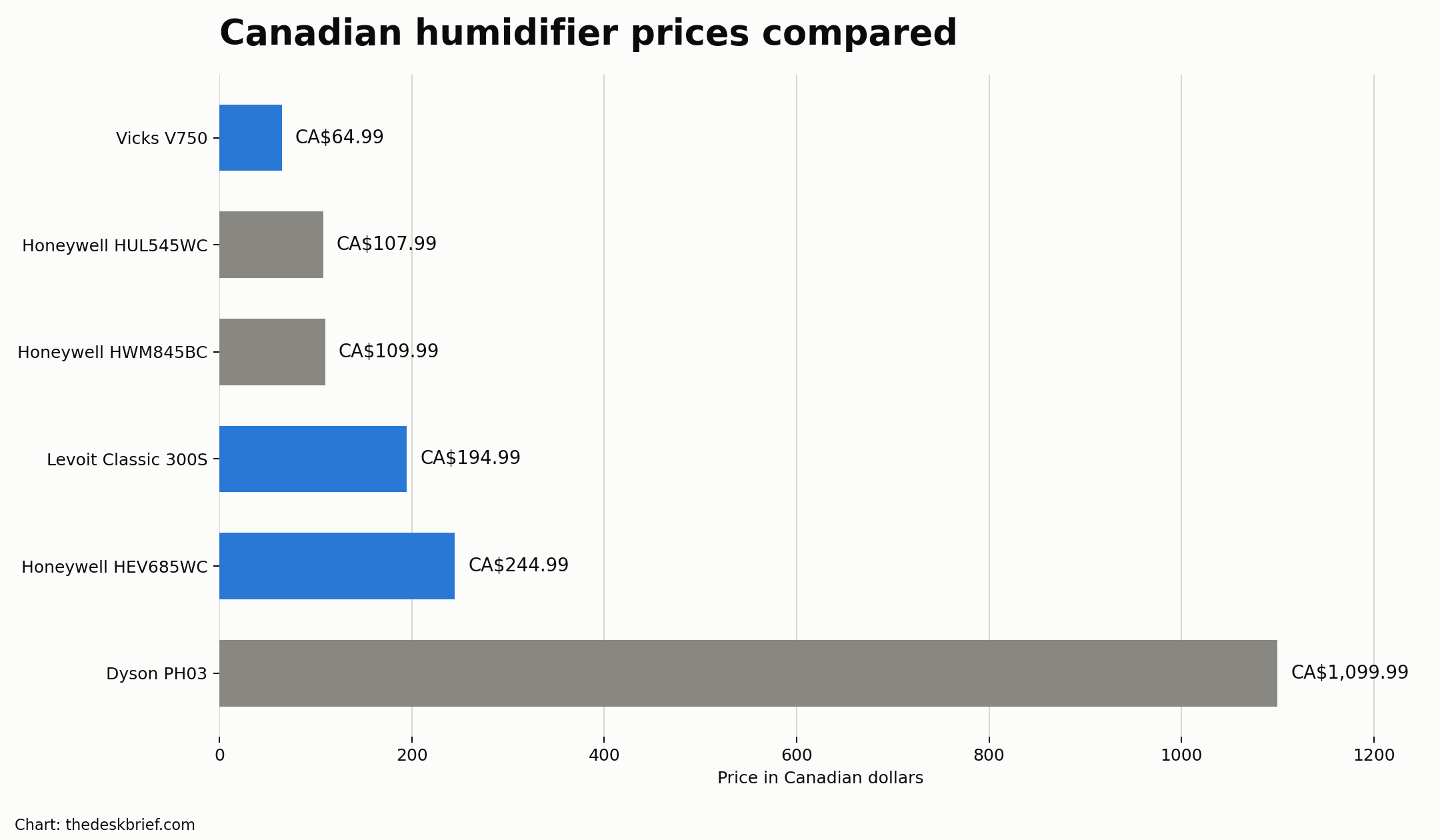
| Dyson PH03 | CA$1,099.99 (US$914.99) | Evaporative humidifier and purifier | Whole-room projection | 5 L | App, sensors, fan and HEPA filtration | One premium air-quality appliance | Not listed |
Room ratings are manufacturer claims, not guarantees. A closed 400-square-foot bedroom is much easier to humidify than a 400-square-foot living room connected to a hall, kitchen, and stairwell. Drafty windows, ceiling height, ventilation, and outdoor temperature all change the result.
My top picks
Top pickBest overall: Levoit Classic 300S
The Classic 300S sits in the useful middle. Its 6 L tank is generous without making the machine awkward, top filling is painless, and its ultrasonic system stays around 30 dB on low. The VeSync app adds schedules, target humidity, and remote control. Those are not novelty features in winter. Setting a target around 40 percent is much better than discovering condensation on the windows after running a manual dial all night.
The weakness is the same one shared by every ultrasonic model: it atomizes whatever is in the water. Hard tap water can leave white mineral dust on a monitor, desk, or dresser. Distilled water avoids that, but filling a 6 L tank with purchased water gets expensive. If your tap water is hard, the Honeywell HEV685WC is the more practical long-term choice.
Compact pickBest compact option: Honeywell HUL545
The black Honeywell HUL545 is the smaller, simpler alternative for a bedroom where app control does not matter. The current product listing includes an essential-oil tray, automatic shut-off, and a dual-direction mist outlet.
It is still an ultrasonic humidifier, so hard tap water can leave white mineral dust and regular cleaning remains necessary. The Vicks V750 no longer earns the budget recommendation because its available Canadian Amazon listing had climbed well above budget pricing. At that price, skip it.
Best for hard waterBest for hard water and large rooms: Honeywell HEV685WC
The HEV685WC is the machine I would buy for a large living area with hard municipal water. It uses evaporation: a fan pulls air through a wet wick, so most minerals remain in the filter instead of landing as dust. Its two tanks hold roughly 11.4 L in total, and an adjustable humidistat lets it cycle rather than running blindly.
That capacity is useful, but it is not elegant. Two tanks take room at the sink, the fan is audible, and replacement wicks are a recurring cost. Still, evaporation is naturally self-limiting. Output drops as the room approaches a comfortable humidity level, which makes accidental over-humidification less likely. For a serious heating season, that trade feels sensible.
Best premiumPremium pick: Dyson PH03, with a warning
The Dyson PH03 combines an evaporative humidifier, HEPA air purifier, fan, air-quality sensors, automatic control, and app support. It also costs CA$1,099.99 (US$914.99). If you already want premium air purification and would rather maintain one appliance than two, the combination has a defensible logic.
As a humidifier purchase alone, it is poor value. The Honeywell moves moisture into a large space for less than one quarter of the price. Dyson’s cleaning cycle and filtration do not remove maintenance, either. Buy the PH03 because you want the whole air-quality system and its polished controls, not because expensive vapour is somehow better vapour.
Evaporative, ultrasonic, or warm mist?
Evaporative humidifiers
An evaporative machine uses a fan to pull dry air through a wet wick. The air picks up water and returns to the room. The process filters out much of the mineral content and becomes less efficient as humidity rises, both of which are genuine advantages.
The compromise is fan noise and filter cost. A wick that stays wet can also become unpleasant if it is neglected. I like evaporative models for large rooms, long winter use, and homes with hard water. The Honeywell HCM-350 is a popular smaller example, but stock and pricing can be inconsistent. The HEV685WC is easier to recommend when you need substantial output.
Ultrasonic humidifiers
Ultrasonic models vibrate water into a very fine visible mist. They are quiet, efficient, and easy to package in a compact body. Smart features are common, which is why models like the Classic 300S are so good beside a bed or desk.
They require more care than their clean-looking mist suggests. Minerals and anything growing in the tank can be dispersed into the room. Use distilled or demineralized water if you see white dust, empty standing water daily, and clean the base regularly. The Levoit LV600S adds warm and cool mist, a 6 L tank, smart control, and claimed coverage up to 753 square feet. The OasisMist 1000S stretches capacity to 10 L and claims up to 600 square feet. Both are attractive on paper, but their marketplace prices and availability vary enough that I would compare them carefully against the Classic 300S before buying.
Warm-mist humidifiers
A warm-mist unit heats water and releases steam. Boiling reduces many microbes in the water, and there is no fan or wick to replace. The design is simple, quiet, and well suited to one closed room.
The downsides are equally straightforward: a burn risk, higher power consumption, and scale on the heater. Warm mist does not humidify a room more effectively merely because the vapour feels warm. I would use it in an adult bedroom or office, not on the floor of a nursery.
What to actually check before buying
Tank size and useful runtime
Runtime claims usually come from the lowest output setting. A machine advertised for 60 hours may need daily refilling when a furnace is running and the outdoor temperature is well below freezing. For overnight use, 3.8 L is workable. For all-day use, I prefer 6 L or more. A top-fill design matters almost as much as capacity because you will repeat the job for months.
Real room size
Buy for the air volume and layout, not the floor area alone. A closed bedroom gives a small humidifier a fair chance. An open main floor leaks moisture into every connected space. If a unit claims 500 square feet, I would treat that as an optimistic ceiling, especially in an older house. One portable machine rarely humidifies an entire home evenly.
Filter and water costs
Evaporative machines trade distilled-water costs for replacement wicks. Check local filter availability before buying and include several filters in the seasonal budget. An ultrasonic unit has no wick, but hard-water users may spend more on distilled water than expected. A warm-mist unit avoids filters but needs regular descaling.
Noise
Ultrasonic is the safe choice for near-silent operation. Evaporative fans produce steady white noise and become obvious on high. Product decibel numbers are usually measured at a gentle setting, so they do not tell the whole story. If you work on calls, place a fan model across the room rather than beside the microphone. For more practical workspace basics, see the work-from-home laptop setup guide and this ergonomic desk setup checklist.
Cleaning difficulty
A wide tank opening and removable parts beat a clever app. Expect to empty and rinse the unit daily, then clean it more thoroughly every few days according to the manual. Avoid any tank with narrow corners you cannot reach. If cleaning feels annoying in the store, it will feel worse on a dark February morning.
A separate hygrometer
Built-in sensors sit close to the mist and can read higher than the rest of the room. A basic hygrometer placed several feet away gives a better picture. Health Canada generally recommends keeping home humidity around 30 to 50 percent. In very cold weather, you may need to stay nearer the low end to prevent water collecting on cold windows.
Frequently asked questions
What humidity should I use during winter?
Aim for roughly 30 to 50 percent, then adjust for your home. If windows are fogging or condensation appears on frames, lower the target. In deep cold, an older or less insulated home may only tolerate 30 to 35 percent without moisture problems.
Is evaporative or ultrasonic better?
Evaporative is better for hard water and large spaces because it limits mineral dust and resists over-humidifying. Ultrasonic is better when quiet operation, compact size, and smart control matter most. Neither is maintenance-free.
Can I use tap water in an ultrasonic humidifier?
You can, but hard water often creates white dust and scale. If you notice residue, use distilled water or switch to an evaporative model. Never assume a small demineralization cartridge makes cleaning unnecessary.
Will one humidifier handle my whole home?
Usually not. Portable room ratings assume favourable conditions, and walls restrict moisture movement. For a whole house, multiple portable units or a properly installed furnace-mounted humidifier are more realistic.
How often should I clean a humidifier?
Empty and rinse it daily, then follow the manufacturer’s deeper cleaning schedule, commonly every few days. Do not let water sit when the machine is off. Replace an evaporative wick when it becomes hard, discoloured, or stops delivering normal output.
The Short Version
- The Levoit Classic 300S is my best overall pick for a bedroom or office because its 6 L tank, low noise, and humidity controls are genuinely useful.
- Choose the Honeywell HUL545 when compact size and quiet operation matter more than app control.
- Choose the Honeywell HEV685WC for a large room or hard water. It is louder and needs filters, but it avoids ultrasonic mineral dust.
- Buy for your actual layout, use a separate hygrometer, and choose the model you will realistically clean several times a week.