The best heated vest for most men is the ORORO Men’s Heated Puffer Vest, while the ORORO Women’s Diamond Quilted Heated Vest is the strongest women-specific pick. Both put useful heat at the collar, mid-back and pockets, include a 35.4 Wh battery, and are easier to layer than a tool-battery vest.
I didn’t wear-test these vests. I compared current Canadian Creators API records with manufacturer specifications for heat zones, battery capacity, runtime, care and fit, then checked the same models in the US catalogue where possible. Runtime below is the manufacturer’s maximum for each setting, not a promise for a windy day.
This page contains affiliate links. If you buy through these links, we may earn a small commission at no extra cost to you. As an Amazon Associate I earn from qualifying purchases. Full disclosure.
Don’t want to read the whole article? Here are our quick picks.
1Best for men ORORO Men’s Heated Puffer Vest. Balanced zones, familiar battery, easy everyday layering.
2Best for women ORORO Women’s Diamond Quilted Heated Vest. Lighter cut with the same practical heating layout.
3More heat coverage Venustas M2118 Men’s Heated Vest. Six zones cover shoulders as well as core.
4Best for jobsites Milwaukee M12 Heated AXIS Vest Kit. Tool-battery durability with front or rear placement.
As an Amazon Associate I earn from qualifying purchases.
Table of Contents
- Heated vest comparison
- Best for men: ORORO Men’s Heated Puffer Vest
- Best for women: ORORO Women’s Diamond Quilted Heated Vest
- More heat coverage: Venustas M2118 Men’s Heated Vest
- Simple controls: Gobi Heat Dune Men’s Heated Vest
- Best for jobsites: Milwaukee M12 Heated AXIS Vest
- Best for DEWALT owners: DCHV095B Puffer Vest
- Heated vest versus heated jacket
- Battery capacity and USB-C compatibility
- Battery care and flying
- How to choose and size a heated vest
- Who should skip this
- Heated vest FAQ
- The Short Version
Best heated vest comparison
Zone count matters only when the zones sit where you feel cold. Collar and pocket panels make sense for a commute. Chest, shoulder and back panels are more useful when you’re standing at a rink, working outside or waiting beside a trail. The table also separates ordinary rechargeable packs from the larger tool batteries used by Milwaukee and DEWALT.
| Pick | Heat layout | Battery and rated runtime | What is included | Buy |
|---|---|---|---|---|
| ORORO Men’s Heated Puffer Vest | 4 zones, collar, back, pockets | 35.4 Wh, up to 10 hours | Battery and cable, no wall charger | Amazon |
| ORORO Women’s Diamond Quilted Heated Vest | 4 zones, collar, back, pockets | 35.4 Wh, up to 10 hours | Battery and cable, no wall charger | Amazon |
| Venustas M2118 Men’s Heated Vest | 6 zones, collar, shoulders, back, pockets | 36 Wh, 2.5 to 9.5 hours | Battery and carry bag, no wall charger | Amazon |
| Gobi Heat Dune Men’s Heated Vest | 3 zones, chest and back | 5000 mAh, up to 10 hours | Battery and charger | Amazon |
| Milwaukee M12 Heated AXIS Vest Kit M300B-21L | 2 independently controlled zones | M12 pack, 2 to 8 hours | Battery, power source and charger | Amazon |
| DEWALT DCHV095BD1-L Heated Puffer Vest | 3 core zones | 20V MAX tool battery | Battery, adapter and charger | Amazon |
Best for men: ORORO Men’s Heated Puffer Vest
Amazon.ca pricing and availability were refreshed November 05, 2026 at 05:31 PM EST. Product prices and availability are accurate as of the date/time indicated and are subject to change. Any price and availability information displayed on Amazon.ca at the time of purchase will apply to the purchase of this product.
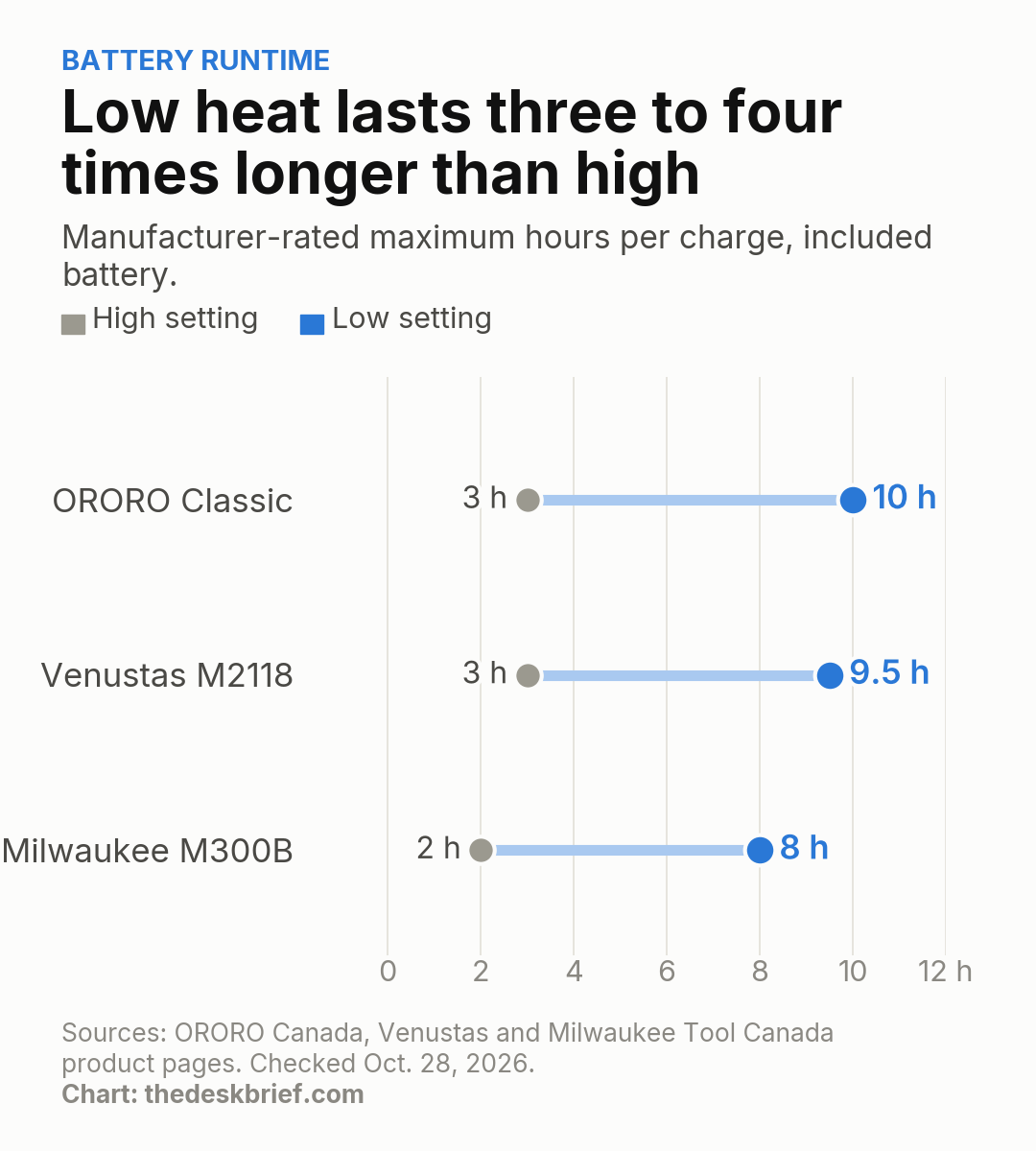
For most men, the best heated vest is the ORORO Men’s Heated Puffer Vest because its design answers the everyday questions cleanly. Four elements heat the collar, middle back and both hand pockets. The included 4800 mAh, 35.4 Wh battery is rated for three hours on high, six on medium and ten on low. USB-C charges the battery, and a USB-A port can charge a phone.
The nylon shell is wind and water resistant, while FELLEX insulation gives it some value when the heat is off. ORORO lists a regular fit and sizes through 5XL on its Canadian Classic Vest page. Measure chest and waist instead of ordering from a T-shirt label, because useful contact between the garment and your core matters.
The downside is that all four zones change together. You can’t turn off the collar while keeping the pockets warm. The package includes a battery and charging cable but no wall adapter, so this is ready to wear only if you already have a suitable USB charger.
Best for women: ORORO Women’s Diamond Quilted Heated Vest
The best heated vest for women is the ORORO Women’s Diamond Quilted Heated Vest. It uses the same four-zone logic and 35.4 Wh battery as the men’s pick, but the garment is cut for women’s sizing. ORORO says the medium vest weighs 13 ounces before the battery, with a regular hip-length fit. That makes it easier to wear under a coat than a bulky unisex work vest.
ORORO rates runtime at three hours on high, six on medium and ten on low. The shell is wind and water resistant, the battery and cable are included, and the battery has USB-C input. Remove the battery, use a mesh bag and wash cold; ORORO says not to machine dry this model.
Its limitation is the same single-button control as the men’s version. Buyers who want separate body and pocket control need a different ORORO line, usually with more zones and a heavier battery. That upgrade is hard to justify for a commute or an unheated home office.
More heat coverage: Venustas M2118 Men’s Heated Vest
The Venustas M2118 Men’s Heated Vest spreads six zones across the collar, shoulders, middle back and pockets. That layout is better for someone who feels the cold across the upper back, not just at the centre of the torso. The 36 Wh battery is nearly the same energy size as ORORO’s pack. Venustas rates it for 2.5 to 3 hours on high, 5 to 6 on medium and 9 to 9.5 on low.
The Creators API confirms a battery and carry bag in the Canadian package, but no wall charger. The manufacturer’s current page lists a regular fit, water-resistant shell, machine washing and sizes through 5XL. Six zones do not create extra energy, so the broader coverage is not free heat. Expect the high setting to empty the pack much sooner than low.
Simple controls: Gobi Heat Dune Men’s Heated Vest
The Gobi Heat Dune Men’s Heated Vest keeps the system simple: two chest zones, one large back zone and three heat levels. Gobi lists a 5000 mAh battery, up to ten hours of runtime, a wind- and water-resistant nylon shell, and a total weight below two pounds with the battery. The Canadian API record says the battery and charger are included.
This is the pick for someone who doesn’t need heated pockets or a collar. Fewer zones can also be easier to understand, but they leave your hands and neck to ordinary insulation. Gobi publishes the ten-hour maximum without a complete per-setting table on the Dune page, so it isn’t plotted in the chart.
Best for jobsites: Milwaukee M12 Heated AXIS Vest
The Milwaukee M12 Heated AXIS Vest Kit M300B-21L makes sense when M12 batteries already live on your workbench. Its two zones cover chest and back, with independent high, medium and low controls. Milwaukee rates the supplied system for two hours on high, four on medium and eight on low.
The useful detail is the pass-through battery pocket. You can wear the M12 pack at the front or rear, which matters when a tool belt, chair back or vehicle seat makes one position uncomfortable. The ripstop polyester shell is wind and water resistant, and Milwaukee says the vest is washer and dryer safe.
For a desk or casual walk, the battery system is bulkier than a flat apparel pack and the two-zone layout is less generous. Don’t buy into a tool platform just to warm a home office. Existing M12 owners are the clear audience.
Best for DEWALT owners: DCHV095B Puffer Vest
The DEWALT DCHV095BD1-L Heated Puffer Vest is another ecosystem choice. DEWALT confirms a vest, 20V MAX battery, charger and adapter in this kit, plus three heat settings and three core zones. Its quilted polyester shell is insulated, water repellent and wind resistant, with waterproof zippers on several storage pockets.
DEWALT’s product page does not publish a per-setting runtime, so there is no honest number to add to the chart. The tool battery is also more noticeable than a compact apparel battery. Its advantage is compatibility for someone already committed to DEWALT packs, not a better commute vest for everyone.
Heated vest versus heated jacket
A heated vest concentrates limited battery power around the core and layers easily under a shell. It leaves your arms free, packs smaller and works better indoors. A heated jacket adds sleeve coverage and more weather protection, but it is bulkier and can spend battery energy on zones you don’t need at a desk.
Choose the vest when your coat already blocks wind or when you move between an unheated garage and the house. Choose a jacket when the heated garment must also be the outer weather layer. For sitting still at home, a heated blanket may cover more of you without carrying a battery.
Battery capacity and USB-C compatibility
Compare watt-hours when the manufacturer publishes them. Milliamp-hours alone can mislead because it describes charge without voltage. ORORO’s 4800 mAh pack at 7.4 V is about 35.4 Wh. Venustas lists 36 Wh for the standard M2118 system. Those nearly equal energy stores also have nearly equal published runtimes.
A USB-C charging port does not prove that a generic USB-C power bank can run the vest. Many apparel packs use USB-C only to recharge the battery, then deliver 7.4 V through a separate DC plug. Milwaukee and DEWALT use their own tool-battery systems. Match voltage, connector, protocol and manufacturer guidance before substituting any pack. The wrong cable can fail to heat the vest or damage the system.
Battery care and flying with a heated vest
Health Canada’s lithium-ion guidance says to use the charger supplied with the product, charge on a hard surface where heat can escape, keep batteries away from soft surfaces, and stop using batteries that are damaged, swollen or overheating. Don’t charge a vest battery unattended overnight. Remove it before washing and reconnect it only after the garment and connector are fully dry.
For flights, Transport Canada says lithium batteries and power banks belong in carry-on baggage, not checked luggage. The FAA gives the same carry-on-only rule for spare packs and sets a 100 Wh limit before airline approval is required. Protect terminals from short circuits and check the airline’s own limits before leaving home.
How to choose and size a heated vest
The best heated vest starts with the intended use, not the highest zone count. A home office needs quiet controls, a compact pack and enough insulation to stay useful when switched off. Winter walking rewards wind resistance and a battery that doesn’t bounce. A jobsite makes tool-battery compatibility and abrasion resistance more valuable.
Then measure chest, waist and hips over the layer you expect to wear underneath. Heating panels work best near the body, but tight armholes and a compressed battery pocket make a vest miserable. A slightly close fit with room for a base layer is better than either a loose shell or a restrictive fashion fit.
If only your hands, feet or desk area are cold, target the problem. The site’s under-desk foot warmer guide, small under-desk heater picks and heated mouse pad comparison cover narrower options that don’t put a battery against your torso. For cold feet away from the desk, the heated socks guide compares rechargeable pairs by heat area and runtime.
Who should skip this
Skip a heated vest if you regularly forget to charge devices, dislike a battery at your waist, or need full arm protection from wind and precipitation. Ordinary insulated layers are simpler. If cold affects only one stationary desk, a foot warmer or blanket can also be easier to manage.
Heated vest FAQ
How long does a heated vest battery last?
Manufacturer maximums for these picks range from eight to ten hours on low for the standard included batteries. High heat can cut that to two or three hours. Cold weather, battery age and the number of active zones can reduce runtime.
Can any USB-C power bank run a heated vest?
No. A USB-C port may charge the included battery without making the vest compatible with a generic power bank. Match the required voltage, output protocol and connector, and follow the garment manufacturer’s compatibility list.
Can you wash a heated vest?
Many current vests are machine washable after the battery is removed, but drying rules vary. Follow the exact care label, protect the connector as directed and do not reconnect power until the garment is completely dry.
Can a heated vest battery go on an airplane?
Spare lithium batteries and power banks must travel in carry-on baggage, with terminals protected from short circuits. Check the battery’s watt-hour rating and your airline’s rules before travel.
The Short Version
The best heated vest isn’t the one with the most zones. The ORORO Men’s Heated Puffer Vest and Women’s Diamond Quilted Heated Vest are the safest general recommendations because their four zones, compact battery and published care instructions fit ordinary winter use. Choose Venustas for broader shoulder coverage, Gobi Heat for a simpler three-zone design, or Milwaukee and DEWALT only when their tool batteries already suit your work.