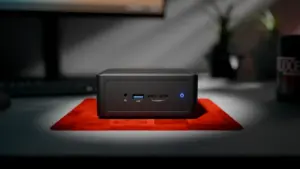
GIGABYTE AI TOP AERO now has exact Australian preorder configurations and prices, but it is not shipping and still has no US or Canadian order path. PLE Computers lists 64GB/2TB, 128GB/2TB and 128GB/4TB models from A$8,899 to A$14,499.
Last updated November 19, 2026: GIGABYTE still directs buyers to local announcements for configurations, prices and availability. PLE Computers now lists three exact Australian configurations, but the product pages label them preorder, show delivery and pickup as out of stock, and do not give a ship date. Newegg US has exact configurations on auto-notify rather than for sale, while exact-model Best Buy US and Canadian searches found no offer. This page will track the first shipped configuration and independent test.
Nobody at The Desk Brief has handled this computer. I compared GIGABYTE’s published specifications with NVIDIA’s platform data and Microsoft’s live Surface Dev Box listing. This is a buying decision built from disclosed facts, not a review dressed in future tense.
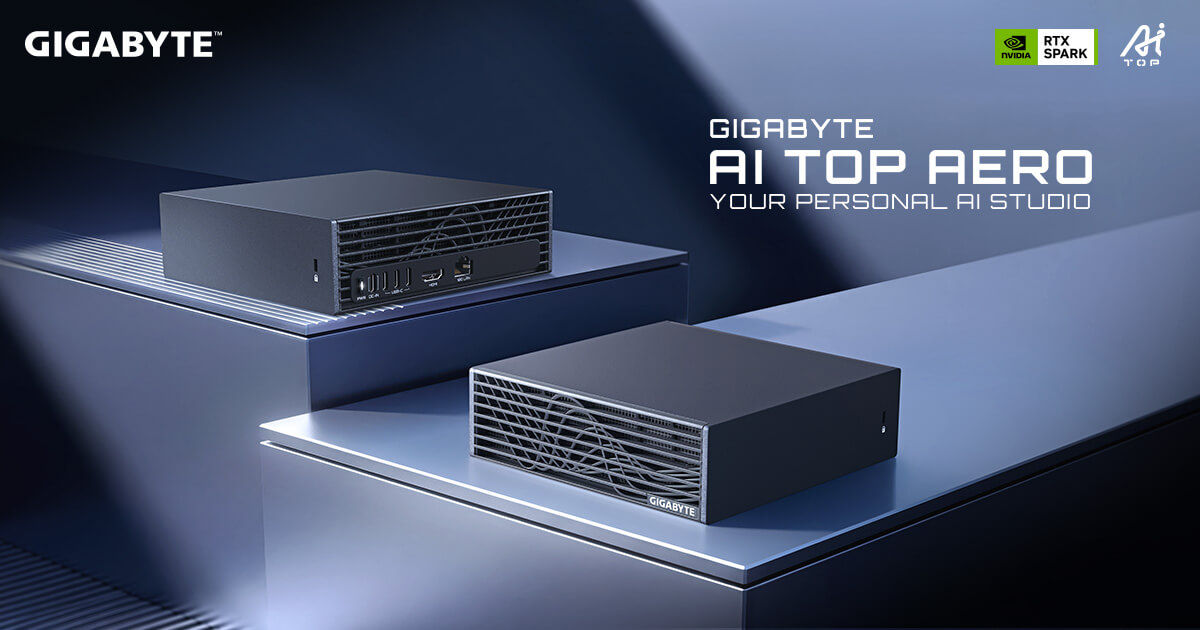
Table of Contents
- GIGABYTE AI TOP AERO Arrives With Seven Useful Facts
- Surface Dev Box Sets an Uncomfortable Reference
- The Memory Pool Has One Expensive Job
- NVIDIA’s Platform Numbers Are Not a GIGABYTE Test
- The Blank Cells Decide More Than the Logo
- A 128GB Buyer and Everyone Else
- Proof I Want Before a Preorder Becomes a Purchase
- GIGABYTE AI TOP AERO FAQ
- The Short Version
GIGABYTE AI TOP AERO Arrives With Seven Useful Facts
GIGABYTE confirms the full RTX Spark N1X configuration: a 20-core NVIDIA Grace CPU, a Blackwell RTX GPU, Windows 11, an LPDDR5X shared pool that tops out at 128GB and up to a 4TB PCIe Gen5 SSD. The case occupies roughly one litre. Its named connections are USB Type-C, 10GbE Ethernet and Wi-Fi 7.
Australian retail listings now identify 64GB/2TB, 128GB/2TB and 128GB/4TB tiers, but GIGABYTE still has not published a complete regional product specification. Physical dimensions, USB count, display output list, warranty and power remain missing from the manufacturer launch page. GIGABYTE says its cooling design supports sustained AI and creative work, yet supplies no temperature, clock, noise or duration result. Cooling language is not a cooling test.
The missing port counts are especially odd. A one-litre workstation can become a desk-cable problem when a dock is required for ordinary peripherals. The live RTX Spark mini PC comparison shows how ASUS and MSI publish enough I/O detail to plan a setup. GIGABYTE has given us a category name instead of a rear-panel diagram.
Surface Dev Box Sets an Uncomfortable Reference
Microsoft’s Surface RTX Spark Dev Box remains on preorder at US$5,999.99. That price is painful, but it buys a defined 128GB configuration, a removable 2TB SSD, a 100 W thermal envelope and a developer-focused Windows image. GIGABYTE may undercut it. GIGABYTE may also charge workstation money for the 128GB version. There is no honest way to choose between those outcomes yet.
| Decision point | GIGABYTE AI TOP AERO | Surface RTX Spark Dev Box |
|---|---|---|
| Release state | Australia preorder; no ship date | US preorder |
| Memory | Up to 128GB LPDDR5X | 128GB unified memory |
| Storage | Up to 4TB PCIe Gen5 | Removable 2TB SSD |
| Cooling disclosure | Cooling design claimed; power and noise not announced | 100 W thermal envelope |
| Named networking | 10GbE and Wi-Fi 7 | Ethernet and Wi-Fi; exact rates vary by configuration page |
| Current price | From A$8,899 at an Australian retailer | From US$5,999.99 |
| Named drawback | No complete retail specification | High price and still preorder-only |
The Surface system remains the safer North American reference because Microsoft names the configuration it will sell. My Surface Dev Box analysis explains why its preconfigured tools and business support can justify a premium for a team, while an individual developer should be much harder to impress. The Australian AI TOP AERO prices do not settle US or Canadian value.
The Memory Pool Has One Expensive Job
The strongest reason to wait for the GIGABYTE AI TOP AERO is not that it is small. It is the chance to put a large local model into one shared memory pool while keeping NVIDIA’s CUDA software stack. A conventional graphics card with 16GB or 32GB of dedicated memory can be faster at many jobs, but it cannot load a model that exceeds its available VRAM without offloading or compression.
Unified memory is not the same as 128GB of dedicated VRAM. Windows, the CPU, the GPU, the model weights and the context cache all draw from the same pool. GIGABYTE has not said how much memory the shipping configurations reserve for the system, which 64GB and 128GB tiers will exist, or whether the memory bandwidth changes between them.
That makes workload definition more valuable than the capacity headline. A developer running a 70B model, long context and several agent processes can use the room. Someone running an 8B coding model, office applications and occasional image generation is paying for capacity that will spend much of its life empty.
NVIDIA’s Platform Numbers Are Not a GIGABYTE Test
NVIDIA reports that RTX Spark reached 4.6 times the coding-agent performance, 2.7 times the fine-tuning performance and 1.8 times the code-compilation performance of an Intel Core Ultra X9 388H baseline. NVIDIA identifies the tests as AA-AgentPerf-local with Qwen3.8-27B, Unsloth LoRA with Llama 3.1 8B and Linux kernel compilation through Phoronix Test Suite.
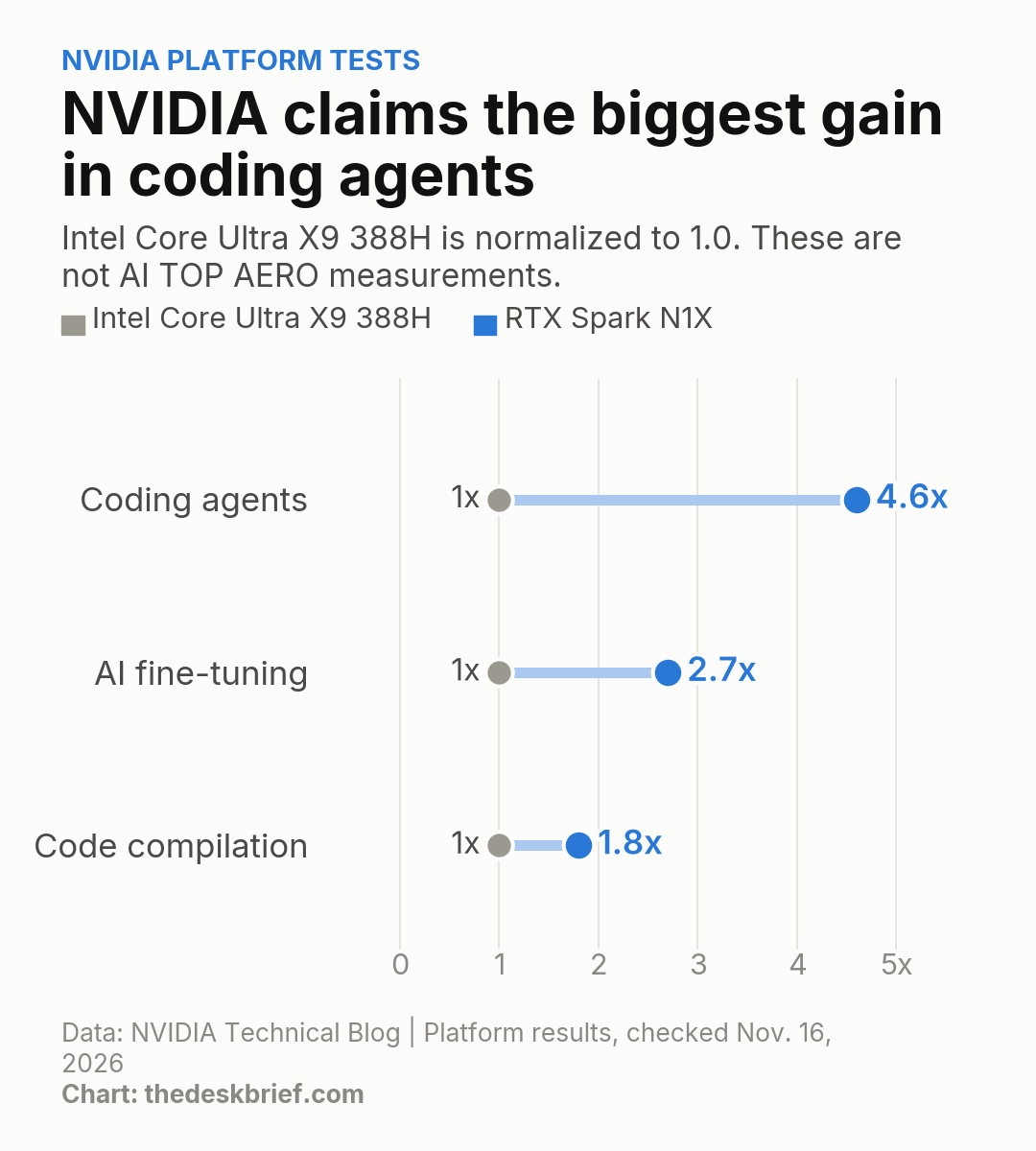
The coding-agent result is the interesting one because it uses a 27B model, a workload that can expose the value of a large memory pool. It is still a manufacturer comparison. It does not reveal AI TOP AERO fan noise, sustained clock speed, tokens per second, storage temperature or performance after an hour in GIGABYTE’s enclosure.
It also does not answer Windows on Arm compatibility for a particular toolchain. NVIDIA says CUDA, PyTorch builds and thousands of Conda packages are available, but a buyer should check every required package, plug-in, driver and peripheral. Emulation can rescue ordinary applications. It cannot invent an Arm driver for specialized hardware.
The Blank Cells Decide More Than the Logo
Before GIGABYTE AI TOP AERO deserves an order, it needs a manufacturer configuration table and an actual delivery date. The Australian listings show that the 128GB and 4TB maximums belong to more expensive tiers, while the entry preorder has 64GB and 2TB. Buyers still need exact display outputs, USB speeds, power supply rating, service access and warranty coverage by region.
Storage access is a large part of the value. ASUS publishes two M.2 slots for its competing ProArt GR1X. GIGABYTE only says “up to 4TB PCIe Gen5 SSD,” which tells us nothing about a second slot or replacement procedure. The earlier ProArt GR1X breakdown is the better starting point for anyone who wants known expansion rather than the largest number in a press release.
Noise and idle power belong on the list too. An always-on agent box spends plenty of time waiting. A quiet 10 W idle can be more useful at a desk than a flashy peak claim, while a small fan that pulses through every background task can make a one-litre case feel much larger. GIGABYTE has published neither measurement.
A 128GB Buyer and Everyone Else
The likely buyer already knows why 128GB and CUDA belong in the same machine. That may be a developer keeping large models local, a studio working with private assets, or a team that runs agents around the clock and wants a box beside the desk instead of another cloud bill. For that buyer, waiting for GIGABYTE’s top configuration is reasonable.
Most people can stop waiting. A gaming desktop offers a clearer upgrade path and established x86 software compatibility. A smaller local model does not need this memory ceiling. Anyone who needs 128GB today should compare a shipping Ryzen AI Max mini PC when CUDA is optional, or use the defined Surface preorder when business support and a ready developer image outweigh price.
Preordering an Australian configuration without a ship date would be backwards for most buyers. Set the workload, minimum usable memory, required software and price ceiling first. If GIGABYTE’s retail model meets all four, the small chassis becomes useful. If it misses one, the logo on the front does not repair the purchase.
Proof I Want Before a Preorder Becomes a Purchase
The next update should be mundane: an Australian ship date plus exact US, Canadian and UK or European configurations, manufacturer prices and warranty terms. After that, independent testing should measure sustained AI performance, memory bandwidth, fan noise, idle power, SSD temperature and Windows on Arm compatibility.
A teardown should answer whether the SSD and wireless card are replaceable, whether a second drive fits, and how much work is required to clean the cooler. Those details decide whether this is a small workstation or an expensive sealed appliance. The press image already looks tidy. Repair access has to earn its own evidence.
GIGABYTE AI TOP AERO FAQ
Can it run a 120B local model?
NVIDIA says the 128GB RTX Spark platform can run coding models up to 120B parameters. Actual fit and speed depend on quantization, context length, memory reserved by Windows and the application. GIGABYTE has not published an exact-system result.
Is AI TOP AERO the same as AI TOP ATOM?
No. AI TOP AERO uses the RTX Spark N1X platform and Windows 11. AI TOP ATOM is GIGABYTE’s DGX Spark line built around NVIDIA’s GB10 platform and DGX OS. The similar names hide different software targets.
Will this be a good gaming PC?
NVIDIA lists DLSS 5, Reflex and ray tracing support for RTX Spark, and GIGABYTE promotes gaming. No independent AI TOP AERO frame-rate, compatibility or latency results exist. A conventional gaming desktop remains the lower-risk purchase.
Should developers wait for it?
Wait when the job needs a large unified memory pool and native CUDA on Windows. The current preorder is limited to Australia and lacks a ship date. Buy a defined alternative when 64GB is enough, x86 compatibility is mandatory, or the project cannot wait for GIGABYTE to establish local stock.
The Short Version
GIGABYTE AI TOP AERO now has three exact Australian preorder configurations, starting at A$8,899 for 64GB and 2TB. None has a ship date, and no US or Canadian order path is open. GIGABYTE still has not published enough detail to show whether its cooler can hold platform performance quietly.
Wait for shipping stock, complete ports, storage access and independent sustained-load results. The Australian price does not establish North American value, and a preorder without a delivery date is not a substitute for a machine that can leave a warehouse.