RTX Spark gaming performance is promising, but no retail laptop has a controlled gaming benchmark yet. RTX Spark laptops have been shipping since October 16. Surface, HP, Lenovo and selected MSI configurations are orderable, while Dell and some ASUS configurations remain on preorder. NVIDIA claims AAA play at 1440p above 100 FPS with ray tracing, DLSS, and Reflex. Until an exact shipping laptop is tested, treat that as a manufacturer claim, not a result.
Is RTX Spark good for gaming? Probably as a second job. If games are the machine’s main purpose, buy a proven laptop with a discrete GeForce GPU. If local AI, video, or 3D work comes first, RTX Spark may provide credible evening gaming alongside its unusually large unified-memory pool.
Updated October 17, 2026: RTX Spark retail shipping began October 16. Official US starting prices now span US$2,599.99 to US$3,799.99. Microsoft lists the Surface Laptop Ultra from US$2,599.99 with 24GB of memory and a 512GB SSD, and the Canadian base price is C$3,899.99. Other manufacturers now publish prices too, while release timing varies by model. See the full manufacturer-sourced price table. No retail chassis has repeatable game results.
By Ryan Billings | Published August 29, 2026. Last updated October 17, 2026. This is specification and compatibility analysis, not a review. Featured image: OpenAI-generated editorial illustration.
Table of Contents
- What RTX Spark Gaming Hardware Actually Is
- Confirmed Games, Launch Claims, and Anti-Cheat Work
- What the Gamescom Hands-On Proved
- Arm, Prism, and the Compatibility Catch
- What We Still Do Not Know
- Who Should Buy It
- Who Should Skip It
- Frequently Asked Questions
- The Short Version
What RTX Spark Gaming Hardware Actually Is
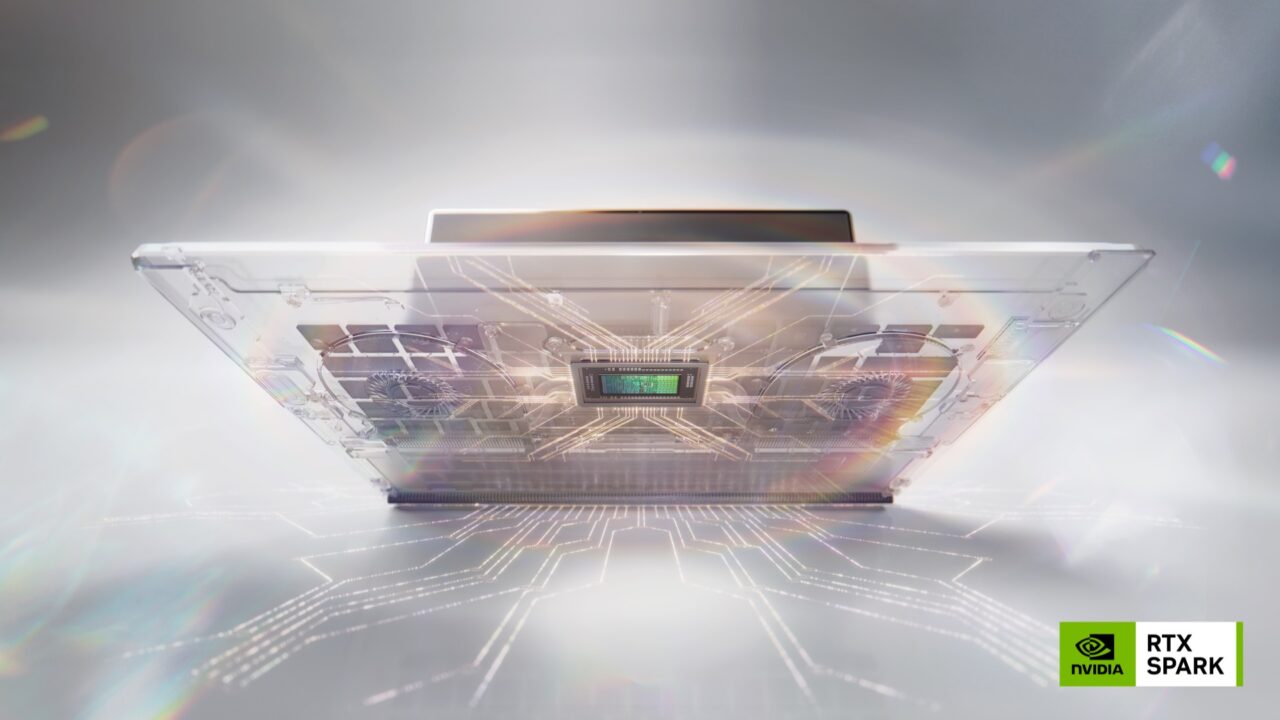
RTX Spark is one system-on-chip, not a conventional laptop CPU sitting beside a replaceable or separately packaged gaming GPU. NVIDIA connects a 20-core Grace Arm CPU to a Blackwell RTX GPU with 6,144 CUDA cores. The same platform can be configured with up to 128GB of unified memory, which the CPU, GPU, Windows, and applications share.
The Blackwell GPU brings the familiar RTX stack, including ray tracing, Reflex, and DLSS. NVIDIA’s current material highlights DLSS 4.5, while DLSS 4 introduced Multi Frame Generation and transformer models. That technology can make a demanding game look and feel much faster, but generated frames are not a substitute for a published native-rendering result. Input latency and base frame rate still matter.
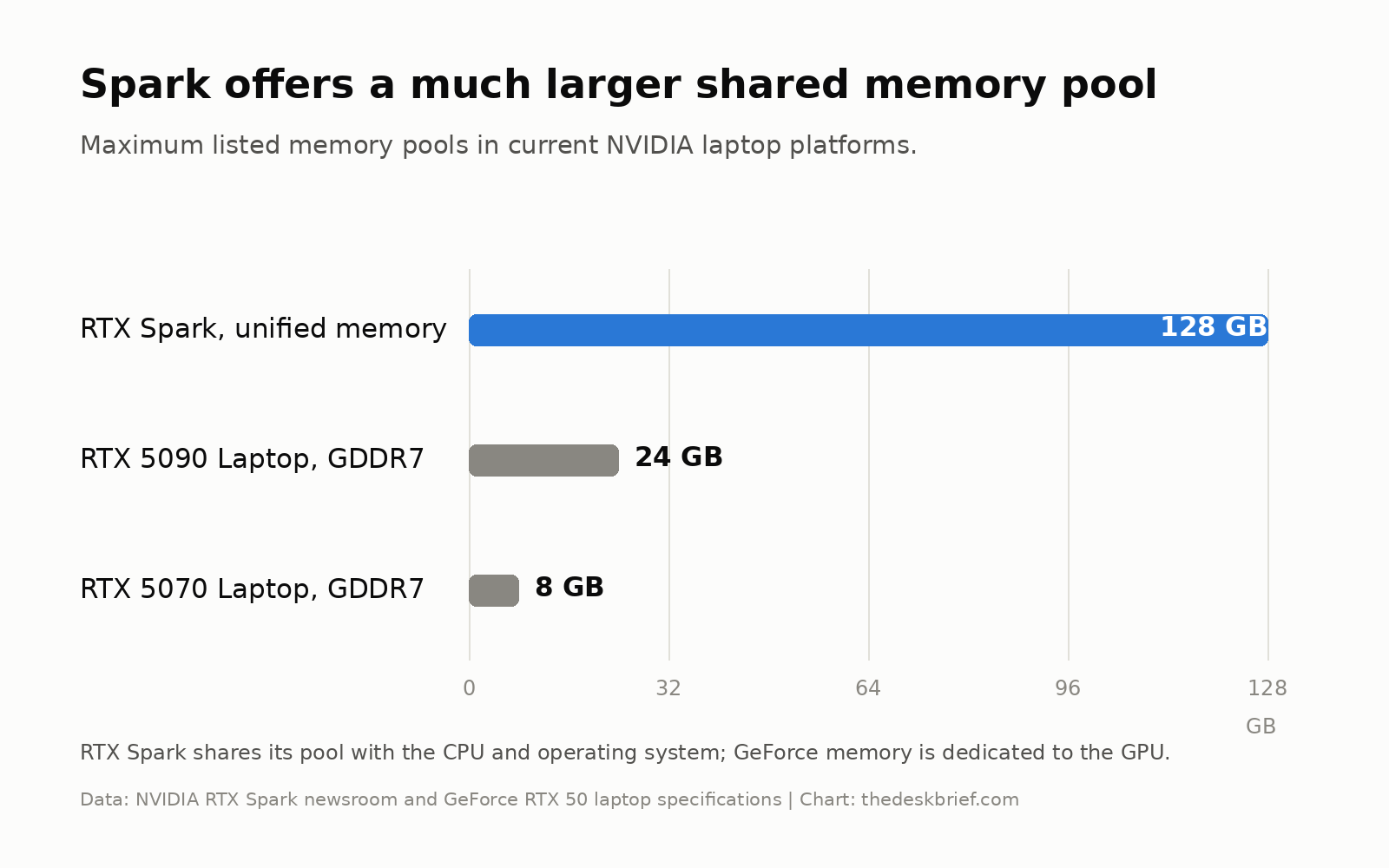
Unified memory is the feature that separates Spark from an ordinary gaming laptop. NVIDIA lists 24GB of dedicated GDDR7 on an RTX 5090 Laptop GPU and 8GB on an RTX 5070 Laptop GPU. Spark’s maximum 128GB pool is dramatically larger, but it is shared and capacity alone does not predict game performance. The pool is compelling when a creator needs a huge 3D scene or local model. A game needs bandwidth, latency, drivers, power, and cooling as well as enough memory.
For the broader platform and model context, start with the RTX Spark laptop explainer. The RTX Spark versus Apple silicon comparison covers why that large memory pool matters more to some creative and AI workloads than it does to a conventional game library.
Confirmed Games, Launch Claims, and Anti-Cheat Work
NVIDIA’s August 25 Gamescom update names F1 25, Apex Legends, Anno 117: Pax Romana, ARC Raiders, and THE FINALS as titles it is working with publishers to support on RTX Spark devices. That is meaningful progress because the list covers racing, a large strategy game, and multiplayer shooters rather than five carefully chosen lightweight indies.
The more important line in NVIDIA’s Gamescom announcement concerns EA Javelin Anticheat. NVIDIA says it is working with EA on native Javelin support for Spark, including F1 25. A Windows game can render perfectly under translation and still refuse to start when its kernel-level anti-cheat does not support Arm. The port therefore removes a hard blocker, not merely a few percentage points of performance.
At Microsoft’s October 7 event, Microsoft says hundreds of AAA titles will be great on RTX Spark at launch and announced that Call of Duty will come to RTX Spark in 2027. These are Microsoft claims, not compatibility tests.
Microsoft also showed Gears of War, released October 6, running at 60 frames a second on a Surface Laptop Ultra while a GitHub Copilot workload and DaVinci Resolve mastering ran at the same time. Settings and resolution were not given.
What the Gamescom Hands-On Proved
PC Gamer’s Gamescom report is encouraging and properly limited. Its writer played Doom: The Dark Ages on a Dell XPS 16 Creator Edition and praised the OLED display, keyboard, and low apparent noise during that short session. Other demonstrations included ARC Raiders, F1 25, 007 First Light, and Borderlands 4.
The report does not provide benchmarked FPS. The writer could not inspect the settings or determine the exact DLSS and frame-generation combination, and NVIDIA kept measured frame rates private. A smooth booth demo proves that selected builds can run selected games. It does not tell me how a retail laptop behaves after 30 minutes, whether one manufacturer’s cooling is better, or how much performance Prism costs.
Tom’s Guide later tried six models and reported that the demonstrations looked significantly above 60 FPS at medium-to-high settings with DLSS enabled. It also said four emulated games, including 007 First Light, looked clear with no discernible latency. The limits matter: there was no visible FPS counter, no disclosed native base frame rate, and no controlled settings, thermal, noise, or battery test. This is stronger independent hands-on evidence than a stage video, but it is still not a benchmark suite.
Arm, Prism, and the RTX Spark Gaming Catch
Spark’s Grace CPU uses Arm instructions, while most Windows PC games were compiled for x86-64 processors. Microsoft’s Prism emulator translates those applications. Microsoft says Prism is tuned for RTX Spark, supports 32-bit and 64-bit x86 applications, and includes AVX and AVX2 compatibility work.
Translation is no longer an automatic deal-breaker, but a game library is not one workload. Launchers, mods, peripheral utilities, copy protection, and anti-cheat can each create their own failure. Easy Anti-Cheat and BattlEye support are useful foundations, while Javelin’s port shows why native anti-cheat work still has to happen vendor by vendor. For competitive players, compatibility is a pass-or-fail gate before frame rate enters the conversation.
What We Still Do Not Know
- Independent FPS: no retail Spark laptop has a controlled, repeatable gaming benchmark suite yet.
- Settings and DLSS modes: the Gamescom demonstrations did not expose the combinations used.
- Thermals and sustained clocks: a quiet booth session is not a thermal test.
- Battery gaming: no sourced test shows unplugged performance or runtime under a game load.
- Model variation: thin designs can assign very different cooling and power budgets to the same silicon.
NVIDIA claims AAA play at 1440p and over 100 FPS with ray tracing, DLSS, and Reflex in its launch specifications. It does not identify a game, quality preset, native base frame rate, power target, or retail chassis for that headline. I am recording it as a manufacturer claim, not turning it into a result.
Who Should Buy It
RTX Spark gaming makes the most sense as a secondary capability. The ideal buyer runs local AI models, edits large video projects, renders complex scenes, or wants one thin Windows machine with a very large GPU-accessible memory pool. That buyer also plays mainstream single-player games and accepts checking compatibility before purchase.
In the UK, verified manufacturer entry prices start at about £2,599 including VAT for the Surface Laptop Ultra. The Lenovo Pro 9n, sold there as the Yoga Pro 9n Gen 11, starts at £2,670, while ASUS lists the ProArt P14 from £2,699.99. See the full RTX Spark laptop guide for the UK and Canadian manufacturer price table.
I would wait for independent testing of the exact laptop, not just the Spark chip. Use the RTX Spark laptop shortlist to compare announced designs, then apply the pricing framework in the RTX Spark price guide. A cheaper memory configuration may be the sensible gaming crossover; paying for 128GB to launch Apex Legends is rather like buying a moving truck for the cup holder.
Who Should Skip It
Skip the first wave if gaming is the machine’s primary job, you play anti-cheat-heavy competitive titles, rely on mods or niche peripherals, or need known performance today. A mature x86 gaming laptop with a discrete GPU offers a broader record of game support, model-specific reviews, driver behaviour, and repair expectations.
Also wait if you cannot tolerate launch uncertainty. Compatibility lists can expand after sale, but that does not help on the night your group chooses the one title that fails. Proven hardware is less novel and much easier to recommend with a straight face.
Frequently Asked Questions
Can RTX Spark run AAA games?
Yes, selected AAA games have run in demonstrations. Microsoft showed Gears of War running at 60 frames a second on Surface Laptop Ultra while GitHub Copilot and DaVinci Resolve mastering also ran, but settings and resolution were not given. NVIDIA also claims 1440p play above 100 FPS with RTX features. There are no independent retail benchmarks with disclosed settings yet.
Does RTX Spark support DLSS 4?
Its Blackwell GPU supports the DLSS feature family, and NVIDIA now promotes DLSS 4.5 on the platform. Actual support and available modes depend on each game.
Will every Windows game work through Prism?
No such guarantee exists. Prism translates many x86 applications, but anti-cheat, launchers, drivers, mods, and peripherals can still need native support or updates.
Is 128GB of unified memory better than discrete VRAM?
It is much larger than typical laptop VRAM and valuable for memory-heavy AI and creator work. It is shared with the rest of the system, however, and does not by itself make games faster.
The Short Version
RTX Spark gaming is real enough to take seriously and too untested to buy as a gaming-first platform. Microsoft showed Gears of War at 60 frames a second on Surface Laptop Ultra while two creative workloads also ran, but settings and resolution were not given. The 6,144-core Blackwell GPU, DLSS support, huge unified-memory option, confirmed games, and native Javelin work are promising. The missing independent FPS, thermals, settings, and broad compatibility evidence matter more. Buy Spark for creator or local-AI work when good gaming is a welcome second job. Buy a proven discrete-GPU laptop when games are the first job.