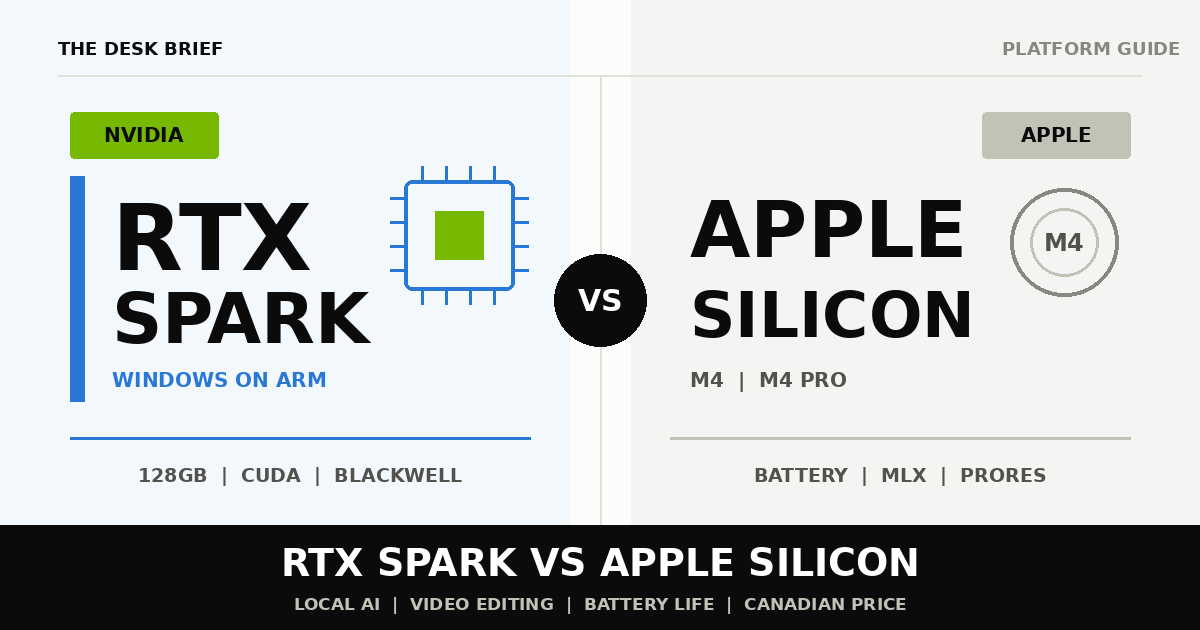
RTX Spark vs Apple Silicon is a choice between buying a proven Apple laptop and choosing among newly shipping Windows systems that promise far more AI memory. Apple wins the low-risk decision today. RTX Spark is the more interesting machine if your work is limited by model size, CUDA support, or Windows-only creative tools.
Last updated: October 17, 2026.
RTX Spark laptops have been shipping since October 16. The catch is production evidence, not launch timing or pricing. Microsoft lists the Surface Laptop Ultra from US$2,599.99 with 24GB of memory and a 512GB SSD, and the Canadian base price is C$3,899.99. Official US starting prices now span US$2,599.99 to US$3,799.99, with manufacturer Canadian prices for five models. Release timing varies by model, and production battery results remain unavailable. See the full RTX Spark price table for every current figure. An M4 MacBook Air or M4 Pro MacBook Pro is boring by comparison, which is useful when the laptop has to earn money on Monday morning.
This is a specification and evidence comparison, not a hands-on test. I checked NVIDIA and Apple specifications, Canadian retail listings, and independent measurements on August 21, 2026. The one public RTX Spark prototype result belongs in the evidence pile, not on a victory banner.
Table of Contents
- RTX Spark vs Apple Silicon: The Decision in One Table
- Unified Memory Is Not the Same Thing
- Local AI and LLM Inference
- Video Editing and Creative Work
- Battery Life and Daily Work
- Canadian Price and What to Buy
- Who Should Skip This
- Frequently Asked Questions
- The Short Version
RTX Spark vs Apple Silicon: The Decision in One Table
The short answer to RTX Spark vs Apple Silicon depends on whether 32GB or 48GB is enough. If it is, Apple gives you a known computer with mature software and independently measured endurance. If it isn’t, RTX Spark’s advertised 128GB ceiling changes what can fit in memory, although it doesn’t guarantee that every workload will run faster.
| Platform | Unified memory | CPU and GPU | AI and creative stack | Canadian price checked | Main catch |
|---|---|---|---|---|---|
| RTX Spark laptop | Up to 128GB | Up to 20-core Grace CPU, 6,144-core Blackwell RTX GPU | Native CUDA, TensorRT, OptiX, NVENC and RTX tools | From C$3,499 for ASUS ProArt P14; Surface Laptop Ultra C$3,899.99 | Release dates vary by model; no retail battery tests |
| M4 MacBook Air | 16GB base, up to 32GB | 10-core CPU, 8-core or 10-core GPU | MLX, Metal, Core AI and dedicated ProRes media engine | CA$1,199.99 for 16GB and 256GB at Best Buy | Fanless sustained-load limits, two Thunderbolt ports, small base SSD |
| M4 Pro MacBook Pro 14 | 24GB base, up to 48GB | 12-core or 14-core CPU, 16-core or 20-core GPU | MLX, Metal, Core AI, ProRes engine and Thunderbolt 5 | CA$2,299.99 for 24GB and 512GB at Best Buy | Memory and storage can’t be upgraded |
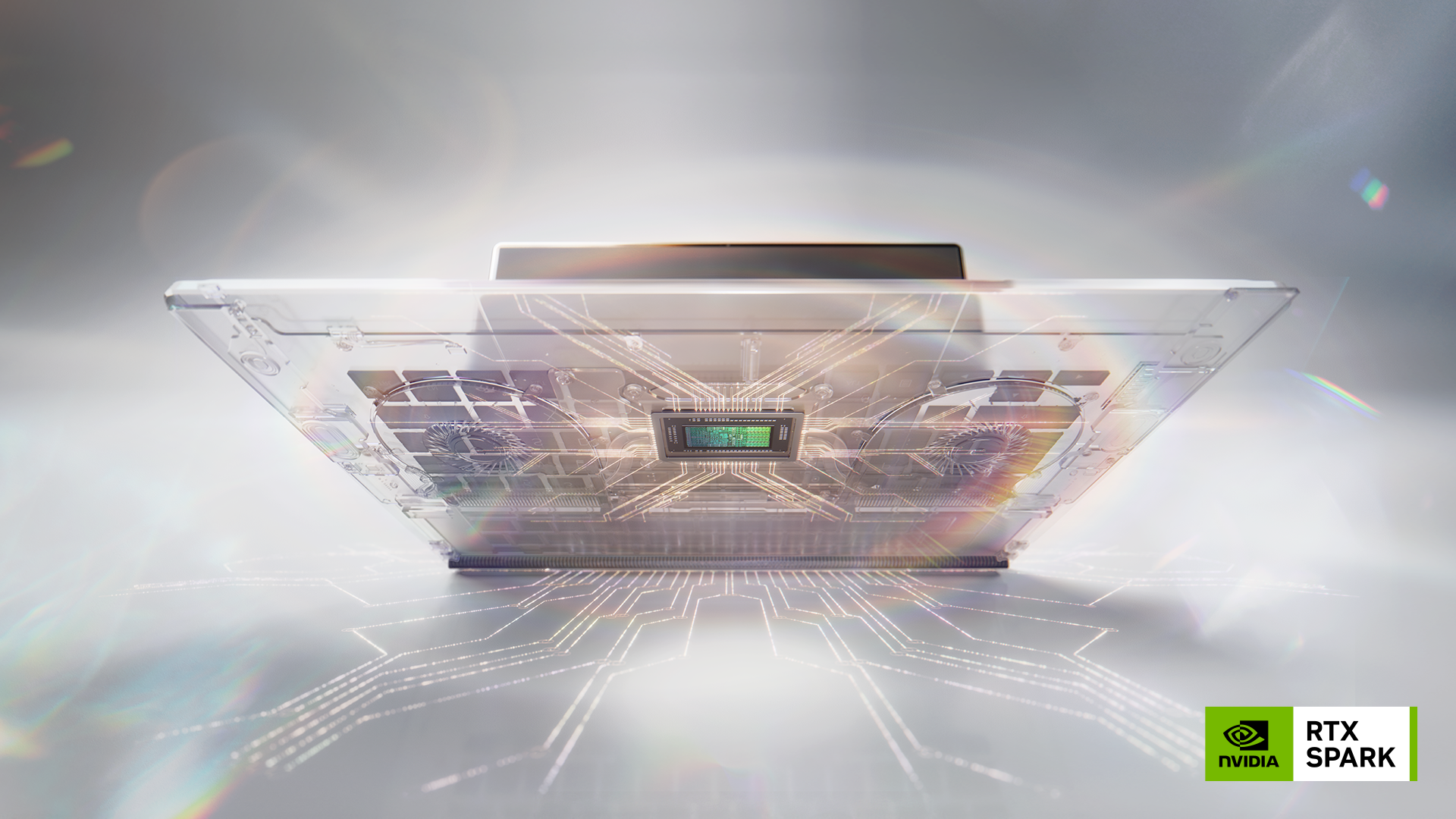
NVIDIA’s RTX Spark platform page confirms up to 20 CPU cores, 6,144 Blackwell GPU cores, one petaflop of FP4 AI performance, and 128GB of unified memory. Those are maximum platform claims, not a promise that every laptop in the confirmed RTX Spark lineup will carry the full configuration.
Unified Memory Is Not the Same Thing
This is where RTX Spark vs Apple Silicon gets more useful than a normal VRAM comparison. Both platforms let the CPU and GPU work from one memory pool. A large model does not have to fit inside a separate 8GB laptop GPU while the system keeps another 32GB sitting on the CPU side.
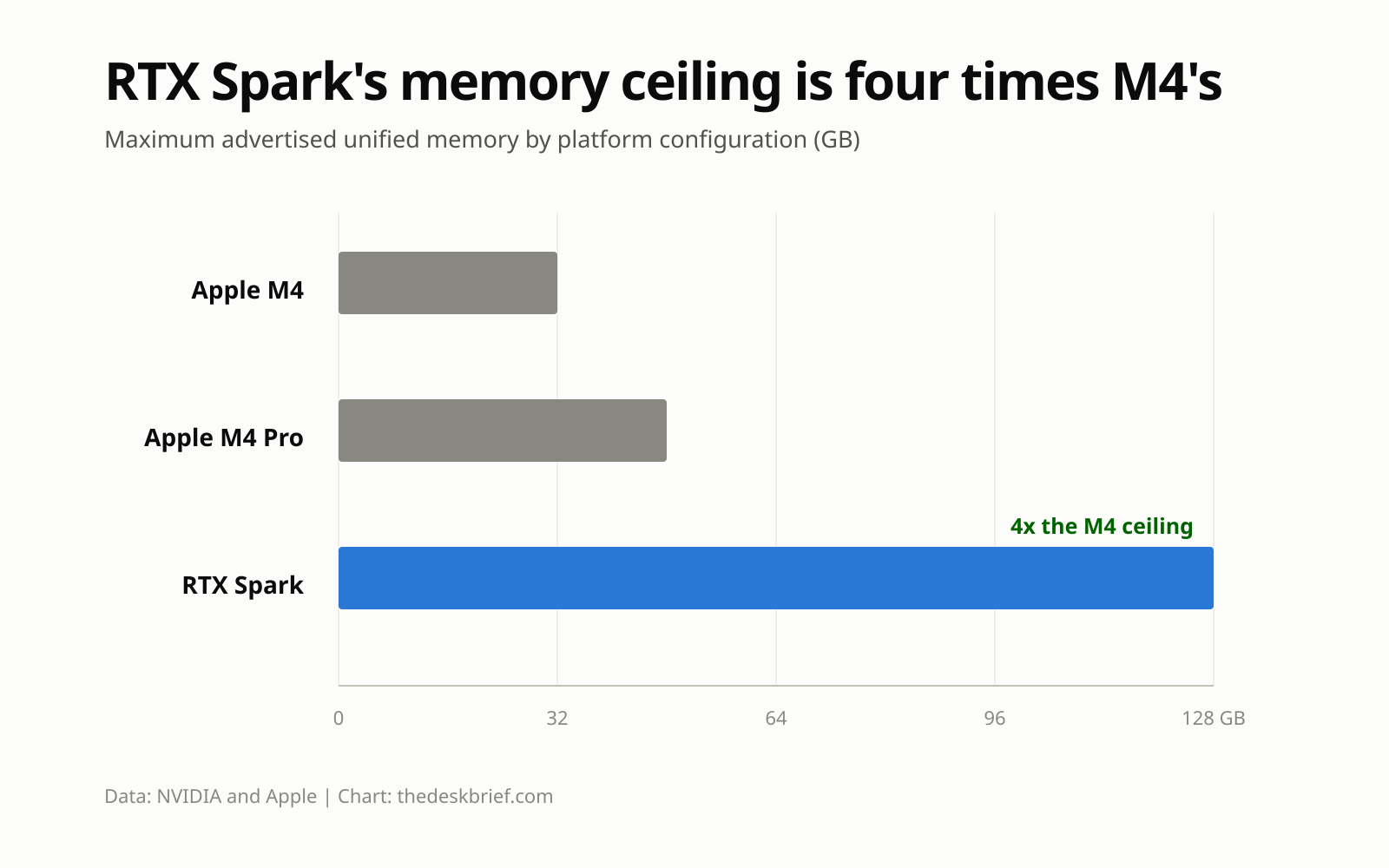
The numbers still aren’t interchangeable. Apple lists 120GB/s of memory bandwidth for M4 and 273GB/s for M4 Pro. Its M4 Air tops out at 32GB, while Apple’s M4 Pro specifications stop at 48GB. RTX Spark reaches 128GB, but NVIDIA has not published a laptop memory-bandwidth figure on its product page. Capacity is confirmed. The speed of that capacity in final retail laptops is not.
Don’t size a laptop by the model file alone. macOS or Windows, the inference runtime, context cache, and your other applications all need room. My RAM guide for local AI explains why a model that technically fits can still leave a miserable working margin.
Local AI and LLM Inference
For local AI, RTX Spark vs Apple Silicon splits into ecosystem and capacity. NVIDIA gives developers native CUDA plus TensorRT and a Blackwell GPU. That matters when the project, extension, or research code already expects CUDA. You spend less time hunting for a Metal-compatible substitute and more time running the thing you opened the laptop to run.
Apple is not starting from zero. Apple’s MLX framework was built for Apple silicon and lets CPU and GPU operations use shared memory without copying arrays between separate pools. Tools such as Ollama and LM Studio also make smaller local models approachable. For a practical shortlist, see my local coding model guide.
The 128GB ceiling is RTX Spark’s decisive advantage over M4 and M4 Pro. It can hold workloads that simply don’t fit in 32GB or 48GB. That is not the same as proving better tokens per second. Prompt processing, generation speed, quantization support, memory bandwidth, thermals, and software maturity can all change the result.
Microsoft says that, across the models it tested, Surface Laptop Ultra delivered faster time-to-first-token performance for language models and shorter image-generation time than M5 Pro-powered laptops. NVIDIA’s preliminary testing, shown on Microsoft’s event slide, claims Windows on RTX Spark devices delivered up to 2.1x faster time to first token, up to 4.3x faster image generation, and up to 6.2x faster video generation than MacBook Pro M5 Pro. These are vendor claims, not independent results.
Tom’s Hardware reported a Cinebench 2024 multi-core score of 1,386 from a pre-production Surface Laptop Ultra with RTX Spark. The result trailed a 12-core M4 Pro, and the prototype showed driver, display, and idle-power problems. The outlet also saw driver updates reduce some performance. That is useful warning data, not a retail verdict. Read the prototype report before treating leaked benchmark charts as settled.
Video Editing and Creative Work
For video work, RTX Spark vs Apple Silicon is less dramatic. M4 and M4 Pro include hardware engines for H.264, HEVC, ProRes, ProRes RAW, and AV1 decode. The Mac has years of native Final Cut Pro and DaVinci Resolve support behind it. M4 Pro also has 273GB/s memory bandwidth and active cooling in the 14-inch MacBook Pro.
RTX Spark brings NVIDIA’s video engine, OptiX, and the broader RTX application stack to a Windows on Arm machine. NVIDIA says more than 1,000 accelerated apps and games are supported, but the phrase doesn’t tell you whether your exact plug-in, capture device, font manager, or corporate utility is native. Windows on Arm translation can rescue some software. It doesn’t turn compatibility into a detail.
If you edit for clients today, buy around the application and codec you actually use. My budget video-editing laptop guide explains why the M4 Air is a strong portable pick but a weak storage value. RTX Spark should wait for retail Premiere Pro, Resolve, export, and plug-in testing.
Battery Life and Daily Work
Battery evidence makes the current RTX Spark vs Apple Silicon decision easy. NVIDIA says RTX Spark laptops offer all-day battery life but supplies no hour figure on the platform page. Apple rates the M4 Air for up to 15 hours of wireless web use and the 14-inch M4 Pro for up to 14 hours.
Independent results give Apple’s claims some shape. RTINGS measured nearly 12 hours of video playback from the 13-inch M4 Air. Notebookcheck measured 15 hours and 47 minutes of Wi-Fi use at 150 cd/m² from its 14-inch M4 Pro test unit. Different methods prevent a direct contest, but both are retail laptops with repeatable results. RTX Spark has no equivalent evidence yet.
The ordinary desk details matter too. The M4 Air is silent because it has no fan, but sustained rendering can throttle. The M4 Pro MacBook has active cooling, three Thunderbolt 5 ports, HDMI, and an SDXC slot. RTX Spark will span several laptop designs, so ports, display quality, noise, and battery size must be judged model by model.
Canadian Price and What to Buy
Canadian pricing now makes the comparison concrete. Best Buy listed the 16GB and 256GB M4 MacBook Air at CA$1,199.99 and the 24GB and 512GB M4 Pro MacBook Pro at CA$2,299.99 when checked. Both were sold out online, so treat those as observed prices, not stock promises. The least expensive manufacturer-priced RTX Spark model in Canada is the ASUS ProArt P14 at C$3,499. Microsoft lists the Surface Laptop Ultra at C$3,899.99 with 24GB of memory and a 512GB SSD. The full RTX Spark price table covers the other official US and Canadian starting prices without converting currencies.
My recommendation: buy the M4 MacBook Air at Best Buy Canada for office work, travel, light editing, and smaller local models. Step up to the M4 Pro MacBook Pro at Best Buy Canada for sustained creative work, better ports, and 24GB or 48GB memory configurations. Retailer links are marked sponsored.
Wait for RTX Spark if CUDA is mandatory or your model needs more than 48GB. The right time to buy is after the exact configuration you want has a firm ship date, a production BIOS, stable drivers, and independent battery and application tests. If you are comparing it with a conventional GeForce system, the live Canadian GPU price tracker gives you the cost of the upgradeable route.
Who Should Skip This
Skip RTX Spark if you need a proven laptop immediately, depend on unverified Windows peripherals, or mostly run email, browser tabs, and Microsoft 365. Paying workstation money for 128GB of memory you won’t fill is expensive optimism.
Skip the M4 Air if you render for hours, need more than two Thunderbolt ports, or know that 32GB will be tight. Skip M4 Pro if 48GB is already below your working set. In that case, an M4 Max MacBook Pro is Apple’s closer 128GB comparison, but it belongs in a different price class from the two machines covered here.
Frequently Asked Questions
Is RTX Spark vs Apple Silicon fair after launch?
It is fair as a specification and buying-timing comparison. It is not fair as a final performance review. RTX Spark’s memory ceiling, CUDA support, and official starting prices are confirmed. US prices run from US$2,599.99 to US$3,799.99, but retail battery life and production performance remain unconfirmed.
Does unified memory replace VRAM?
It changes the arrangement. CPU and GPU share one pool instead of dividing system RAM and dedicated VRAM. The operating system and applications still consume part of that pool, so 32GB unified memory is not 32GB reserved exclusively for a model.
Is RTX Spark faster than M4 Pro?
There is not enough production evidence to say. A reported RTX Spark prototype scored 1,386 in Cinebench 2024 multi-core and trailed a 12-core M4 Pro, but it had unfinished drivers and power-management problems. Final AI results may favour RTX Spark in CUDA and FP4 workloads without making it faster at every CPU task.
Should I wait for an RTX Spark laptop in Canada?
Consider RTX Spark if you specifically need CUDA or more than 48GB of unified memory. Shipping began October 16, and Surface, HP, Lenovo and selected MSI configurations are orderable, while Dell and some ASUS configurations remain on preorder. Canadian prices are official for five models, but do not postpone paid work without an exact configuration and independent retail testing.
The Short Version
Apple is the safer buy. M4 Air handles ordinary desk work and light creation cheaply, while M4 Pro adds sustained performance, better ports, and up to 48GB of memory. Both have real prices and independent battery data.
RTX Spark is now the shipping Windows option to consider for local AI. Its 128GB ceiling and native CUDA stack can unlock work that M4 and M4 Pro cannot hold in memory. Canadian pricing now starts at C$3,499, but wait for retail testing before spending. A promise is not a benchmark, even when the promise has 6,144 CUDA cores.