The reason so many people are asking should I buy a laptop now or wait in 2026 is not the usual pre-holiday deal-hunting. It is a memory shortage that has quietly added double-digit percentages to the price of nearly every laptop on sale, and it is the single biggest thing standing between you and a good purchase this year.
Prices checked and links verified September 2026.
This page contains affiliate links. If you buy through these links, we may earn a small commission at no extra cost to you. Full disclosure.
The blunt version, since you came here for a decision and not a chip-market lecture: if you need a laptop for work in the next month or two, buy it and move on. Waiting is unlikely to save you money before 2027. But the same shortage that drove prices up is finally starting to cool, so the answer to should I buy a laptop now or wait genuinely flips to “wait” for a smaller group of readers. This piece sorts out which group you are in, using the numbers that actually drive the decision instead of the headlines that skip them.

Table of Contents
- Should I Buy a Laptop Now or Wait? The Honest Answer
- Why Laptop Prices Are Climbing in 2026
- The Spike Is Cooling, Which Changes the Math
- What This Means for Your Next Laptop
- Who Should Skip This
- FAQ
- The Short Version
Should I Buy a Laptop Now or Wait? The Honest Answer
In August 2026, buy a laptop now if you need one, because a memory shortage tied to AI demand has pushed DRAM and NAND prices up 15 to 20 percent with no relief coming this year. Wait only if your current laptop still works, since new memory supply is not expected until 2027.
Start with the part that decides it for most readers. Memory, meaning the RAM and the SSD storage, is one of the few laptop components whose price moves fast, and right now it is moving up hard. TrendForce, the memory-market research firm, reported that conventional DRAM contract prices rose 58 to 63 percent in the second quarter of 2026 alone, with NAND flash, the chips inside SSDs, up 70 to 75 percent in the same window. Laptop makers cannot quietly eat increases that size, so they pass them on to you.
That is why the practical answer to should I buy a laptop now or wait leans toward “now” for anyone with a real need. No discount event on the 2026 calendar is big enough to undo a cost increase of that scale, and the shortage is structural rather than seasonal. New memory fabrication plants from the major suppliers are not expected to reach volume until 2027, so the pressure does not ease on its own before then. Waiting a few weeks does not out-wait a multi-year supply problem.
Why Laptop Prices Are Climbing in 2026
The cause is not laptops. It is artificial intelligence. Data-center operators are buying memory in enormous volumes to feed AI servers, and chip makers have shifted production toward the high-margin parts those customers want. That leaves less conventional DRAM and NAND for the PCs, laptops, and phones the rest of us buy, and basic supply and demand does the rest. The chips in your next laptop are competing for factory space against the chips in a hyperscaler’s AI cluster, and the hyperscaler is winning.
The companies that make your laptop have said so plainly. As reported by PCWorld in January 2026, Lenovo, Dell, HP, Acer, and Asus warned customers of 15 to 20 percent price increases, with one Asus memo cited as high as 10 to 30 percent depending on the model. Market-research firm IDC expects average PC prices to rise by up to 8 percent across 2026, and noted that some vendors have started selling pre-built desktops with no RAM installed so the sticker price looks lower. Memory has gone from a rounding error on the bill of materials to a line item nobody can hide.
This is the same force behind the rest of the site’s price coverage. If you are shopping components rather than a whole machine, the RAM prices buy-or-wait breakdown and the SSD price increase guide cover those parts directly, and the GPU prices guide handles graphics cards for anyone building a desktop instead.
The Spike Is Cooling, Which Changes the Math
Here is the nuance the “prices are up, buy now” headlines miss: the rate of increase is slowing sharply. TrendForce’s July 2026 forecast has conventional DRAM rising 13 to 18 percent in the third quarter and NAND 10 to 15 percent, well below the brutal second-quarter jumps. The firm’s own explanation is direct: shoppers in consumer markets like PCs and phones are reaching their affordability limit, so sellers cannot push prices as hard as they did in the spring.
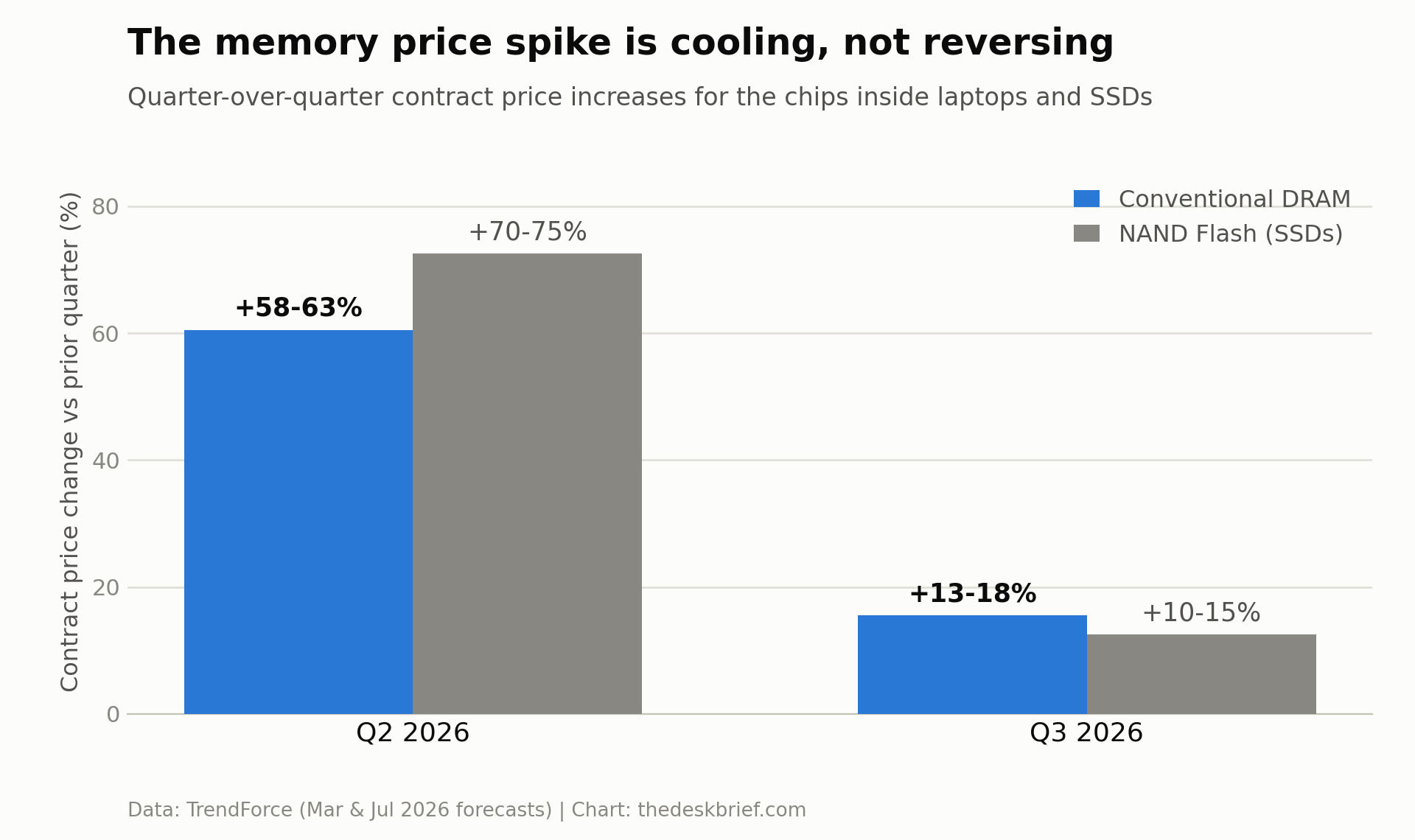
That does not mean prices fall. It means the climb flattens. A laptop is not going to get cheaper in the next few months, but it is also not going to lurch another 60 percent higher the way the raw chips did in spring. If you have been paralyzed waiting for a crash, sit with this plainly: there is no crash coming in 2026, only a slower climb toward a higher plateau. Once the market stops rewarding patience, patience stops being a strategy.
What This Means for Your Next Laptop
Once you have settled should I buy a laptop now or wait, three concrete moves follow from the same shortage that made the question hard.
First, buy the RAM and storage you need up front. Because memory is the expensive part, the tempting play is to grab a cheap 8GB or 16GB machine now and upgrade later. That plan is worse than usual right now, since the aftermarket RAM and SSD you would add have climbed just as much as the parts already inside the laptop. Buy 16GB at a minimum, 32GB if you run heavy applications or local AI tools, and get it configured that way from the factory where you can.
Second, reset your expectations at the bottom of the market. The genuinely cheap laptop is the biggest casualty of this shortage. IDC’s warning about RAM-less pre-builts is the desktop version of the same squeeze, and on laptops the sub-US$500 tier is thinning out while the machines that remain there cut memory to hit the price. If your budget is tight, a well-configured refurbished or last-generation model is often a better use of money than a stripped-down new one at the same sticker.
Third, if you were going to buy this year anyway, stop timing it. Our work-from-home laptop setup guide walks through what actually matters in a work machine, from ports to keyboard to screen, and none of it gets cheaper by refreshing a price tracker for another month.
Who Should Skip This
Not everyone needs to act on any of this. If your current laptop is fine, the correct move is to keep using it. A shortage-inflated market is the worst possible time to replace a working machine out of boredom, and holding for another year costs you nothing while the supply side slowly catches up. Boredom is not a hardware requirement.
You can also ignore the urgency if you buy exclusively at the high end. Premium and mobile workstation laptops carry margins fat enough that a memory increase is a smaller share of the total, so the percentage hit is real but less painful, and those models rarely sell at a discount worth waiting for anyway. The readers who genuinely need to move are the ones shopping the mainstream and budget tiers, where memory is a big slice of the price.
FAQ
How do I decide if I should buy a laptop now or wait?
Answer one question: do you have a real need in the next couple of months? If yes, buy now, because prices are not falling this year. If your machine still works and you can hold out until 2027, waiting is defensible, since new memory supply is expected to arrive around then.
Will laptop prices drop later in 2026?
Almost certainly not. TrendForce still forecasts double-digit quarter-over-quarter increases for memory through the third quarter of 2026, just smaller ones than the spring. The trajectory is a slower climb, not a decline, so a laptop bought later this year is unlikely to be cheaper than one bought today.
Should I buy extra RAM now and install it later?
Only if a specific machine forces the choice. Aftermarket RAM and SSDs have risen as much as the parts inside laptops, so buying the memory separately saves little and adds hassle. Configure it correctly at purchase whenever the option exists, and treat soldered-memory models as a fixed decision you make once.
Is this shortage going to end soon?
Not quickly. Analysts describe it as structural, driven by AI data-center demand, with new fabrication capacity not reaching volume until 2027 at the earliest. Plan around a tight, expensive memory market for the rest of this year rather than a fast recovery.
The Short Version
The question of should I buy a laptop now or wait has a clear default in 2026: if you need one, buy it, because a memory shortage tied to AI demand has pushed prices up 15 to 20 percent and nothing reverses that this year. The one solid reason to wait is a current laptop that still works, in which case sit tight until 2027 when new supply is due. Either way, buy the RAM and storage you need at the point of sale, skip the stripped-down budget models, and do not wait for a price crash that is not coming.
Browse current laptops on Amazon (affiliate)