
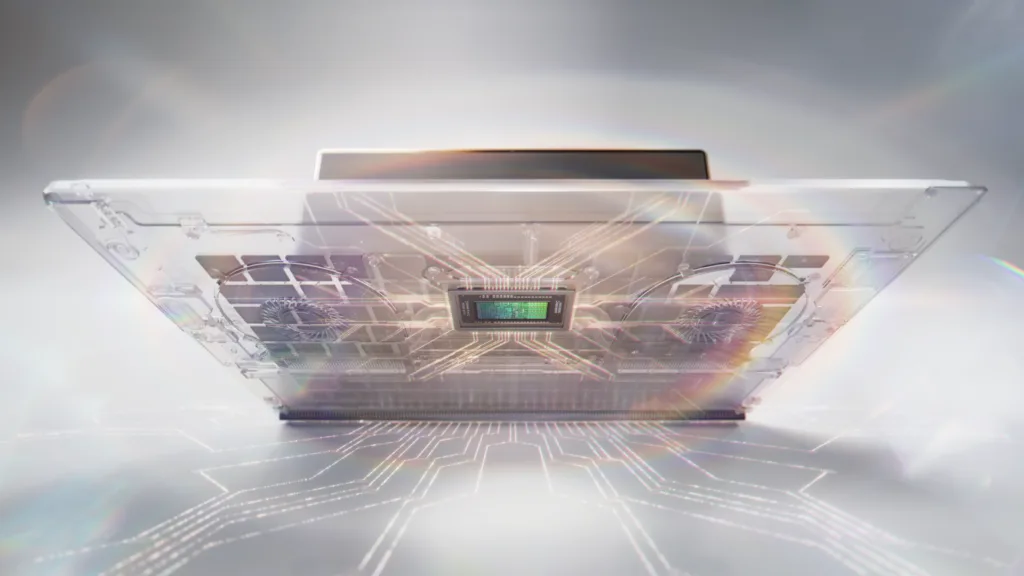
The NVIDIA RTX Spark laptop platform combines up to 6,144 CUDA cores, 128GB of unified memory, and 1 PFLOP of FP4 AI compute in Windows-on-Arm systems. RTX Spark laptops began shipping on October 16. Surface, HP, Lenovo and selected MSI configurations are orderable now, while Dell and some ASUS configurations remain on preorder. That shared memory is available to the GPU for large language and diffusion models, which is the real reason these laptops are different. This is the platform explainer, based on NVIDIA’s specifications and pre-production demonstrations, not the model comparison or a hands-on review. Here is what the architecture means, what Gamescom proved, and which limits still need independent testing.
The decision in one line: wait if you want a general-purpose laptop. Shortlist RTX Spark only if 128GB of unified memory and native CUDA matter more than mature Windows-on-ARM compatibility.
Last updated: October 17, 2026.
Image: Microsoft / NVIDIA
Looking for a specific model? See the full breakdown: Best RTX Spark Laptops 2026: All 9 Models Compared.
Table of Contents
What the NVIDIA RTX Spark Laptop Actually Is
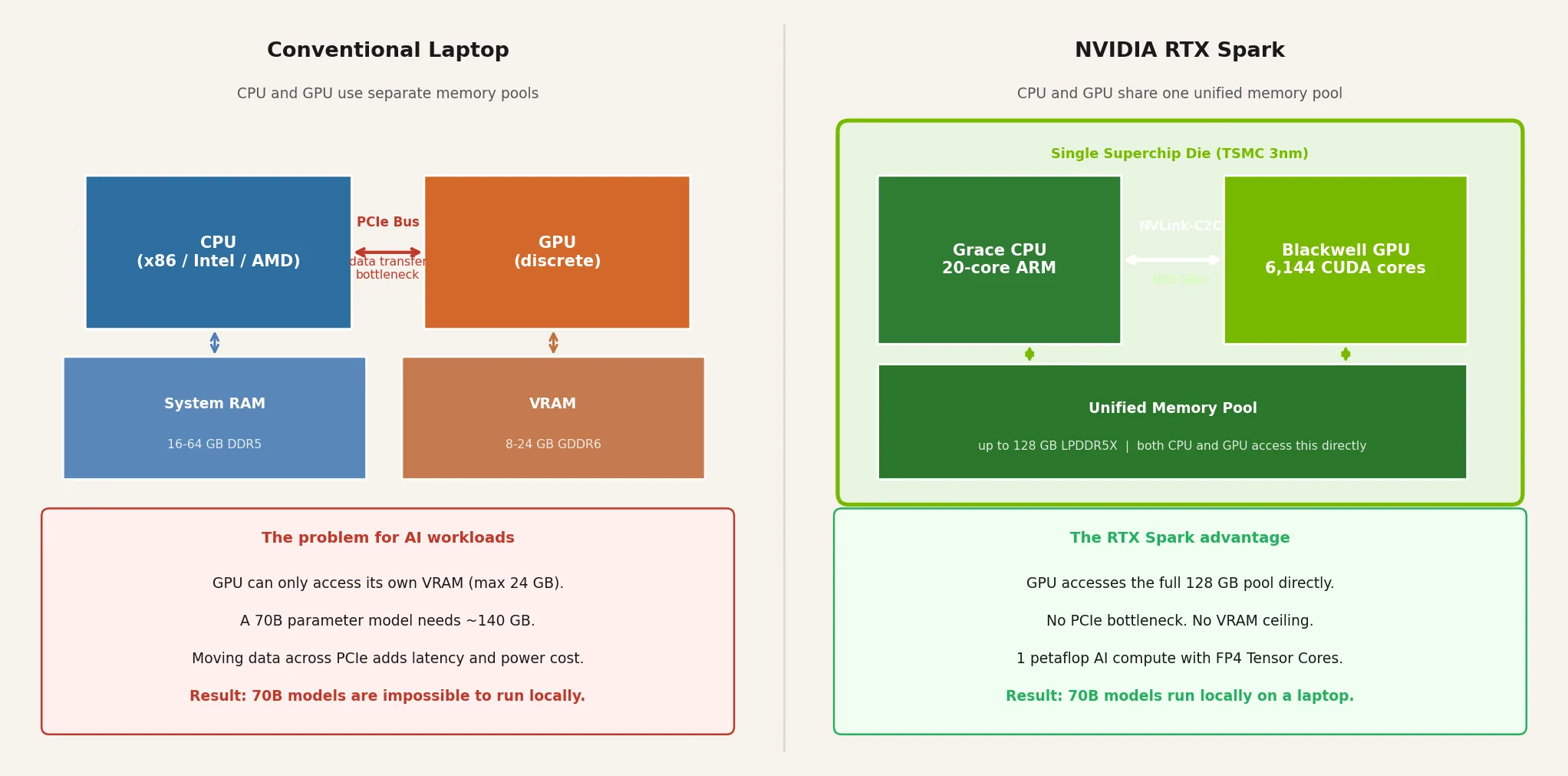
RTX Spark is NVIDIA’s first laptop-class product built on the Grace Blackwell architecture. It combines a 20-core ARM CPU (the same Grace CPU line used in NVIDIA’s data centre chips) with a Blackwell GPU on a single die, connected by NVLink-C2C. The key number is memory: up to 128GB of unified LPDDR5X that both the CPU and GPU can access at full bandwidth, with no PCIe bottleneck between them.
The AI compute figure NVIDIA quotes is 1 petaflop at FP4 precision. That sounds like a press release number until you realize what it means practically: you can run 70B parameter models locally on a laptop. Not slowly. Not with heavy quantization sacrifices. Properly, at useful inference speeds.
The Architecture Difference That Matters
Most laptops have a fundamental problem for AI workloads. The CPU has its own RAM (16–64GB). The GPU has its own VRAM (4–16GB, sometimes 24GB on high-end machines). When a model doesn’t fit in VRAM, you’re constantly moving data across PCIe, which has maybe 64GB/s of bandwidth on a good day.
The NVIDIA RTX Spark laptop eliminates that boundary. The memory pool is unified. NVLink-C2C bandwidth is 900GB/s between the CPU and GPU dies. There’s no separate VRAM limit. A 70B parameter model in Q4 quantization needs roughly 40GB. On a conventional laptop with 16GB VRAM, that model runs at maybe 2–3 tokens per second if it runs at all. On RTX Spark, IntuitionLabs has demonstrated the same model at 30+ tokens per second.
That’s not a marginal improvement. That’s a different category of machine for this specific use case. If you’ve been following local AI agent setups, this is the hardware those setups have been waiting for.
NVIDIA RTX Spark Laptop Specs: Confirmed Maximums
NVIDIA’s current launch specifications confirm maximums rather than two retail price tiers: a 20-core Grace CPU, up to 6,144 Blackwell CUDA cores, up to 128GB of unified memory, and up to 1 PFLOP of FP4 AI compute. Final memory options and power limits vary by manufacturer and are not yet published for every system. Microsoft lists the Surface Laptop Ultra from US$2,599.99 with an 18-core CPU, 5,120-core GPU, 24GB of memory, and a 512GB SSD. The Canadian base price is C$3,899.99. Manufacturers now publish official US starting prices for all nine models; the full RTX Spark price table tracks every manufacturer source, Canadian price, and order status.
NVIDIA publicly names laptop designs from ASUS, Dell, HP, Lenovo, Microsoft Surface, and MSI. Retail availability began October 16. Microsoft, HP and Lenovo currently expose orderable configurations, MSI has selected configurations available to add to cart, and Dell remains on preorder. These are not reference designs, so expect variation in chassis quality, display choices, cooling, memory capacity, and battery size.
How It Compares to Apple Silicon
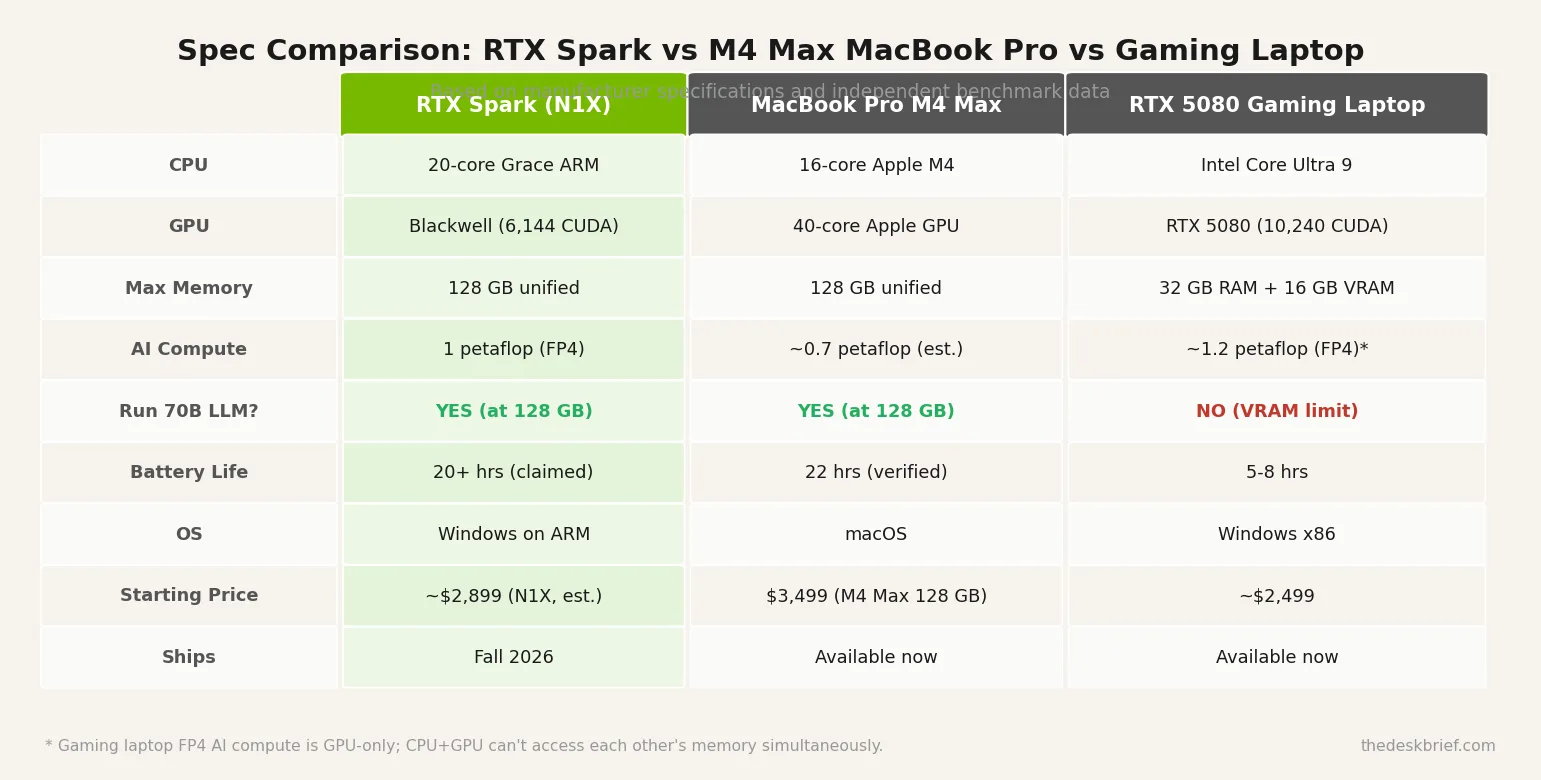
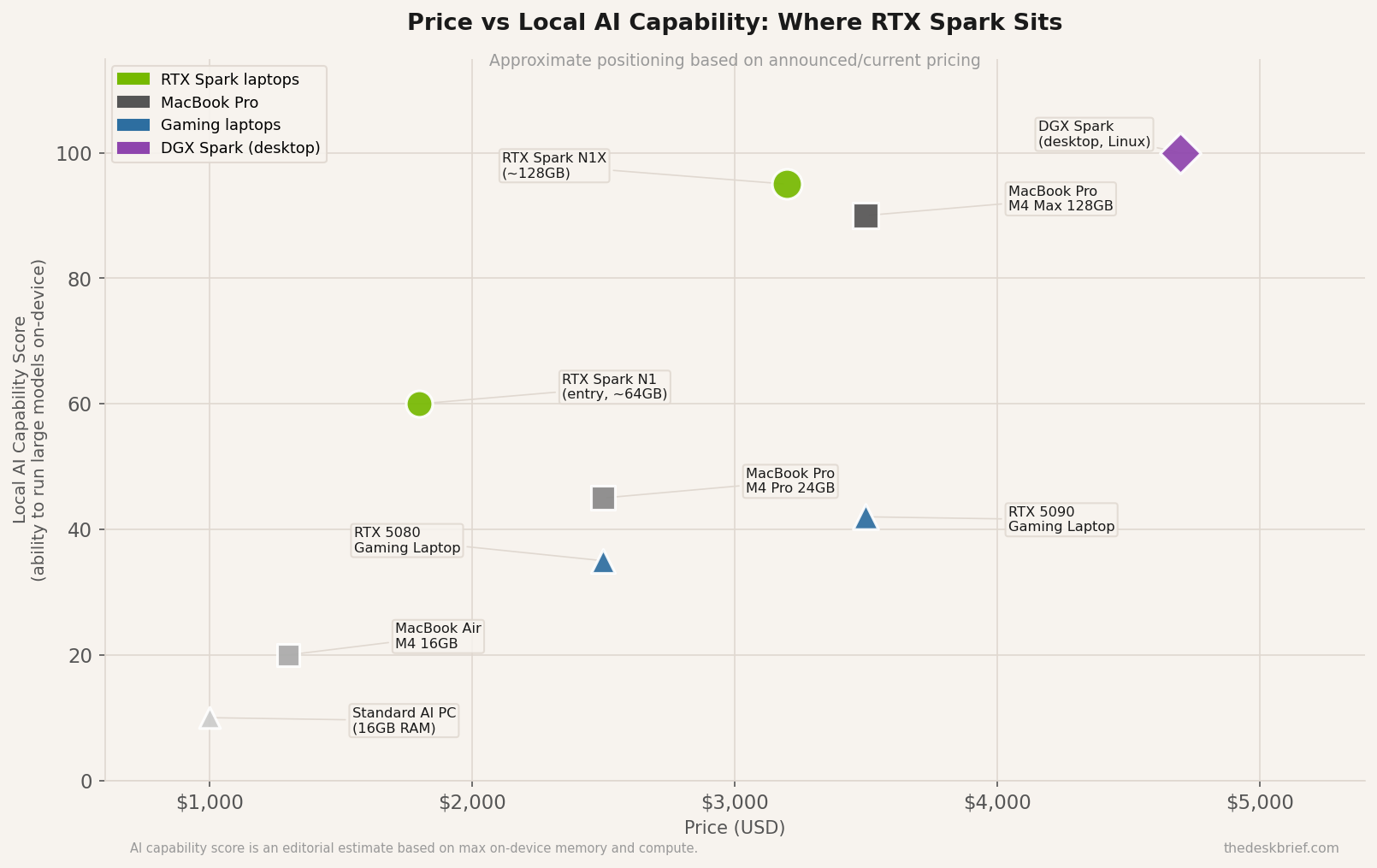
The obvious comparison is the MacBook Pro M4 Max. Apple has been doing unified memory for years, and the M4 Max with 128GB is genuinely excellent for local LLM work. So what does the NVIDIA RTX Spark laptop offer that Apple doesn’t?
GPU compute, primarily. The M4 Max GPU is good, but Blackwell’s 1 petaflop FP4 figure significantly exceeds what Apple Silicon delivers for AI inference workloads. Early benchmarks from IntuitionLabs put RTX Spark roughly 40% faster than the M4 Max at 70B model inference.
The other difference is CUDA. If your workflow involves PyTorch, TensorRT, or any NVIDIA-specific tooling, RTX Spark is native and Apple isn’t. Fine-tuning, training small models, using frameworks built around CUDA: all of that is easier on RTX Spark.
Apple’s advantage: the ecosystem, the OS, battery life that’s actually predictable, and years of software optimization. RTX Spark runs Windows on ARM. That comes with its own compatibility questions, which I’ll get to.
The 128GB Unified Memory Question
The headline is 128GB of unified memory. Let me put that in practical terms for AI workloads, because this is the number that actually changes what’s possible on the NVIDIA RTX Spark laptop.
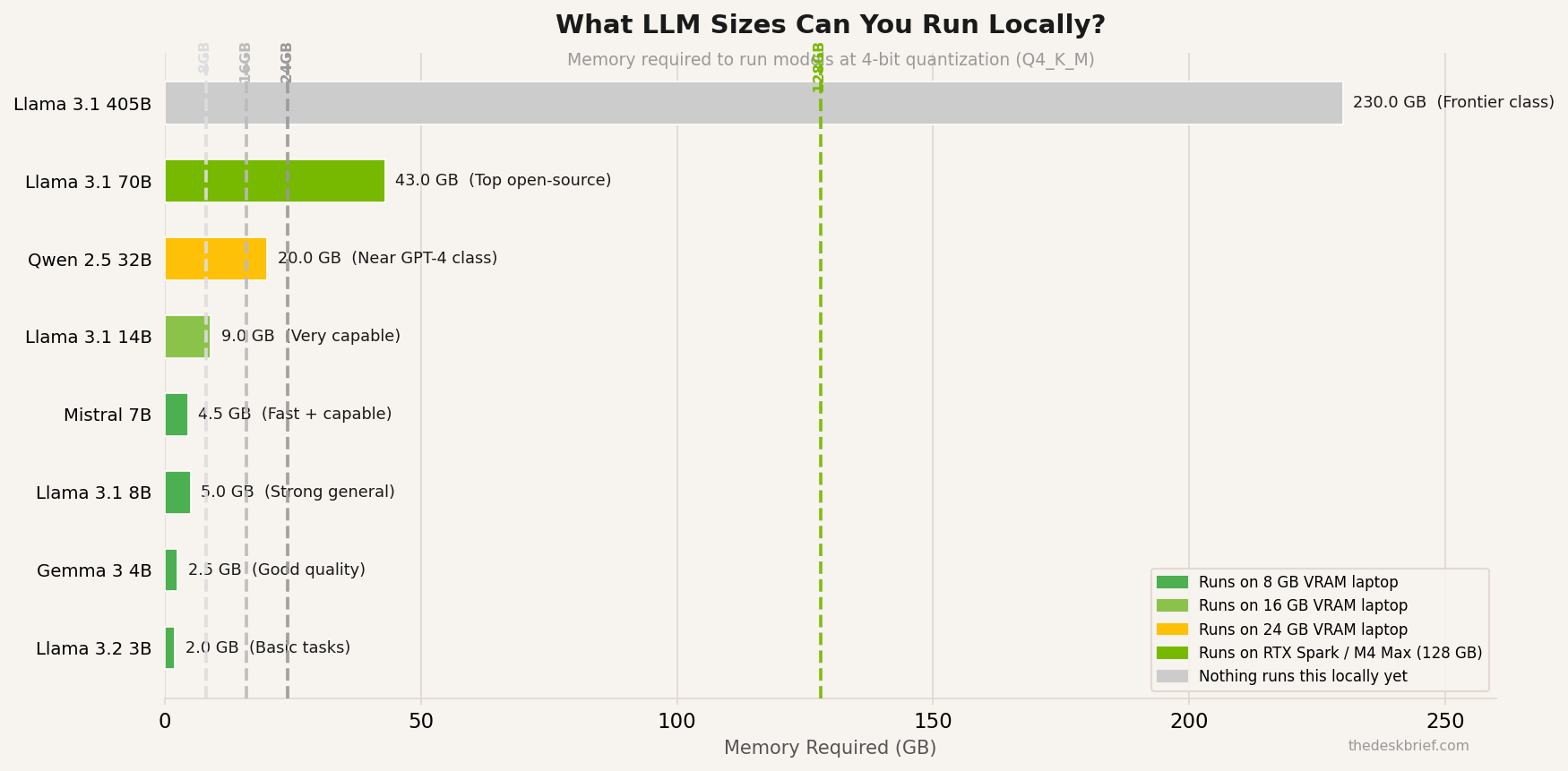
A standard 8GB VRAM laptop runs Llama 3.2 3B or Phi-3 Mini. Decent for simple tasks, not for anything serious. A 24GB card handles Llama 3.1 70B at 4-bit, barely, with speed that makes it frustrating to use. With 128GB unified memory, you can run 70B models properly, and you can fit a 405B model with aggressive quantization. That’s the full spectrum of currently available open-weight models.
For general desk setup work this doesn’t mean much. If you’re already running a smart desk setup and want to add local AI to the mix, 128GB of unified memory is the threshold that makes it serious rather than a hobby.
Limitations I’m Not Going to Pretend Don’t Exist
Windows on ARM
This is the biggest unknown for the NVIDIA RTX Spark laptop. The Grace CPU is an ARM chip. RTX Spark runs Windows on ARM. Microsoft has made significant progress with x86 emulation through Prism, and many mainstream applications run fine. But not everything does. Some developer tools, some older software, some niche utilities won’t run or will run poorly. If your entire workflow is web browsing, Office, and common creative applications, you probably won’t notice. If you have specific software dependencies, you need to check compatibility before buying. The Snapdragon X2 Elite laptop guide covers the same Arm compatibility tradeoff across current consumer systems.
Gaming Support Is Real, Benchmarks Are Not
Gaming is now part of the pitch, but the evidence has a hard limit. NVIDIA’s Gamescom update names F1 25, Apex Legends, Anno 117: Pax Romana, ARC Raiders, and THE FINALS, plus native EA Javelin anti-cheat work. PC Gamer also played selected demonstrations on real Spark laptops. No independent outlet has published controlled retail FPS, thermals, battery drain, or sustained noise results. The RTX Spark gaming evidence guide separates those demonstrations from the benchmarks that still do not exist.
If the sealed memory gives you pause, compare the cost of an upgradeable desktop with the current Canadian GPU price tracker and Canadian RAM price tracker. Both track desktop parts, not laptop pricing, which is exactly the alternative you’re weighing.
Battery Life Is Uncertain
NVIDIA has not published comparable battery-life test conditions for the announced laptops, and short pre-production demonstrations cannot answer the question. Battery capacity, cooling, display choice, and manufacturer power tuning will vary. Wait for instrumented tests of the exact retail model instead of treating an estimate or NVIDIA’s all-day language as measured runtime.
Other AI chatbot competition and reality
If you are not familiar with locally hosted hosted LLMs and rely heavily on Gemini, GPT, Claude, etc, it is very important to realize the quality is not the same. Premium chat models have upwards of a trillion parameters and have taken months to train ($$$) with advanced tools, and feature that simply do not compare to smaller models. Smaller models certainly have their place but you might be disappointed in the response quality and features. However, if your internet goes out your local LLM will be there for you always. I actually keep a few backup LLMs just incase of armageddon as the LLMs poses an insane amount of knowledge for their size.
Launch Status and Model-Specific Availability
RTX Spark laptops began shipping on October 16, but order status still varies by model and configuration. Microsoft currently exposes purchase actions for Surface Laptop Ultra, HP marks both OmniBook base configurations in stock, Lenovo marks Pro 9n and Yoga 9n 2-in-1 in stock, and MSI shows Add to Cart for its 64GB and 128GB models. Dell says its XPS 16 Creator Edition remains on preorder through Best Buy, and selected ASUS configurations still show preorder or out-of-stock states. The Surface Laptop Ultra starts at US$2,599.99 with 24GB of memory and a 512GB SSD, and its Canadian base price is C$3,899.99. See the full manufacturer-sourced RTX Spark price table for every model. ServeTheHome reports that the 128GB DGX Spark rose to US$6,950 and a 64GB version launched at US$4,999. For Microsoft’s Windows desktop sibling, see our Surface RTX Spark Dev Box guide.
Who Should Buy the NVIDIA RTX Spark Laptop
RTX Spark is specifically interesting to a narrow group: people who need to run large language models locally without a cloud subscription, AI developers who want CUDA without a workstation, and researchers who need frontier-class model capability in a portable form factor.
It’s not for most people. If your AI usage is ChatGPT and Copilot, you’re paying for hardware to replicate a service you already have cheaper through a subscription. If you’re a developer working with standard tools on standard datasets, a well-specced M4 MacBook Pro does the job at a lower price and with better software maturity.
The people the NVIDIA RTX Spark laptop makes sense for are the ones who already know they need it: running local models for privacy reasons, doing serious fine-tuning work, building applications against open-weight models, or needing 70B+ inference without a cloud API budget.
The DGX Spark Reference Point
If you want to understand what RTX Spark delivers without waiting for the laptop, the NVIDIA DGX Spark with 128GB memory and a 4TB SSD is shipping now. It uses the same Grace Blackwell architecture in a small desktop form factor and runs Linux. Early reviews confirm the 70B model inference numbers. The hardware delivers what NVIDIA claims.
The DGX Spark isn’t a consumer product in any normal sense, but it’s a useful data point. The architecture works. The question for the NVIDIA RTX Spark laptop is whether the laptop form factor, Windows on ARM, and the price points make sense when you’re buying in October 2026 against whatever Apple and Qualcomm have released by then.
My Take
The NVIDIA RTX Spark laptop is solving a real problem for a specific type of user, and it’s solving it properly. Unified memory at 128GB with NVLink-C2C bandwidth genuinely changes what’s possible for local AI workloads on a laptop. The 1 petaflop FP4 compute figure isn’t marketing fluff, the architecture difference from conventional laptops is real, and the 70B model inference benchmarks are backed by actual hardware testing.
The honest limitations: Windows on ARM compatibility uncertainty, unknown battery life, no production review data, and no firm manufacturer ship date for Dell, MSI, or the Lenovo Yoga 9n 2-in-1. Official prices are now published across the lineup, although some starting configurations and Canadian prices remain unstated.
If local AI capability is your primary purchase criterion, the NVIDIA RTX Spark laptop is the most interesting machine announced in years. If it’s a secondary consideration, you probably already have a machine that’s good enough, and the price premium doesn’t justify itself for occasional LLM use.
Retail units are now available, but independent production battery, thermal and compatibility data remain thin. The specifications are compelling; exact-model reviews still matter before spending workstation money.
Frequently Asked Questions
What is the NVIDIA RTX Spark laptop?
The NVIDIA RTX Spark laptop is NVIDIA’s first machine built on Grace Blackwell architecture, combining a 20-core ARM CPU and Blackwell GPU with up to 128GB of unified LPDDR5X memory. It’s designed primarily for local AI workloads, including running 70B parameter language models without cloud connectivity.
When does the NVIDIA RTX Spark laptop come out?
RTX Spark laptops began shipping on October 16. Surface Laptop Ultra, both HP models, both Lenovo models and selected MSI configurations are currently orderable; Dell and some ASUS configurations remain on preorder. Surface Laptop Ultra starts at US$2,599.99 with 24GB of memory and a 512GB SSD; its Canadian base price is C$3,899.99. The full price table tracks timing and manufacturer-confirmed prices for every model.
How does the NVIDIA RTX Spark laptop compare to MacBook Pro M4 Max?
Both use unified memory architectures that eliminate the GPU VRAM bottleneck. RTX Spark delivers roughly 40% faster inference on 70B models based on IntuitionLabs benchmarks, and it supports CUDA-based tooling natively. The MacBook Pro M4 Max has a more mature software ecosystem, better battery life, and macOS. The NVIDIA RTX Spark laptop runs Windows on ARM, which has compatibility trade-offs.
What LLMs can you run on the NVIDIA RTX Spark laptop?
With 128GB of unified memory, the NVIDIA RTX Spark laptop can run any currently available open-weight model, including Llama 3.1 70B at full precision and Llama 3.1 405B with 4-bit quantization. Inference speed at 70B is reported at 30+ tokens per second, which is usable for real work rather than just technically possible.
Planning a full workstation around it? Start with the ergonomic desk setup checklist so the desk fits you as well as the hardware, and the cable management guide for everything the new machine plugs into.


