Galaxy Watch 9 is the Samsung watch most people should buy. It starts at US$379.99, runs the same new health platform as the US$699.99 Ultra 2, and keeps US$320 in your pocket. The expensive model earns its premium with titanium, a brighter screen, longer battery life, trail navigation and diving tools. If those aren’t part of your week, buying the Ultra 2 is paying for a tougher answer to a problem you don’t have.
This page contains affiliate links. If you buy through these links, we may earn a small commission at no extra cost to you. Full disclosure.
Last updated: September 2, 2026. The watch is now shipping, and this guide now includes independent one-month testing. Galaxy Watch 9 44mm on Amazon
Samsung prices and retailer links were checked September 13, 2026.
Samsung opened U.S. pre-orders on 22 July 2026 and began general availability on August 7. It is now available worldwide. The company’s official closed-up styling is Galaxy Watch9, but this article uses the spaced name people actually search for. Nobody at The Desk Brief has worn the watch, so the features and performance claims here come from Samsung’s Unpacked keynote, U.S. newsroom release and product page.
Galaxy Watch 9 price, sizes and models
The 40mm Bluetooth model starts at US$379.99, while LTE starts at US$429.99. Samsung lists a 40mm case in Graphite or Cream and a 44mm case in Graphite or Silver. Both use an Armor Aluminum case, a 3,000-nit Super AMOLED display, dual-frequency GPS, 2GB of memory and 32GB of storage. Bluetooth and Bluetooth plus LTE variants are listed, alongside Wi-Fi and NFC.
Battery capacity is 390mAh in the 40mm model and 445mAh in the 44mm model, with Samsung claiming up to 30 hours with the always-on display enabled. Tom’s Guide averaged about 32 hours from the 40mm model and measured a roughly 90-minute full charge. Its month-long test found similar sleep data to the Pixel Watch 5 and generally reliable workout tracking, but the Samsung watch was slightly less precise than the Pixel in direct exercise comparisons and struggled to log climbing accurately on a seven-mile hike. That is useful retail evidence, not a promise for the 44mm or LTE models.
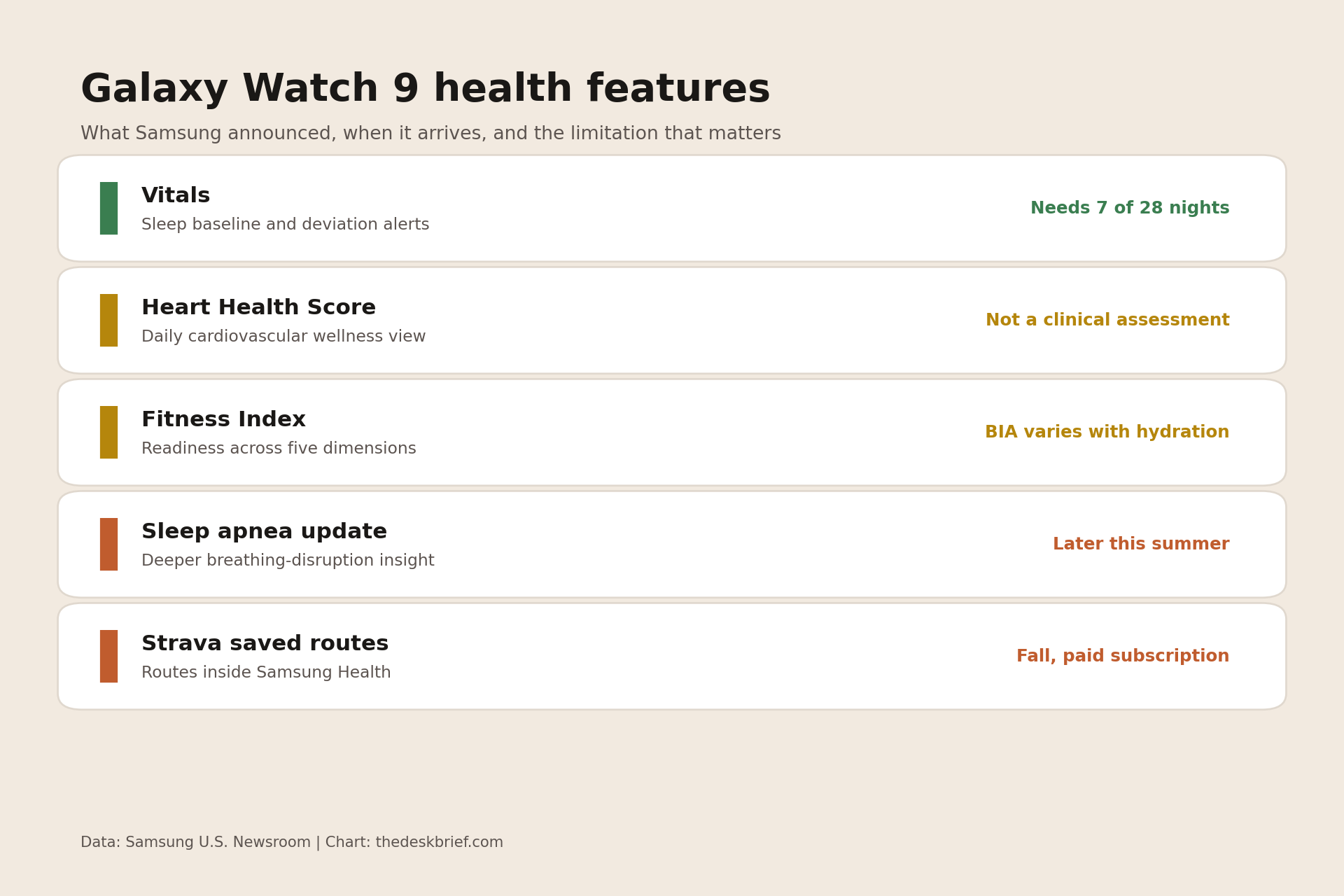
Featured chart: Galaxy Watch 9 wellness signals, timing and limitations. Data: Samsung U.S. Newsroom. Chart: thedeskbrief.com.
Galaxy Watch 9 health features need context
Samsung Health now serves more than 77 million users, and Samsung is pitching this watch as a move from reactive treatment toward “proactive care.” The useful idea is a connected record of sleep, activity and recovery rather than isolated readings. The danger is assuming that five more numbers automatically create better decisions. They don’t.
Vitals tracks five key biometrics while you sleep and learns a personal baseline. Samsung named heart rate and heart-rate variability as two signals it can flag when they move significantly, then offers possible influences and suggestions for the day. The newsroom says setup requires wearing the watch for seven of 28 nights. That makes consistent overnight wear essential, and the first few nights can’t tell you much about your normal pattern.
Heart Health Score combines activity and vascular-load data into a daily cardiovascular view. Samsung says it can show how daily behaviour affects the risk of developing heart disease and suggest steps to reduce that risk. Treat that as Samsung’s marketing claim, not a diagnosis. A consumer wrist sensor estimating risk isn’t the same as a clinician assessing symptoms, history, lab work and validated measurements.
Fitness Index looks at readiness across five dimensions, including endurance and body composition, compares the result with a target, and recommends workout intensity. Body composition on the watch relies on bioelectrical impedance analysis. Its estimates can shift with hydration, recent food, skin contact and placement, so the trend under consistent conditions is more useful than any single reading. These are wellness tools and don’t replace seeing a doctor.
Galaxy Watch 9 sleep apnea claims, carefully stated
Galaxy watches have already looked for possible signs of moderate to severe sleep apnea. Later this summer, Samsung says a new FDA-cleared capability will provide deeper insight into breathing disruption during sleep. The feature assesses risk for people who haven’t previously been diagnosed. Samsung’s own footnote says it isn’t a standalone diagnosis, a replacement for polysomnography or an apnea monitor.
FDA-cleared does not mean FDA-approved. As the FDA explains, 510(k) clearance generally means a device was found substantially equivalent to an existing legally marketed device, while premarket approval uses an independent safety-and-effectiveness standard for high-risk devices. That distinction doesn’t make clearance meaningless. It does put the claim in its proper regulatory box.
Samsung also said the Galaxy Ring will become the first and only FDA-cleared over-the-counter ring device for sleep apnea risk detection this fall. That is another future feature, not something a buyer receives on August 7. If breathing disruptions concern you, take the watch’s notification to a qualified clinician. Don’t use a reassuring score to dismiss symptoms.
Fitness coaching is useful, but subscriptions stack
Running Coach returns with plans spanning a first 5K through a full marathon. After a run, advanced metrics analyse stride and posture to point out technique changes. Fitness Index can then steer a tailored session toward the intensity Samsung thinks matches your readiness. That’s a coherent loop, provided the advice proves specific enough to change what you do.
The content layer is less tidy. Samsung’s iFIT partnership brings level-appropriate workouts, but premium content needs an iFIT subscription after a two-month trial. Starting this fall, Strava subscribers can bring saved routes into Samsung Health and open favourite routes from the watch. The included Strava trial lasts 60 days, so two of the promoted experiences can become recurring bills.
That also makes the launch date slippery. The hardware ships on August 7, while the breathing-disruption upgrade is due later in the summer, Strava routes arrive in the fall, and the Ring’s clearance feature is also a fall promise. You’re buying a roadmap alongside the watch. Samsung may deliver every item, but purchase-day value should be judged on what works on purchase day.
More scores can produce less clarity
Vitals, Heart Health Score and Fitness Index all try to compress noisy personal data into something glanceable. That’s sensible product design until a morning score starts setting the emotional tone for the day. More numbers aren’t the same as more insight, and daily scoring can nudge some people toward anxiety instead of action. A useful score should explain what changed and give you a choice you can actually make.
Baseline-driven features also depend on weeks of fairly consistent wear. Take the watch off every night to charge it and its sleep analysis loses the very data it needs. Wear it overnight and the 30-hour battery claim leaves a narrower charging window during the day. The comfort of the aluminum case and Samsung’s broad mix of soft silicone and fabric bands may matter more than the flashier AI label.
Data portability remains another open practical question. Samsung Health is designed to deepen the Galaxy ecosystem, and moving years of history to a competing platform isn’t the headline feature at Unpacked. That lock-in deserves weight if you change phone brands often. Samsung’s coming AI glasses make the broader strategy clearer: connected devices become more useful precisely when leaving the platform becomes inconvenient.
Galaxy Watch 9 vs Ultra 2: save the US$320
The Galaxy Watch 9 and Ultra 2 share Vitals, Heart Health Score, Fitness Index, sleep apnea detection and the Snapdragon Wear Elite platform. The Ultra 2’s extra US$320 buys titanium, IP69K and 10ATM ratings, a 5,000-nit peak display, an 800mAh battery rated for up to 60 hours, trail guidance and a diving platform. Those are real upgrades. They’re just aimed at a narrower buyer.
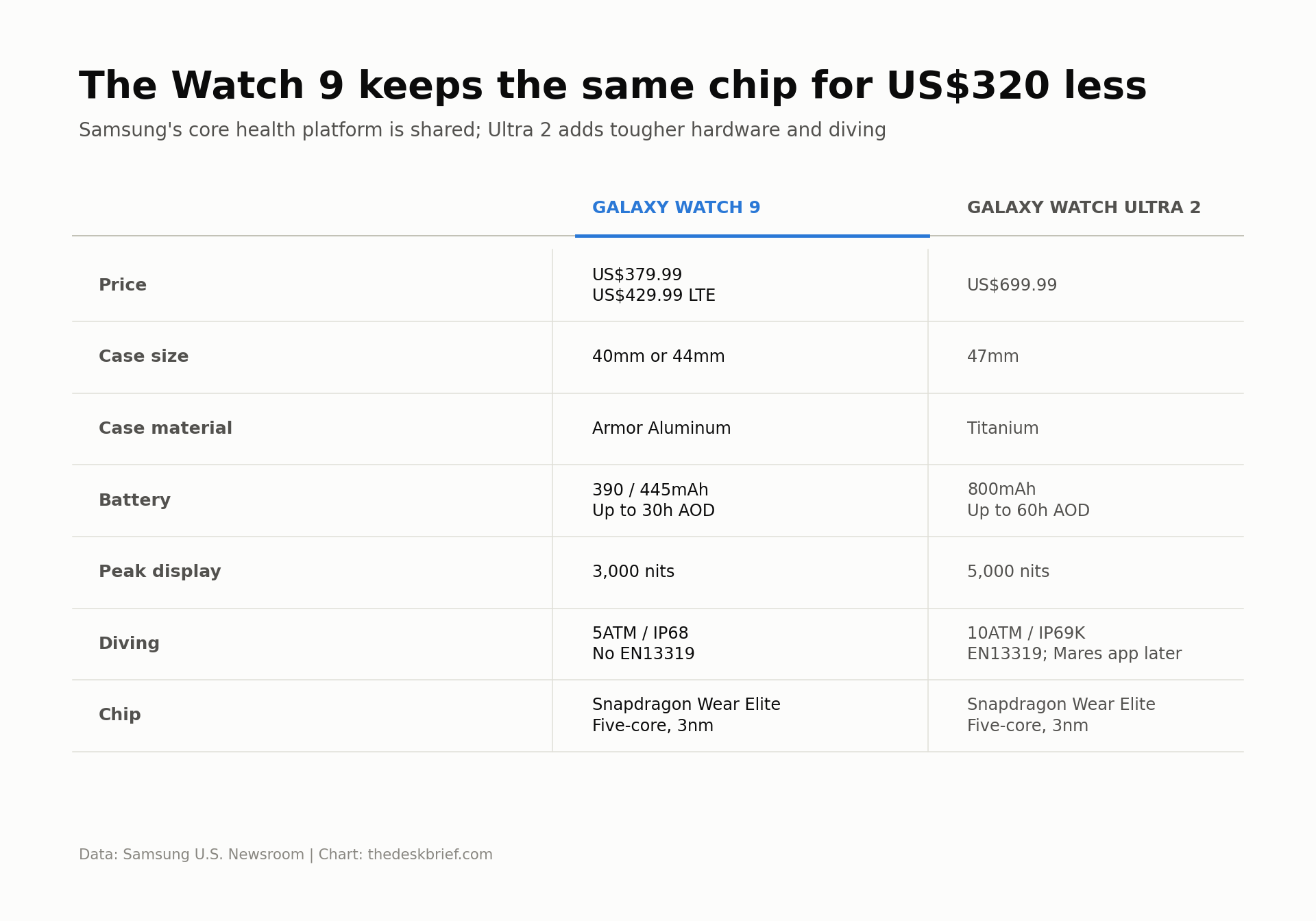
Our Samsung Galaxy Watch Ultra 2 guide examines the rugged hardware, EN13319 claim and delayed Mares dive-computer app in detail. The short version for launch day is simple: automatic depth, dive time and water temperature work on August 7, while the decompression software comes later in 2026 and requires a separate subscription.
For everyday sleep, workouts, notifications and health trends, the cheaper watch reaches the same software destination. Put the saving toward a phone upgrade, a few years of subscriptions or something that improves the rest of your setup. Even the new Samsung Galaxy Card doesn’t change that basic rule: calculate the net value you’ll use, not the largest number on the product page.
Who should skip this
Skip the Galaxy Watch 9 if you use an iPhone, since Samsung lists Android 13 or newer as the compatibility requirement. Skip it if daily charging already annoys you, or if you want a watch that keeps its best training features outside subscription services. People who know a daily health score will feed anxiety rather than useful habits should also think twice. A simpler tracker can be the healthier purchase.
Divers, serious trail runners and people who routinely punish their gear should look at the Ultra 2, but only after pricing its delayed dive subscription and accepting the larger 47mm case. Everyone else should start here. The Galaxy Watch 9 is less dramatic, less expensive and, for most wrists, the correct Samsung watch.