
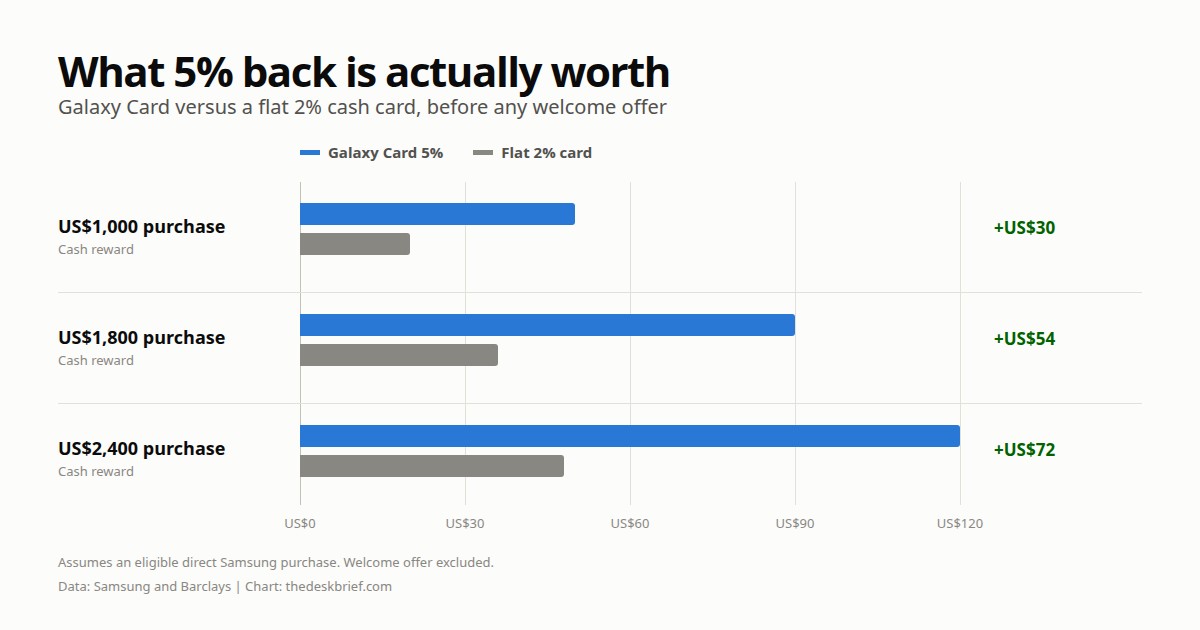
The Samsung Galaxy Card turns a US$1,800 to US$2,400 foldable purchase into US$90 to US$120 in cash rewards. That is the number worth caring about. The metal card, the Samsung logo, and the promise of 5% back are packaging around a narrower decision: should you open a credit account to save about US$100 on hardware you were already going to buy?
Yes, the Samsung Galaxy Card can be worth it when you are about to spend US$2,000 directly with Samsung and will pay the statement in full. The 5% category plus the US$200 welcome offer can return US$300 on that spend. For everyone else, this is a brand-loyalty card with a weak 1% base rate and a 23.49% to 32.24% variable purchase APR.
Last updated: August 29, 2026. Barclays rates, Samsung rewards, and the Apple Card comparison rechecked.
Samsung Galaxy Card rewards and terms at launch
This is Samsung Electronics America’s first credit card. Barclays U.S. Consumer Bank issues it on the Visa network, and applications opened in the United States on 22 July 2026. Approval provides an instantly provisioned virtual card in Samsung Wallet, so an approved buyer can use it before the black metal card arrives.
- Annual fee: US$0.
- Samsung purchases: 5% cash rewards on eligible direct purchases.
- Samsung Wallet purchases: 3% on eligible purchases.
- Eligible streaming: 2%, including Netflix, Disney+ and Spotify.
- Everything else: 1%.
- Welcome offer: US$200 after US$2,000 in purchases within 90 days.
- Purchase APR: 23.49% to 32.24% variable.
- Foreign transaction fee: 0%.
- Samsung VIP Advantage: 20% membership discount, plus 5% rewards on purchase or renewal.
The official Samsung card page calls the cash rewards unlimited, so Samsung isn’t advertising an overall earnings cap on the 5% or 3% tiers. The word eligible still matters. Samsung’s launch announcement says direct purchases include Samsung.com, Samsung Experience Stores, the Shop Samsung app, Galaxy Store, Care+, Samsung Secure Wi-Fi, Samsung Smart TV Store, and SmartThings Videos, but the full reward rules control how a transaction is classified.
Launch coverage reports that rewards can be redeemed as statement credits or transferred to a U.S. checking or savings account. Samsung’s page shows a running cash rewards balance, but it doesn’t display every redemption threshold in its public overview. Read the live Barclays reward rules before treating the balance as instant cash.
The Fold 8 purchase math is the reason to care
At 5%, a US$1,800 direct Samsung purchase earns US$90. A US$2,400 purchase earns US$120. A flat 2% cash card would return US$36 or US$48 on those same amounts, so Samsung’s bonus category adds US$54 to US$72. Useful, yes. Transformative, no.
Featured chart: cash rewards on three direct Samsung purchase amounts compared with a flat 2% card. The chart excludes the welcome offer and assumes eligibility for the 5% tier. Data: Samsung and Barclays. Chart: thedeskbrief.com.
The welcome offer changes the first-purchase calculation. Spend exactly US$2,000 within 90 days and the 5% category could produce US$100, while meeting the bonus requirement adds another US$200. That is US$300 total before considering any trade-in credit or preorder promotion. Instant digital provisioning matters here because an approved buyer doesn’t need to wait for the physical card before placing a launch-day order.
Do not assume every discount stacks. Samsung’s launch materials describe card rewards alongside preorder and trade-in offers, but they don’t plainly guarantee that every coupon, education discount, trade-in credit, and card benefit can be combined. Check the final checkout price and the offer-specific terms. The same discipline applies when comparing the Galaxy Watch 9 with Samsung’s Ultra model: calculate the value you will use, not the biggest number in the banner.
The honest problems with Samsung’s credit card
The first problem is simple. This is a store card wearing a metal jacket. Its best return pulls you toward Samsung’s store, while its 1% rate on ordinary physical-card spending loses to a no-fuss 2% card. It shouldn’t be your only card.
The 3% Samsung Wallet tier is more interesting because it can apply beyond Samsung, but the phrase “eligible purchases” is doing real work. Payment routing, merchant acceptance, excluded transaction types, and the requirement to use the Galaxy Card inside Samsung Wallet all matter. The public page says rewards are unlimited, yet that doesn’t make every tap eligible or guarantee the program won’t change.
Then there is the APR. Samsung lists a 23.49% to 32.24% variable purchase APR, depending on the application and credit history. Carrying US$2,000 for one month at those annual rates works out to roughly US$39 to US$54 in interest before the card’s actual daily-balance calculation. A couple of months can erase the 5% hardware reward. Anyone financing a phone because the cash isn’t available should ignore the rewards and compare the financing cost first.
Samsung advertises pre-qualification with no effect on your credit score. Opening the account is still a real credit decision, not a free coupon. Taking on another account for a phone bought once every three years is hard to justify if the incremental return over a 2% card is only US$54 to US$72. The same skepticism belongs in any premium hardware decision, including the US$699.99 Samsung Galaxy Watch Ultra 2.
Samsung Galaxy Card vs Apple Card
| Feature | Samsung Galaxy Card | Apple Card |
|---|---|---|
| Brand-store reward | 5% on eligible direct Samsung purchases | 3% Daily Cash at Apple |
| Mobile-wallet reward | 3% on eligible Samsung Wallet purchases | 2% with Apple Pay |
| Physical-card baseline | 1% | 1% |
| New-account purchase APR | 23.49% to 32.24% variable | 17.49% to 27.74% variable as of July 1, 2026 |
| Device financing | No introductory 0% purchase APR advertised | 0% Apple Card Monthly Installments on eligible Apple products |
Samsung wins only for a near-term eligible Samsung purchase or for someone who can reliably earn 3% through Samsung Wallet. Apple offers less at its own store, but eligible Apple hardware can use interest-free monthly installments. Neither reward justifies carrying an ordinary revolving balance. Pick the ecosystem only after comparing the financing terms and the return on purchases you already planned to make.
Who should skip it
Skip it if you aren’t already buying Samsung hardware. Skip it if you carry a balance, because one billing cycle of interest can consume much of the reward. Skip it if a flat 2% card already covers your spending and you don’t want another login, statement, due date, and account on your credit file.
It also makes little sense for someone likely to leave Galaxy phones. The physical Visa will keep working, but the best general category depends on Samsung Wallet. Rewards ecosystems are designed to make the next Samsung device feel like the easiest choice. That may be convenient, but it isn’t neutral.
The Unpacked stage time changes the story
The Samsung Galaxy Card wasn’t merely a press release timed to borrow attention from new phones. During the Galaxy Unpacked keynote on 22 July 2026, Samsung named Barclays on stage and showed the physical card. Wallet payments and Samsung’s stablecoin initiative also received real stage time. There is no transcript yet, so the safe conclusion is about positioning, not segment order or promises Samsung didn’t make.
Samsung presented Samsung Wallet as a financial platform alongside its hardware ecosystem. The card is the part that ships today: a Barclays account on Visa, instantly provisioned into Wallet after approval, with a metal card following later. That puts payments directly beside the phones, watches, IDs, keys, and other services Samsung wants users to manage from one place. It is a more immediate ecosystem move than the company’s Samsung AI glasses, which aren’t due until fall 2026.
The Samsung Wallet stablecoin initiative has no details yet
Samsung announced a stablecoin initiative during that keynote, but it didn’t publish the details before this article was written. There is no confirmed token, blockchain network, launch date, market list, or explanation of how the initiative will appear in Samsung Wallet. It isn’t a live Galaxy phone payment feature today. This article will be updated when Samsung releases specifics.
The direction is still clear. Samsung Electronics was reported on 4 July as joining OpenUSD, an open dollar-backed stablecoin project involving roughly 140 companies, with fee-free issuance and redemption plus shared reserve-asset revenue. Samsung Wallet also has a Coinbase partnership aimed at more than 75 million U.S. Galaxy users, including three months of Coinbase One for eligible new subscribers.
Read together, the card, Wallet, OpenUSD report, and Coinbase relationship look like pieces of a payments platform. Keep the skepticism switched on. A stablecoin announcement with no product details is a positioning move, and consumer crypto features have a long history of arriving late, launching narrowly, or disappearing after the keynote. Until Samsung publishes terms, the stablecoin is the half that signals where Wallet may go, not a reason to apply for the card.
Verdict: get it for a near-term Samsung purchase, not the metal
The Samsung Galaxy Card makes sense if you are buying an expensive Galaxy device directly from Samsung in the next 90 days, can pay the statement in full, and will actually meet the US$2,000 welcome-offer threshold. In that narrow case, US$90 to US$120 from the purchase plus a US$200 bonus is enough to justify considering another account.
Most people should skip it. The 1% fallback is poor, the best everyday rate ties you to Samsung Wallet, and the APR can wipe out the reward fast. Apply for the math, not for the black metal card or the stablecoin story. After the bonus posts, decide whether 3% through Wallet earns this account a permanent place in your setup.
Terms checked August 29, 2026. Credit-card offers and reward rules can change. This article is editorial information, not financial advice.