For US$64.99, the Epomaker TH65 puts a gasket mount, a rotary knob, hot-swap sockets, and an 8,000mAh battery on the table. A couple of years ago that same pile of hardware started at roughly double the money.
Disclosure: This page contains affiliates. If you buy through them, The Desk Brief may earn a commission at no extra cost to you.
Prices checked and links verified September 2026.
Epomaker announced the board on July 31, 2026. Reviewers have not gotten their hands on this model, so what follows walks through the published specification rather than how the board actually types under your fingers. I have not used one; every number below traces back to Epomaker or to launch reporting I could verify this week.
The interesting part of a US$64.99 keyboard is never the feature list. It is the corner someone cut to reach that price, and whether the corner sits somewhere you will actually feel it. On the Epomaker TH65 there are two of them, and only one is likely to bother a desk worker.
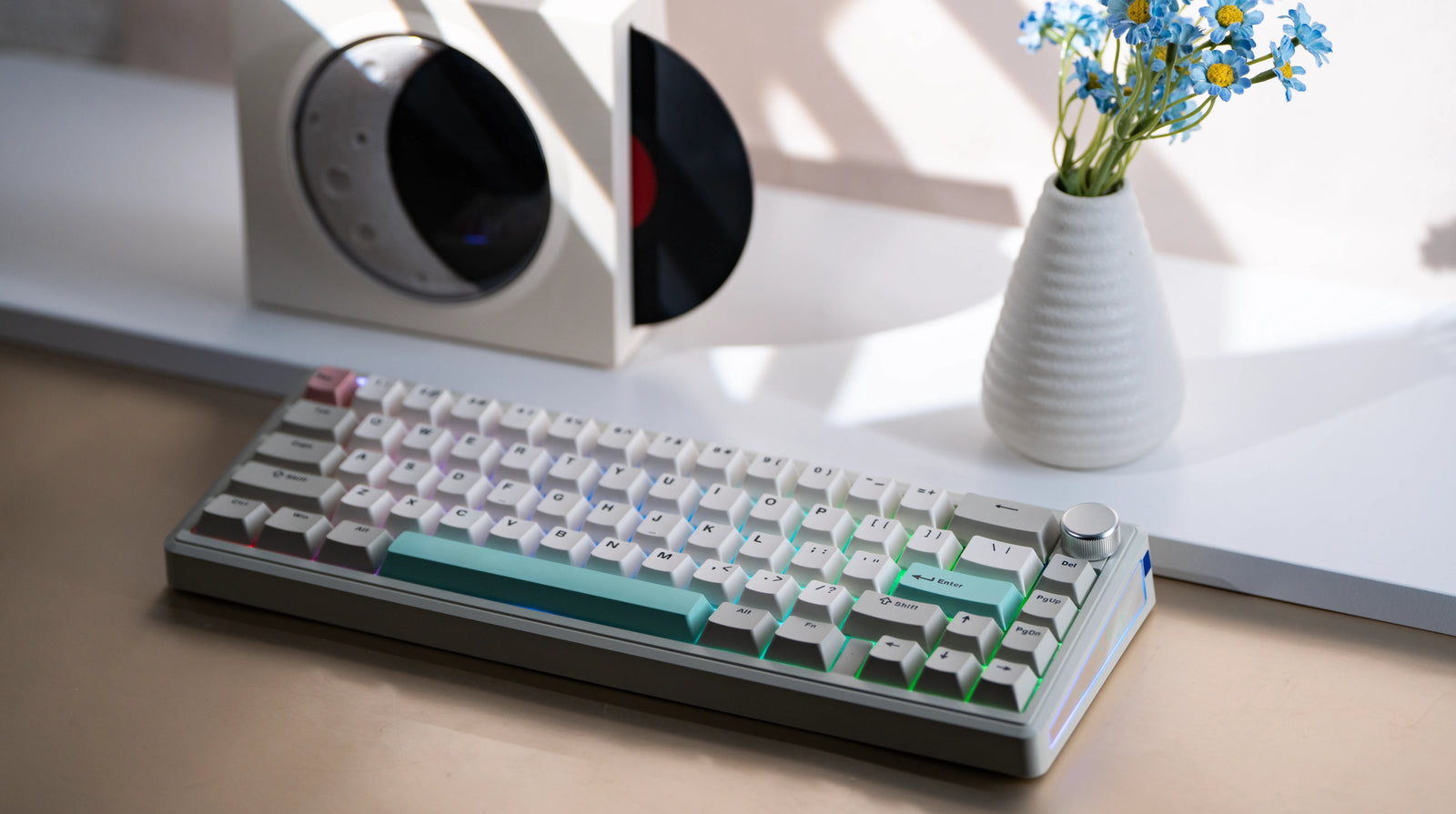
Table of Contents
- What US$64.99 actually buys
- The Epomaker TH65 catch: closed firmware
- Keycaps and the colorway trap
- Where the Keychron V1 Max still earns its premium
- Who Should Skip This
- Frequently Asked Questions
- The Short Version
What US$64.99 actually buys
Start with the layout. This is a 65% board: 66 keys plus a rotary knob, with dedicated arrow keys but no function row. You keep the arrows a compact keyboard usually sacrifices and lose the top row you probably reach for less than you think. Epomaker lists the footprint at roughly 298 x 102 x 41 mm and the weight at about 0.7 kg, so it clears a real chunk of desk next to a full-size board.
The construction is where the price starts to look strange. The TH65 uses a gasket mount with a flex-cut PC plate and five layers of dampening: a sandwich foam, an IXPE switch pad, a sound-optimizing pad, an EPDM socket pad, and a bottom silicone layer. That is the acoustic recipe brands normally reserve for boards two or three times the price, and it is the single specification that makes this launch worth a second look.
Connectivity is tri-mode: a 2.4GHz receiver, Bluetooth, and USB-C. Polling runs at 1000Hz on the 2.4GHz dongle and on the wire, and drops to 125Hz over Bluetooth, which is the usual budget-radio pattern and fine for typing but worth knowing if you plan to game on Bluetooth. Backing all of that is an 8,000mAh battery, which is unusually large for a 65% board and the number Epomaker leans on hardest.
The switches are hot-swappable on 5-pin sockets, so you can drop in most MX-style switches later without a soldering iron. Epomaker ships three of its own to choose from: the Creamy Jade linear, the Crystal silent tactile, and the Clear linear. There is south-facing RGB, a two-stage flip-out foot that sets 6, 8, or 10.5 degrees of tilt, and a braided cable, a keycap-and-switch puller, and two spare switches in the box.
The Epomaker TH65 catch: closed firmware
Here is the first cut corner. The Epomaker TH65 is programmed through Epomaker’s browser-based Upgear driver, not through open QMK or VIA firmware. You remap keys, set macros, and adjust the lighting inside the vendor tool, and firmware updates arrive the same way.
Whether that matters depends entirely on how you use a keyboard. If you set your layout once and never touch it again, a web driver does the job and you will forget it exists. If you live in custom layers, tap-hold behaviour, and per-application macros, closed firmware is the whole ballgame, and this is exactly where a QMK board pulls ahead. Be honest with yourself about which person you are before the price tag makes the decision for you.
Keycaps and the colorway trap
The second corner hides in the colorways. The keycap material changes with the color you pick. The Retro White version ships with double-shot PBT, the durable, texture-holding plastic enthusiasts want. The Black version uses translucent PC for stronger RGB shine-through, and the Pink mixes PC and ABS. ABS is the plastic that goes shiny and slick with months of finger oil.
So the color decision quietly becomes a materials decision. If you want the PBT that still looks new after a year, you are steered to white. Pick black or pink for the look and you accept caps that will polish up faster. The case itself is ABS plastic across the range rather than aluminum, which is the honest reason a gasket-mounted, foam-stuffed board can land at US$64.99 at all.
Where the Keychron V1 Max still earns its premium
The board to measure this against is the Keychron V1 Max, the current budget-enthusiast default. It costs US$94 fully assembled, or US$74 as a barebones kit, per Keychron. The Epomaker TH65 undercuts even that barebones price, which is the headline of the comparison below.
| Specification | Epomaker TH65 | Keychron V1 Max |
|---|---|---|
| Price | US$64.99 | US$94 assembled / US$74 barebones |
| Layout | 65% (66 keys, arrows, no function row) | 75% (function row, arrows, nav column) |
| Case | ABS plastic | ABS plastic |
| Mount | Gasket, flex-cut PC plate | Gasket |
| Hot-swap | Yes, 5-pin | Yes, 3-pin and 5-pin |
| Firmware | Epomaker Upgear web driver | QMK / VIA |
| Wireless | 2.4GHz + Bluetooth + USB-C | 2.4GHz + Bluetooth 5.1 + USB-C |
| Battery | 8,000mAh | 4,000mAh |
| Polling | 1000Hz (2.4GHz / wired) | 1000Hz (2.4GHz) |
| Keycaps | PBT on white only; PC or ABS on others | Double-shot PBT |
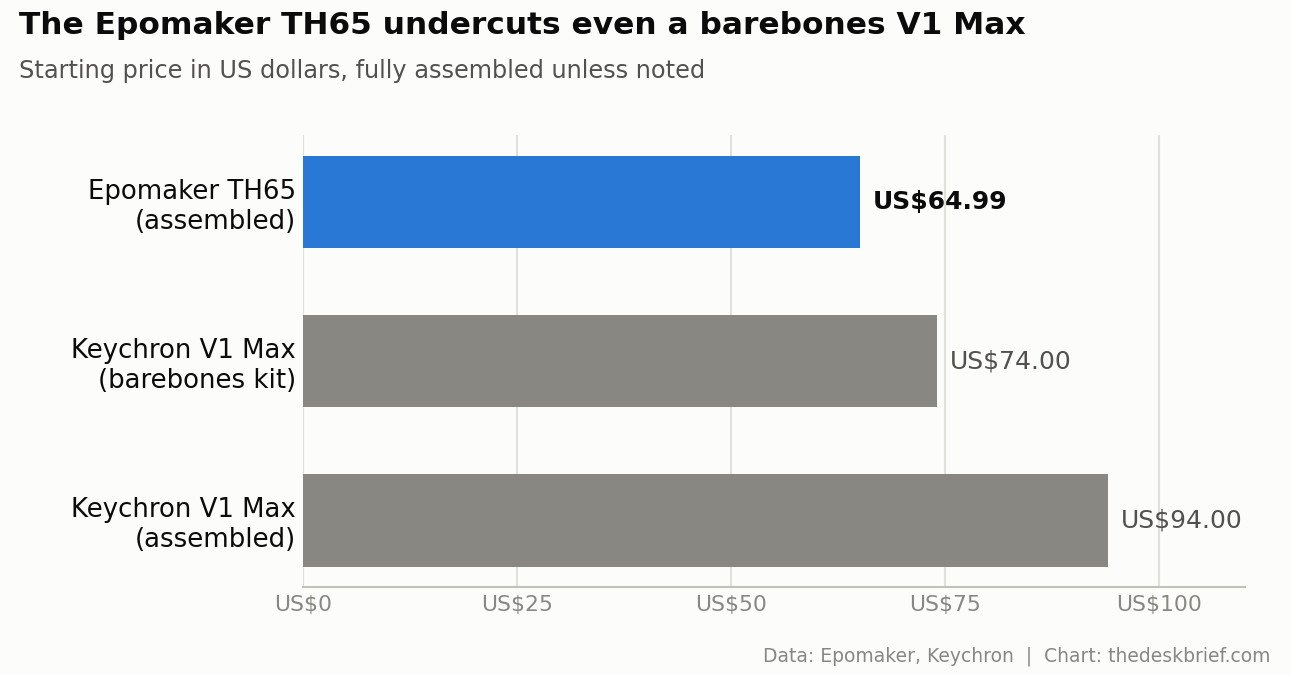
Read that table and the trade becomes clear. The Keychron V1 Max charges its US$29 premium for two things the Epomaker TH65 will not give you: a 75% layout with a real function row, and open QMK/VIA firmware. In exchange, the TH65 hands back double the battery capacity, an arguably better dampening stack on paper, and a smaller footprint. Nobody has bench-tested either claim head to head, so I am comparing spec sheets, not sound.
My read: if you never remap and do not miss a function row, the Epomaker TH65 is the smarter buy. If you remap constantly or want that top row for shortcuts and media keys, choose the Keychron V1 Max and its QMK firmware (affiliates). This is one of those rare cases where the budget option is the correct default and the premium is a genuine, narrow upgrade rather than a tax. If you are still working out how your keyboard fits the rest of the desk, our guide to ergonomic keyboard position covers the placement that actually protects your wrists.
Who Should Skip This
Skip the Epomaker TH65 if QMK or VIA is non-negotiable, because the Upgear driver is a closed system and no firmware update changes that. Skip it if you need a function row, since a 65% board simply does not have one and you will be layering the F-keys behind a Fn press all day.
Skip it too if you want an aluminum case for heft and rigidity, or if you had your heart set on black or pink but also wanted PBT caps, because that combination is not on the menu. None of those are flaws at US$64.99. They are just the edges of what the price can cover, and it is better to see them before the box arrives. A tidy board also deserves a tidy desk, and our cable management guide keeps that single USB-C cable from becoming a mess.
Frequently Asked Questions
Does the Epomaker TH65 support QMK or VIA?
No. Epomaker programs the TH65 through its browser-based Upgear driver, which handles remapping, macros, lighting, and firmware updates. It is not QMK or VIA compatible, so if open firmware is a requirement, this is not your board.
Is the Epomaker TH65 hot-swappable?
Yes. The sockets take 5-pin MX-style switches with no soldering, and Epomaker offers the board with a Creamy Jade linear, a Crystal silent tactile, or a Clear linear switch. Two spare switches and a puller are included so you can start swapping out of the box.
How long does the TH65 battery last?
Epomaker quotes the capacity at 8,000mAh but has not published a rated runtime in hours, so I will not invent one. The cell is double the 4,000mAh in the Keychron V1 Max, which points to long life between charges, but treat the exact figure as unannounced until someone measures it.
Does the Epomaker TH65 come with PBT keycaps?
Only on one colorway. The Retro White version ships with double-shot PBT; the Black uses translucent PC and the Pink mixes PC and ABS. If PBT durability matters to you, the white model is the one to buy.
The Short Version
The Epomaker TH65 puts a gasket mount, five-layer dampening, tri-mode wireless, hot-swap sockets, and an 8,000mAh battery into a US$64.99 keyboard, which is a genuinely unusual amount of hardware for the money. The price you pay for it is closed firmware and PBT keycaps on the white model only.
For a set-and-forget compact wireless board, that is an easy recommendation and the corners land in places most desk workers never touch. If you remap in QMK or need a function row, choose the Keychron V1 Max instead. Either way, size the keyboard to the rest of your workspace first with our ergonomic desk setup checklist, then let the switches be the fun part. For the record, these are manufacturer specifications, not test results, and the TH65 has not been independently reviewed at the time of writing.
Editorial rating: 4.0 out of 5. The TH65 provides unusually strong hardware value with a gasket mount, tri-mode wireless, hot-swap sockets, and a large battery. Closed firmware and model-dependent keycap materials are the main compromises, but it is an easy compact-keyboard recommendation for most buyers.
Current offer checked August 30, 2026: US$65.99, in stock. Prices and availability can change.