Disclosure: This page contains affiliates. If you buy through them, The Desk Brief may earn a commission at no extra cost to you.
The Epomaker RT75 is worth CA$153 only if its removable 1.54-inch screen is the feature you specifically want. Keychron Canada still sells the proven, fully assembled V1 Max for CA$152.99. The RT75 is one cent more expensive, which is comically small. The difference in firmware, controls, and independent testing is not.
The RT75 gives you a detachable 1.54-inch display that can be replaced by four physical keys. The V1 Max gives you open QMK firmware, a rotary knob, adjustable feet, and independent review history. Unless you specifically want that screen, I would buy the Keychron. If you do not need a function row, the CA$92 Epomaker TH65 saves CA$61 and leaves enough money for a decent mouse.
TechPowerUp reported the retail launch on August 14, 2026. I have not used this keyboard. Early hands-on coverage now shows the display setup and fixed typing angle, but no lab outlet has measured battery life, latency, wireless stability, or acoustics. This remains a current specification and price analysis, not a typing review dressed in a nicer shirt.
Last updated: August 29, 2026. Canadian stock, US switch availability, and early hands-on coverage rechecked.
Table of Contents
- What the RT75 actually is
- The removable screen is the whole bet
- Epomaker RT75 vs Keychron V1 Max
- What Epomaker has not proved
- What I would buy
- Who Should Skip This
- FAQ
- The Short Version
What the RT75 Actually Is
The official RT75 product page describes a 75% ANSI keyboard with 83 fixed keys and a modular top-right bay. Install the TFT module and you get a small display for a clock, system information, still images, or GIFs. Remove it and four additional keys take its place, bringing the usable total to 87. That is a clever solution to the usual screen-keyboard problem: the decoration does not permanently eat useful inputs. Epomaker RT75 on Amazon
The rest of the hardware follows the current budget-enthusiast recipe. There is a gasket mount, a polycarbonate plate, six layers of foam and silicone, south-facing RGB, dye-sublimated PBT keycaps, and a hot-swappable PCB. Epomaker offers a pre-lubed Creamy Jade linear switch or a Crystal silent tactile switch. Those parts should make customization easy. They do not tell us how the finished board feels or sounds.
Wireless support covers 2.4GHz and Bluetooth, with USB-C for wired use. Epomaker claims a 1,000Hz polling rate over the cable and 2.4GHz receiver, dropping to 125Hz over Bluetooth. The company also quotes 4ms wired, 8ms 2.4GHz, and 16ms Bluetooth latency. Those are manufacturer numbers, not independent measurements.
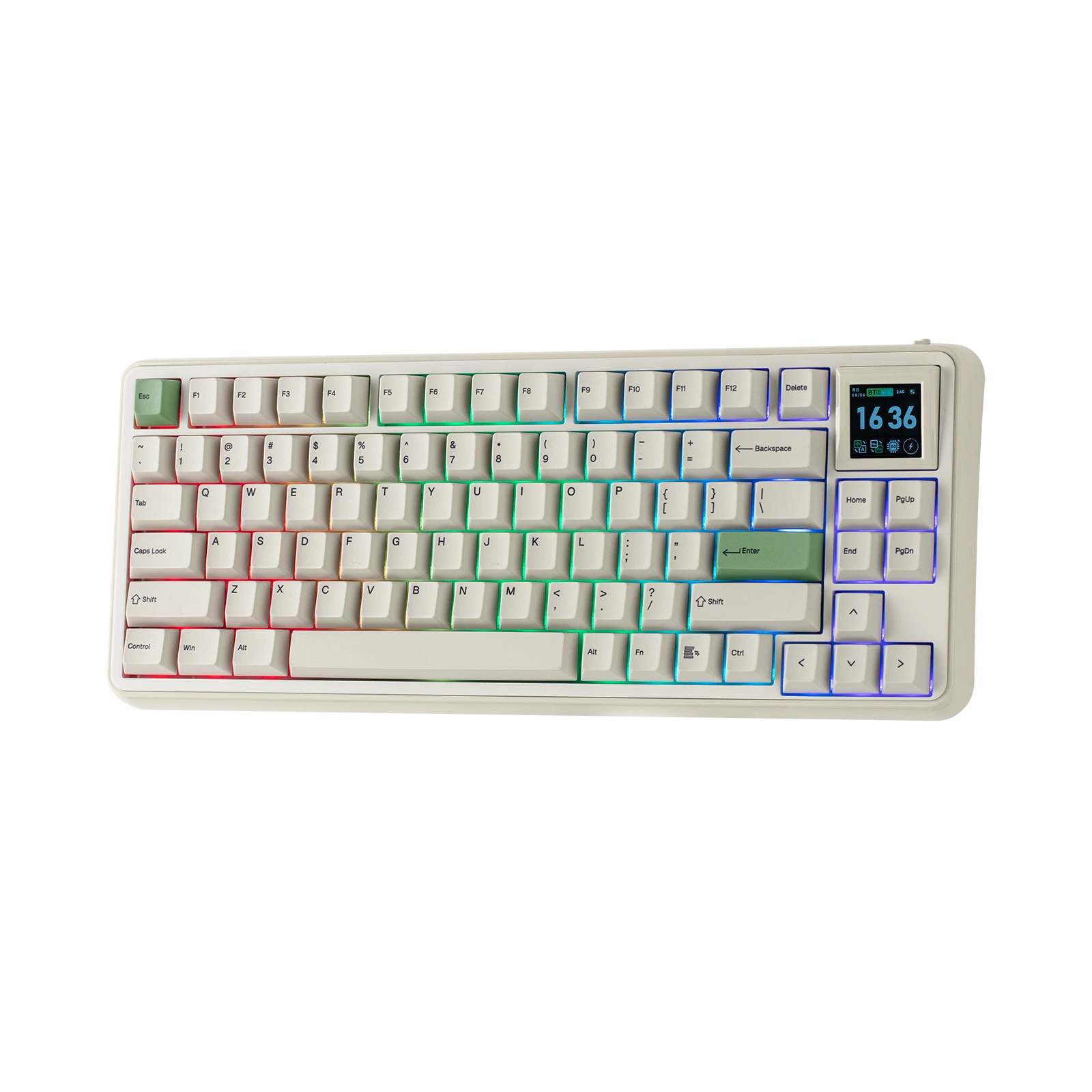
The 5,000mAh battery sounds generous until you compare it with the cheaper TH65’s 8,000mAh cell. Epomaker has not published a runtime claim for the RT75, and the display plus RGB can change battery life dramatically. Capacity alone cannot tell you whether this is a charge-monthly board or a charge-weekly one.
The Removable Screen Is the Whole Bet
A keyboard screen can be useful. A battery gauge saves guessing, a clock is harmless, and a layer indicator would help anyone who remaps keys. The removable design is smarter than the fixed panel on the Yunzii IF68, where the screen permanently replaces navigation keys. If the novelty fades here, you can install four buttons and get the desk space back.
The catch is software. Epomaker supplies its own driver download and says the board stores custom settings onboard, but the current specification sheet does not advertise QMK or VIA. I would not assume open firmware support will appear later. A screen that depends on vendor software is only as useful as that software remains, and there is no independent RT75 testing yet to tell us whether GIF uploads, remapping, and profile switching behave properly.
There is also no knob. Epomaker moved the visual feature into the corner where many 75% boards place volume control. Four replacement keys can handle volume, but a rotary control is faster and does not require looking down. A tiny animated picture is fun. Muting a meeting before your dog contributes to it is useful.
Epomaker RT75 vs Keychron V1 Max
The Keychron V1 Max is the right reference because it solves the same 75% wireless-keyboard job at almost the same Canadian price. It is not glamorous, which is part of the appeal. RTINGS independently measured the V Max family and found true 1,000Hz polling over wired and 2.4GHz connections, excellent latency, and a softer gasket-mounted typing feel. The RT75 has no equivalent independent evidence yet.
| Specification | Epomaker RT75 | Keychron V1 Max | Epomaker TH65 |
|---|---|---|---|
| Current Canadian price | CA$153.00 | CA$152.99 fully assembled sale | CA$92.00 |
| Layout | 75%, 83 keys plus screen or 4 keys | 75%, function row, navigation keys, knob | 65%, 66 keys plus knob |
| Display | Detachable 1.54-inch TFT | None | None |
| Firmware | Epomaker driver; QMK not advertised | Open QMK with browser Launcher | Epomaker software; QMK not advertised |
| Wireless | 2.4GHz and Bluetooth | 2.4GHz and Bluetooth 5.1 | 2.4GHz and Bluetooth |
| Battery | 5,000mAh; runtime not announced | 4,000mAh; up to 225 hours with lighting off | 8,000mAh; runtime not announced |
| Typing angle | Fixed 5.8 degrees | 3.5, 7.1, or 9.5 degrees | 6, 8, or 10.5 degrees |
| Weight | About 1,165 g | 770 g, plus or minus 10 g | About 700 g |
The Epomaker RT75 is wider, deeper, and roughly 395 g heavier than the V1 Max. Some people like a heavy board that refuses to slide. I would rather have the Keychron’s adjustable feet, because keyboard angle affects wrist extension and 5.8 degrees may not suit every desk. Our ergonomic keyboard position guide explains why flatter is usually safer than blindly raising the back.
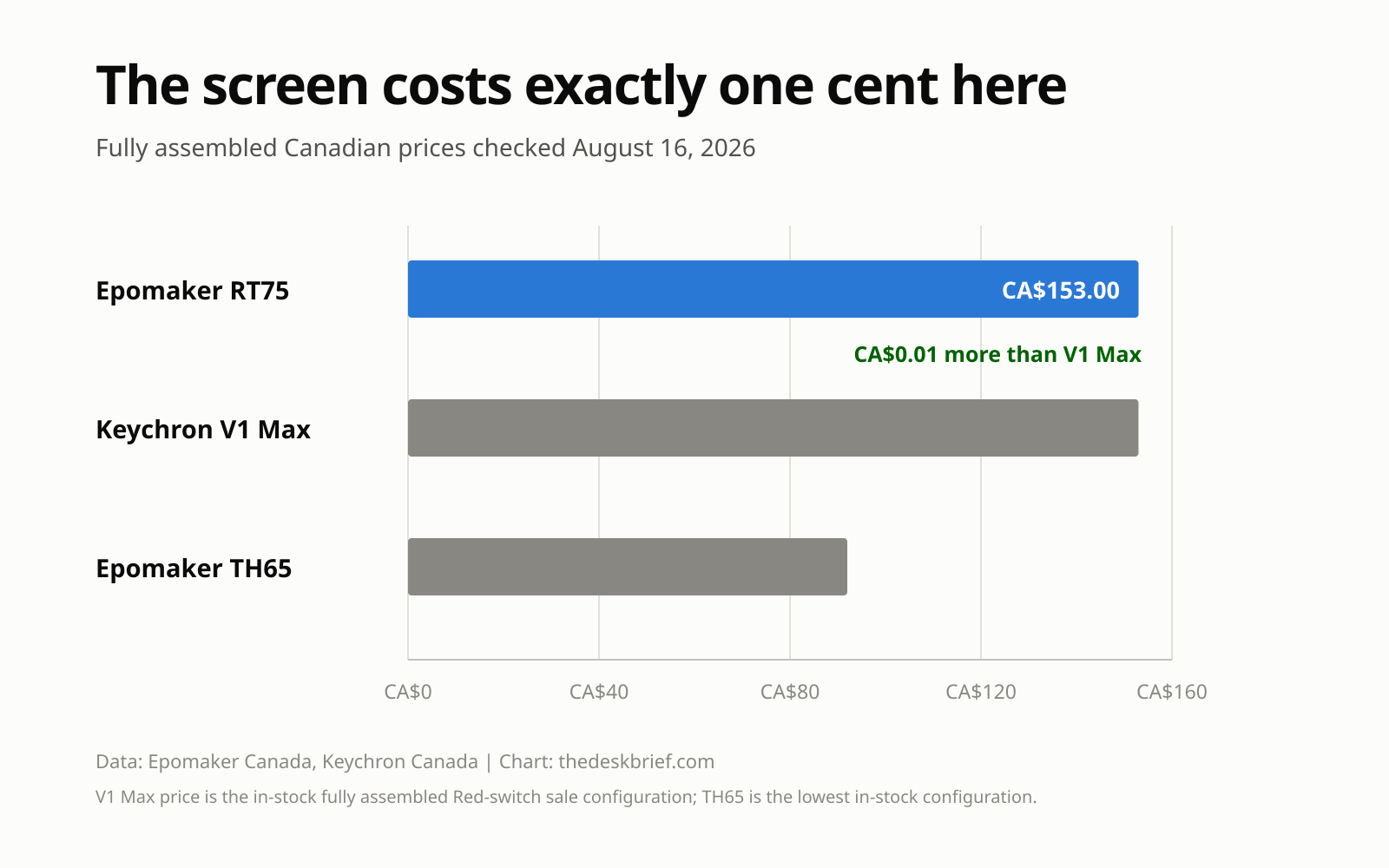
Price removes the easiest defence of the new model. On August 29, Epomaker’s US$91.79 Creamy Jade configuration was unavailable, while the Crystal Tactile Silent version was available at US$93.49. Both Canadian configurations remained available from CA$153.00. At that price, the removable display must beat QMK, a knob, adjustable angle, and a longer independent track record. That is a demanding job for a 1.54-inch panel.
What Epomaker Has Not Proved
Epomaker has confirmed the price, dimensions, materials, connection modes, switch options, polling rates, and one-year warranty. It has not announced useful battery runtime, screen resolution, screen brightness, the display refresh rate, storage available for images, or whether the screen works fully on macOS. The company lists Mac modifier caps, but that is not the same as complete software support.
Early owners and hands-on writers now describe the screen and typing experience, but nobody has published instrumented latency, wireless-stability, acoustic, or battery testing for this exact model. I would also wait for long-term testing of the hot-swappable display connection after repeated removal. A modular part earns its keep by surviving the swapping, not merely by looking tidy in the launch render.
The screen’s viewing angles and legibility are still unknown. So is the quality of the glossy ABS case after months of fingerprints. None of these omissions makes the board bad. They make a CA$153 preorder-style leap harder to justify when the established alternative costs one cent less.
What I Would Buy
I would buy the Keychron V1 Max from Keychron Canada at CA$152.99 while that fully assembled configuration remains in stock. QMK, the knob, adjustable feet, and independent measurements matter more to me than a display.
Buy the Epomaker RT75 from Epomaker Canada at CA$153.00 only if the removable screen is the feature you came for and you are comfortable being an early software tester. If your work does not need a function row, the TH65 remains the cheaper answer. A broader work-from-home desk setup benefits more from spending the CA$61 difference on the part that is actually bothering you.
Who Should Skip This
Skip it if you want open firmware, a rotary knob, or a board with independent battery and latency tests. Skip it if you use an ISO layout, because the current listing is ANSI. Also skip it if you need a very low or adjustable typing angle. The case is fixed at 5.8 degrees before keycap height enters the equation.
Most of all, skip it if the screen merely looks neat in product photos. The removable module is the reason this keyboard costs more than Epomaker’s simpler boards. If you cannot name what you will display on it, you already know how the novelty ends.
FAQ
Is the Epomaker RT75 a review?
No. I have not used the keyboard. Early hands-on coverage now exists, but the RT75 still lacks instrumented latency, battery, wireless, and acoustic testing. The specifications come from Epomaker, while the recommendation uses current prices and independent V1 Max measurements.
Can the RT75 screen be removed?
Yes. Epomaker says the 1.54-inch TFT module can be replaced by four physical keys. The screen can show GIFs, images, a clock, or system information. Its resolution and independent software reliability have not been announced or measured.
Does the RT75 support QMK or VIA?
Epomaker’s current product page does not advertise either one. It provides an Epomaker driver and onboard setting storage. Buy it on that basis, not on the hope that open firmware appears later.
Is CA$153 a good price?
It is fair for a gasket-mounted wireless keyboard with PBT caps and a removable screen, but it is not the best value. The fully assembled Keychron V1 Max was CA$152.99 on the same date, while the smaller Epomaker TH65 was CA$92.00.
The Short Version
Epomaker RT75 turns its 1.54-inch display into four usable keys when the novelty wears off. That is genuinely smarter than a fixed screen.
At CA$153.00, though, it costs one cent more than a fully assembled Keychron V1 Max with QMK, a knob, adjustable feet, and independent testing. I would buy the Keychron. Choose the RT75 only when the removable screen is worth giving those advantages up.
Editorial rating: 3.0 out of 5. The RT75 makes its removable display more useful by letting owners swap it for four keys, and its core keyboard hardware is sound. At its current price, a Keychron V1 Max offers better firmware, adjustability, and independent evidence, so the RT75 is only for buyers who value the screen.
Current offer checked August 30, 2026: US$93.49, in stock. Prices and availability can change.