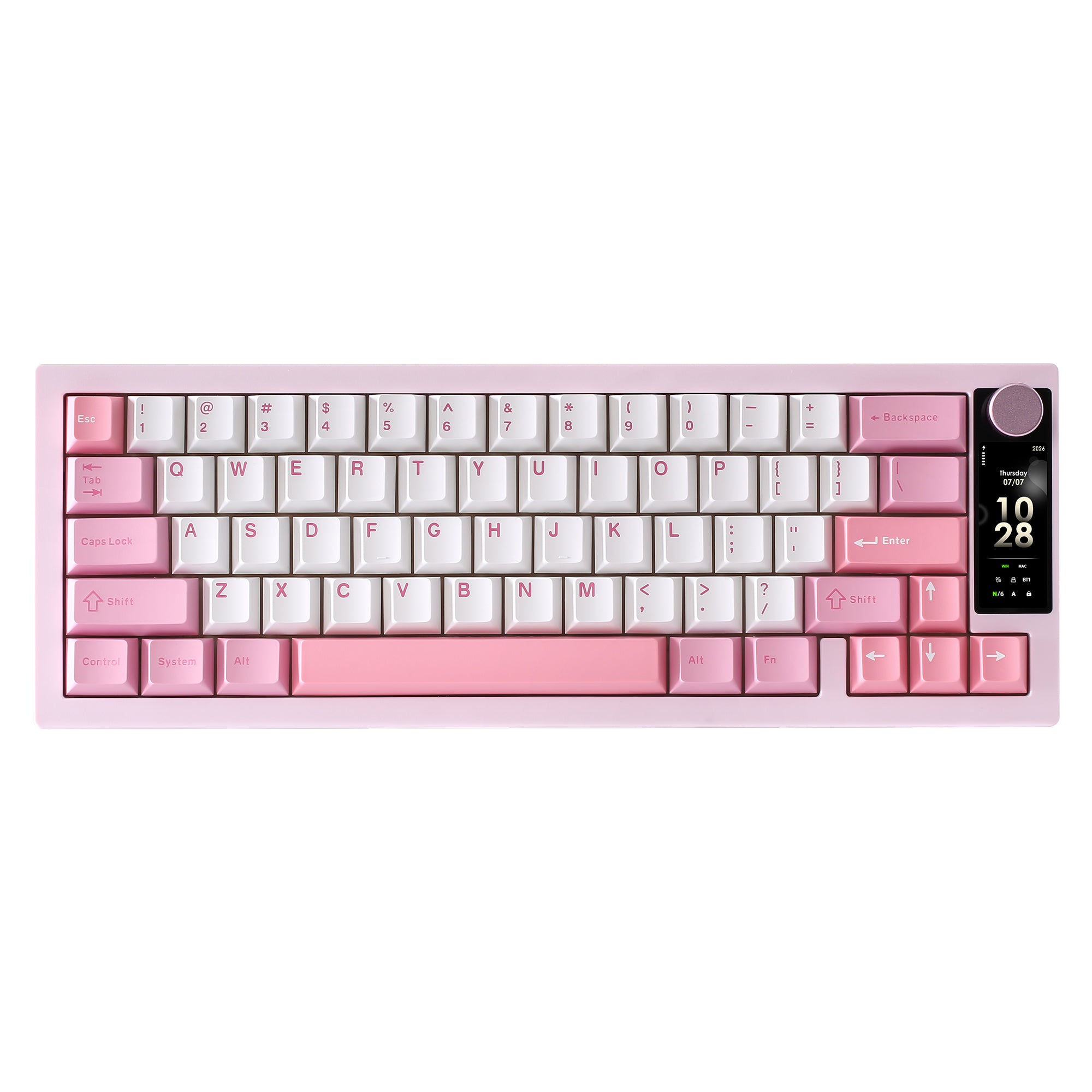
The Yunzii IF68 wants you to look at its screen first. A 200 by 480 TFT panel sits in the top-right corner where a smaller board would put a spacer, cycling through clocks, GIFs, and a battery gauge. Look past the party trick and the more useful story shows up: this is a US$84.99, 65% wireless keyboard with full QMK and VIA support, which is exactly the feature the Epomaker TH65 we looked at earlier this month refused to include.
Prices checked and links verified September 2026.
This page contains affiliate links. If you buy through these links, we may earn a small commission at no extra cost to you. Full disclosure.
No one has published an independent hands-on review of the IF68 yet. Yunzii listed it in July 2026, and the coverage so far is announcement write-ups working from the same spec sheet, not measured typing tests. Treat what follows as a spec read against boards this site has actually discussed, not a verdict typed on the thing.
At US$84.99 on sale, US$96.99 at list, it lands above budget boards like the TH65 and just under the Keychron V1 Max, the board most people settle on when they want QMK without any fuss. That middle slot is the whole question. Is the screen worth the premium over a TH65, and what do you give up against a V1 Max?
Table of Contents
- What the Yunzii IF68 actually is
- The screen and knob: gimmick or genuinely useful?
- Yunzii IF68 vs the Keychron V1 Max
- What Yunzii has not told us
- Who Should Skip This
- FAQ
- The Short Version
What the Yunzii IF68 actually is
Strip the marketing and the IF68 is a conventional enthusiast-style 65% board with one unusual add-on. It uses a 63-key layout with a rotary knob, a gasket-mounted plate with several layers of sound-dampening foam, and a hot-swappable PCB that takes both 3-pin and 5-pin switches. The keycaps are double-shot PBT in a Cherry profile, and the RGB is south-facing, the orientation that keeps legends from washing out under the caps. It ships in black, beige, and pink, with Yunzii’s Milk V2 or Candy linear switches. Yunzii IF68 on Amazon
- Layout: 65%, 63 keys plus a rotary knob
- Connectivity: USB-C wired, 2.4GHz wireless, Bluetooth
- Mount: gasket, multiple foam layers; hot-swap 3-pin and 5-pin PCB
- Keycaps: double-shot PBT, Cherry profile
- Display: 200 by 480 programmable TFT, plus a rotary knob
- Battery: 8000mAh; size 326.5 by 116.9 by 44.2 mm, about 725g
- Software: full QMK and VIA, N-key rollover; one-year warranty
The battery is the quiet standout. Yunzii fits an 8000mAh cell and rates it for up to 30 hours with the RGB and screen running, or up to 23 days with both switched off. For context, the Keychron V1 Max carries a 4000mAh battery. The screen is what eats the difference, so the headline number is less generous than it looks the moment you actually switch the panel on.
The screen and knob: gimmick or genuinely useful?
The 200 by 480 panel is the reason anyone clicks on this keyboard, and it is the hardest part to judge from a spec sheet. It shows the time, a battery gauge, connection status, and your own images or animated GIFs. Yunzii built the IF68 on the bones of its AL68, swapping the Delete, Page Up, and Page Down cluster for the display. That is a real tradeoff, because you lose three navigation keys plenty of people press every day, and on a 65% board those functions move onto a function layer. Remapping matters here, which is where QMK earns its keep.
Whether the screen is worth a cent depends entirely on you. It is genuinely handy for at-a-glance battery and layer state, and the rotary knob for volume and RGB brightness is the least controversial part of the design. It is also a battery drain and a fingerprint magnet, and no spec sheet can tell you how bright or legible the panel is in a lit room. Nobody has measured that yet, so anyone selling you the screen as the reason to buy is guessing.
Yunzii IF68 vs the Keychron V1 Max
The Keychron V1 Max is the right reference because it is what a careful buyer actually cross-shops at this price: a 75% board with QMK and VIA, a well-reviewed typing feel, and a barebones option for people who bring their own switches. Here is how the Yunzii IF68 lines up against it, with the TH65 kept in as the budget floor.
| Spec | Yunzii IF68 | Keychron V1 Max | Epomaker TH65 |
|---|---|---|---|
| Current price | US$84.99 (list US$96.99) | US$94 assembled / US$74 barebones | US$64.99 |
| Layout | 65%, 63 keys + knob | 75%, ~84 keys (knob optional) | 65%, 66 keys + knob |
| QMK / VIA | Yes | Yes | No (closed Upgear app) |
| Onboard screen | 200 by 480 TFT | None | None |
| Connectivity | USB-C, 2.4GHz, Bluetooth | USB-C, 2.4GHz, Bluetooth 5.1 | USB-C, 2.4GHz, Bluetooth |
| Battery | 8000mAh | 4000mAh | Not published |
| Mount | Gasket, foam layers | Gasket, foam | Gasket, flex-cut PC plate |
| Keycaps | Double-shot PBT (all colors) | Double-shot OSA PBT | PBT (white colorway only) |
| Hot-swap | 3-pin and 5-pin | 3-pin and 5-pin | Yes |
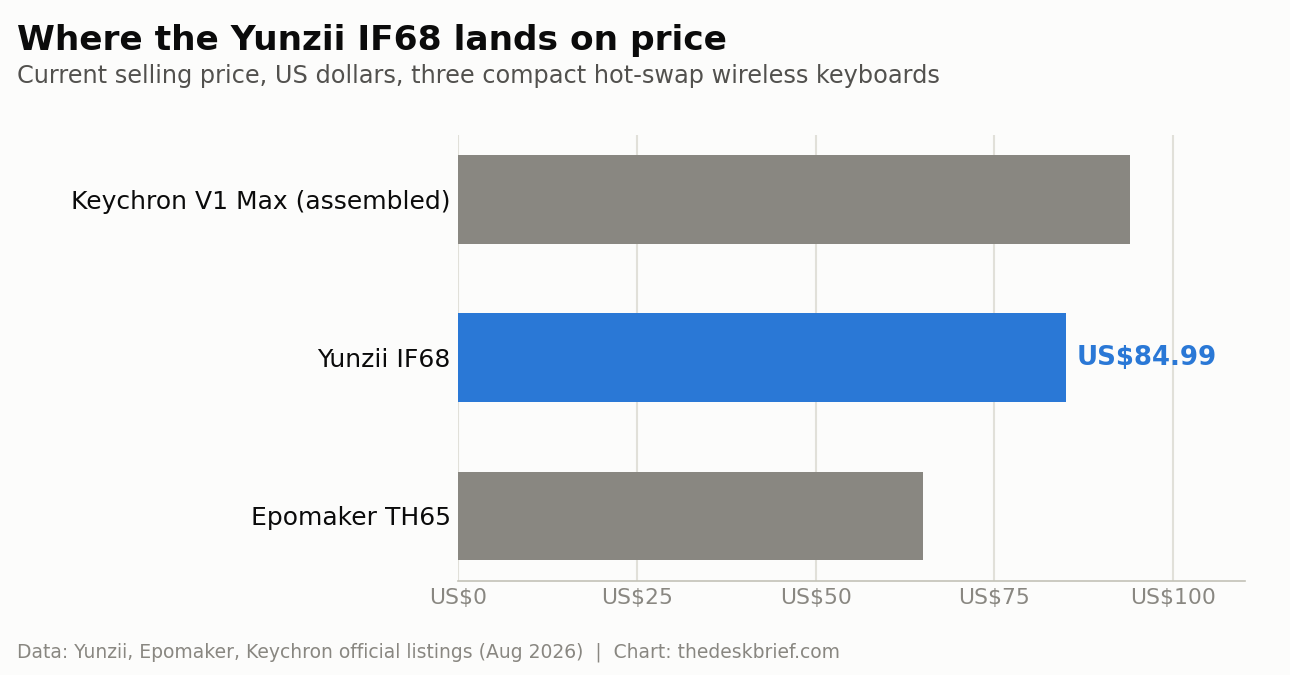
Two things stand out. The IF68 undercuts an assembled V1 Max by about US$9 while matching it on the feature that matters most for a board you keep for years, open QMK firmware. It also carries a bigger battery and a screen the Keychron does not have. What you give up is size and a track record. The V1 Max is a 75% board with a function row and years of independent reviews behind its typing feel, while the IF68 is smaller, screen-first, and untested by anyone outside Yunzii. If you type all day and want proven, the Keychron is still the safer US$94.
What Yunzii has not told us
Several things a buyer should know are simply absent. Yunzii has not published a polling rate, so treat wireless latency as unknown until someone tests it. There is no independent measurement of typing feel, sound, stabilizer rattle, or screen brightness, because no one has reviewed the board. Canadian pricing and availability are not confirmed; the US$84.99 figure is the US store’s current sale price against a US$96.99 list, and both can move. The double-shot PBT keycaps are a genuine step up on the TH65, which reserves PBT for its white colorway only, but PBT quality still varies between makers, and that is one more thing you cannot judge from a product listing.
Who Should Skip This
Skip the IF68 if you type for a living and need a function row or a number pad. A 65% board with a screen where three navigation keys used to be is the wrong tool for that job. Skip it if the screen is the only reason you are interested, because you are paying a premium for a feature no reviewer has vetted. And skip it if you want a keyboard with a paper trail, since the V1 Max and other established boards have been measured to death and the IF68 has not been measured at all. If none of that applies, and you want QMK, tri-mode wireless, and a big battery for under US$90, it is a reasonable board to watch once real reviews land.
FAQ
Does the Yunzii IF68 support QMK and VIA?
Yes. Yunzii lists full QMK and VIA support on Windows and macOS, so you can remap keys, build macros, and set up layers with open tools. That is the main functional difference from the Epomaker TH65, which locks you into a closed companion app instead.
How big is the Yunzii IF68 and how many keys does it have?
It is a 65% board with 63 keys plus a rotary knob, measuring 326.5 by 116.9 by 44.2 mm and weighing about 725g. The TFT screen sits where the arrow and navigation spacer would normally go, so those functions live on a layer.
How long does the battery last?
Yunzii rates the 8000mAh battery for up to 30 hours with the RGB and screen on, or up to 23 days with both off. Real numbers depend heavily on how much you use the display, and there is no independent test to confirm the claim yet.
Is the Yunzii IF68 available in Canada?
Canadian pricing and availability are not confirmed. The current US price is US$84.99 on sale against a US$96.99 list. Expect the usual import markup if you order one before a local listing appears.
The Short Version
The Yunzii IF68 is the rare screen-keyboard where the screen is not the best reason to buy it. At US$84.99 it brings full QMK and VIA, a hot-swap PCB, tri-mode wireless, and an 8000mAh battery, and it fixes the one thing that held back the Epomaker TH65, its closed firmware. The catches are real: three navigation keys give way to a panel nobody has tested, there is no polling-rate spec, and no independent review exists. If you want open firmware on a compact board and can live without a function row, keep it on your list and wait for measured reviews before you commit. If the screen is the whole appeal, spend less on a TH65 or more on a proven Keychron V1 Max instead. For the wider setup, our guides to ergonomic keyboard position and the full ergonomic desk setup checklist are the next stops.
Sources: Yunzii IF68 product page, KitGuru launch coverage, and the Keychron V1 Max product page.
Editorial rating: 3.5 out of 5. The IF68 combines open QMK and VIA firmware, tri-mode wireless, hot-swap sockets, and a large battery at a reasonable price. Its screen replaces useful navigation keys and the exact model lacks independent latency and battery testing, so cautious buyers should wait.
Current offer checked August 30, 2026: US$84.99, backordered. Prices and availability can change.