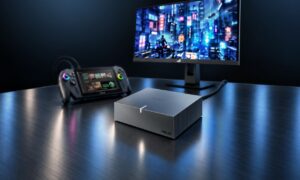
TUXEDO Nano Pro Gen15 asks €1,749 in Germany, about US$1,960, for a Linux mini PC nobody has independently tested yet. TUXEDO is accepting preorders, but says the first units will not ship until mid-November 2026. On November 9, the manufacturer still labeled the exact model “Available for Pre-order Now” and said shipping would start in mid-November.
The reason to wait is not the processor. It is TUXEDO’s unusual claim that two socketed DDR5 slots can take 128GB beside Intel’s Arc B390 graphics. That could make a remarkably small Linux workstation for code, home-lab jobs and medium local AI models. It could also expose memory, driver, noise and cooling limits that a specification sheet cannot settle.
Nobody at The Desk Brief has handled this system. I checked TUXEDO’s specifications against Intel’s processor database, current Apple documentation and published testing of shipping mini PCs. The recommendation rests on confirmed hardware, repair access and the questions that only exact-system testing can answer.
Table of Contents
- The hardware TUXEDO is selling
- TUXEDO Nano Pro Gen15 vs Mac mini
- The 128GB claim needs proof
- Linux support is the real product
- Small chassis, external power brick
- Who should look elsewhere
- Evidence to check once units ship
- TUXEDO Nano Pro Gen15 FAQ
- The Short Version
The Hardware TUXEDO Is Selling
The Core Ultra X7 358H has 16 CPU cores: four performance cores, eight efficiency cores and four low-power efficiency cores. TUXEDO allows a sustained 45 W setting and supplies a 120 W external adapter. Intel lists a 4.8 GHz maximum turbo frequency and an 80 W maximum turbo power for the chip, but neither figure tells us how long this 49 mm-high chassis can hold its fastest state.
Arc B390 integrated graphics bring 12 Xe cores with a manufacturer maximum clock of 2.5 GHz. TUXEDO says the machine can drive four 4K displays and handle light Full HD gaming. Those are platform capabilities and manufacturer positioning, not measured frame rates from this computer. Anyone buying it for a specific game should wait for Linux driver and chassis-level results.
The base German configuration includes 16GB of DDR5 memory in two modules, a 500GB SSD and TUXEDO OS. Its €1,749 price includes 19 percent German VAT and converts to about US$1,960 using the Bank of Canada’s November 9, 2026 daily EUR/CAD and USD/CAD rates, which imply 1 euro equals about US$1.120. Customers outside Germany see €1,470, about US$1,647, before local tax, customs and shipping. TUXEDO lists the US, Canada and UK among its shipping destinations, so the import bill matters.
TUXEDO Nano Pro Gen15 vs Mac Mini
Apple’s shipping M6 Mac mini is the useful value reference. It starts at US$899 with 16GB of unified memory and 256GB of storage, according to Apple’s September availability update. TUXEDO costs roughly twice as much after German tax. Its answer is replaceable memory, two accessible SSD slots, Linux support and a second Ethernet port.
| Decision point | TUXEDO mini PC | Apple Mac mini M6 |
|---|---|---|
| Release state | Preorder; shipping starts mid-November | Shipping now |
| Manufacturer price | €1,749 in Germany, about US$1,960; €1,470, about US$1,647, before tax and import | From US$899 |
| Processor | Core Ultra X7 358H, 16 cores | M6, 12-core CPU |
| Graphics | Arc B390, 12 Xe cores | M6, 12-core GPU |
| Memory | 16GB base; up to 128GB claimed; two socketed DDR5 slots | 16GB base; up to 32GB; fixed unified memory |
| Storage | 500GB base; two accessible M.2 slots | 256GB base; up to 2TB; not user-upgradeable |
| Networking | Two 2.5GbE ports, Wi-Fi 7 | One 2.5GbE port, optional 10GbE, Wi-Fi 7 |
| Named drawbacks | Untested chassis, external power brick, costly import, Linux HDMI cap | Fixed memory and storage, 32GB ceiling, one Ethernet port |
The Mac is the cheaper finished appliance. The TUXEDO is the more flexible small computer. Paying the premium makes sense only when Linux support, replaceable RAM or dual networking solves a job the base Mac cannot. Buying it because both spec sheets contain the word AI is an expensive way to avoid defining the workload.
The 128GB Claim Needs Proof
TUXEDO Nano Pro Gen15 advertises two DDR5-7200 SO-DIMM slots and a 128GB ceiling. Intel’s exact Core Ultra X7 358H page still listed a 96GB maximum and “Up to LPDDR5X 9600 MT/s” on November 9. VideoCardz flagged the same conflict in its launch coverage. The system builder may have validated an implementation Intel’s public table does not describe, but neither company has published a compatible-memory list that resolves it.
That is not a footnote when 128GB is the sales pitch. A buyer needs to know which 64GB modules work, whether they reach the advertised memory rate, and how the integrated GPU reserves system memory. Until those answers exist, treat 128GB as a TUXEDO configuration claim rather than a demonstrated result.
If the team at TUXEDO would like to get in touch with The Desk Brief to verify or clarify these contradictions, we will revise this post.
Capacity also does not guarantee useful local-AI speed. The Arc GPU shares ordinary dual-channel DDR5, while tested Ryzen AI Max systems use much wider soldered memory. The site’s Beelink GTR9 Pro analysis shows what a verified 128GB mini PC can do, and ServeTheHome’s testing found that shipping system needed firmware cleanup even with stronger networking and a much larger cooler. TUXEDO has not published equivalent tokens-per-second, noise or sustained-power data.
Linux Support Is the Real Product
The strongest reason to buy is boring in the best way: TUXEDO installs and supports Linux. TUXEDO OS and Ubuntu are factory options, its Control Center includes fan controls, and the WebFAI recovery tool can rebuild a supported installation. That is more valuable than saving money on a generic mini PC and then discovering that sleep, audio or fan control needs a forum archaeology project.
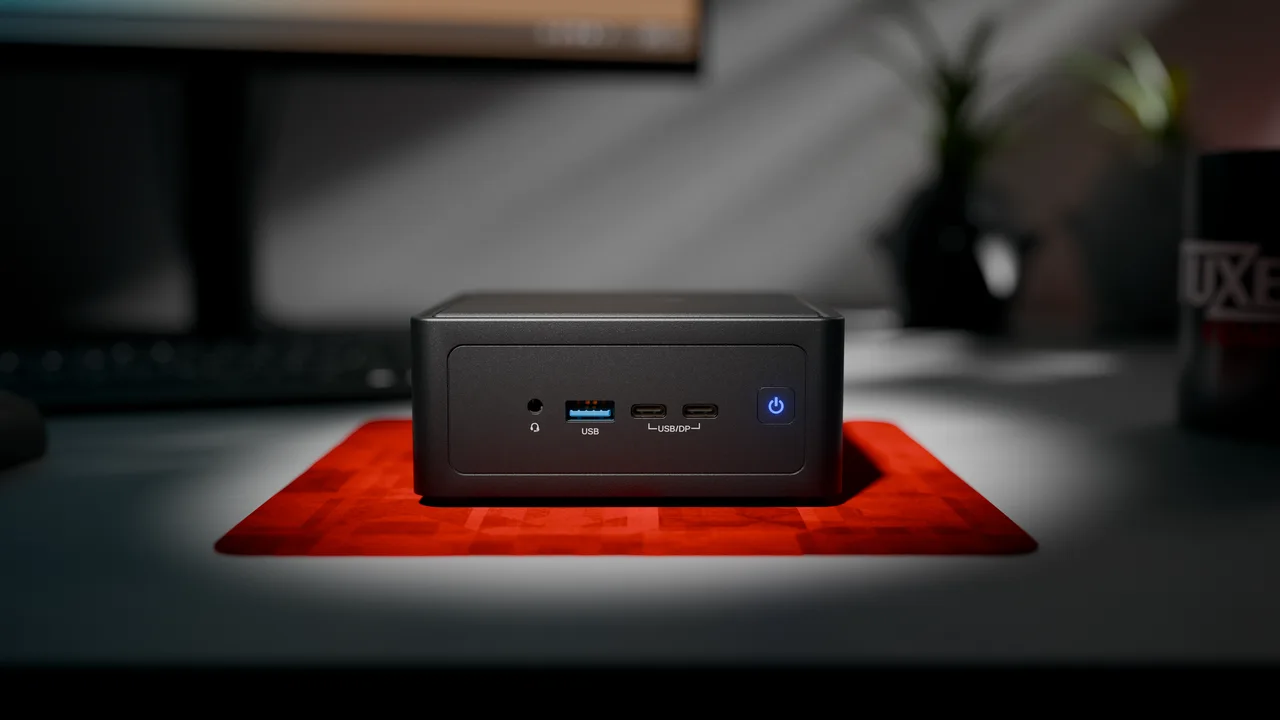
The port layout also suits a home lab. Two 2.5GbE jacks can separate storage and client traffic, or support routing experiments. TUXEDO’s specification table lists the front connections as “1x USB-C / USB4 incl. DisplayPort 2.1,” “1x USB-C 3.2 Gen2x2 incl. DisplayPort 1.4a,” “1x USB-A 3.2 Gen2” and 2-in-1 audio; the overview calls the first connection Thunderbolt 4. Two more USB-A ports and two HDMI outputs sit at the back. Both RAM modules, both SSDs and the wireless card are accessible after removing four base screws.
There is one awkward Linux-specific limit. TUXEDO documents the HDMI ports at 4K 60 Hz under Linux but 4K 120 Hz under Windows. The USB-C display paths also top out at 4K 60 Hz in the current specification. Four displays are possible, but this is not a four-screen high-refresh workstation. The distinction belongs in the buying decision, not in a driver troubleshooting thread after delivery.
Small Chassis, External Power Brick
TUXEDO Nano Pro Gen15 measures 110 by 117.5 mm across the desk, almost 20 percent less footprint than the current Mac mini. It is not the smallest box in the category, and its 120 W adapter still needs somewhere to live. The included VESA mount is the neat answer when a compatible monitor leaves enough clearance for cables and exhaust.
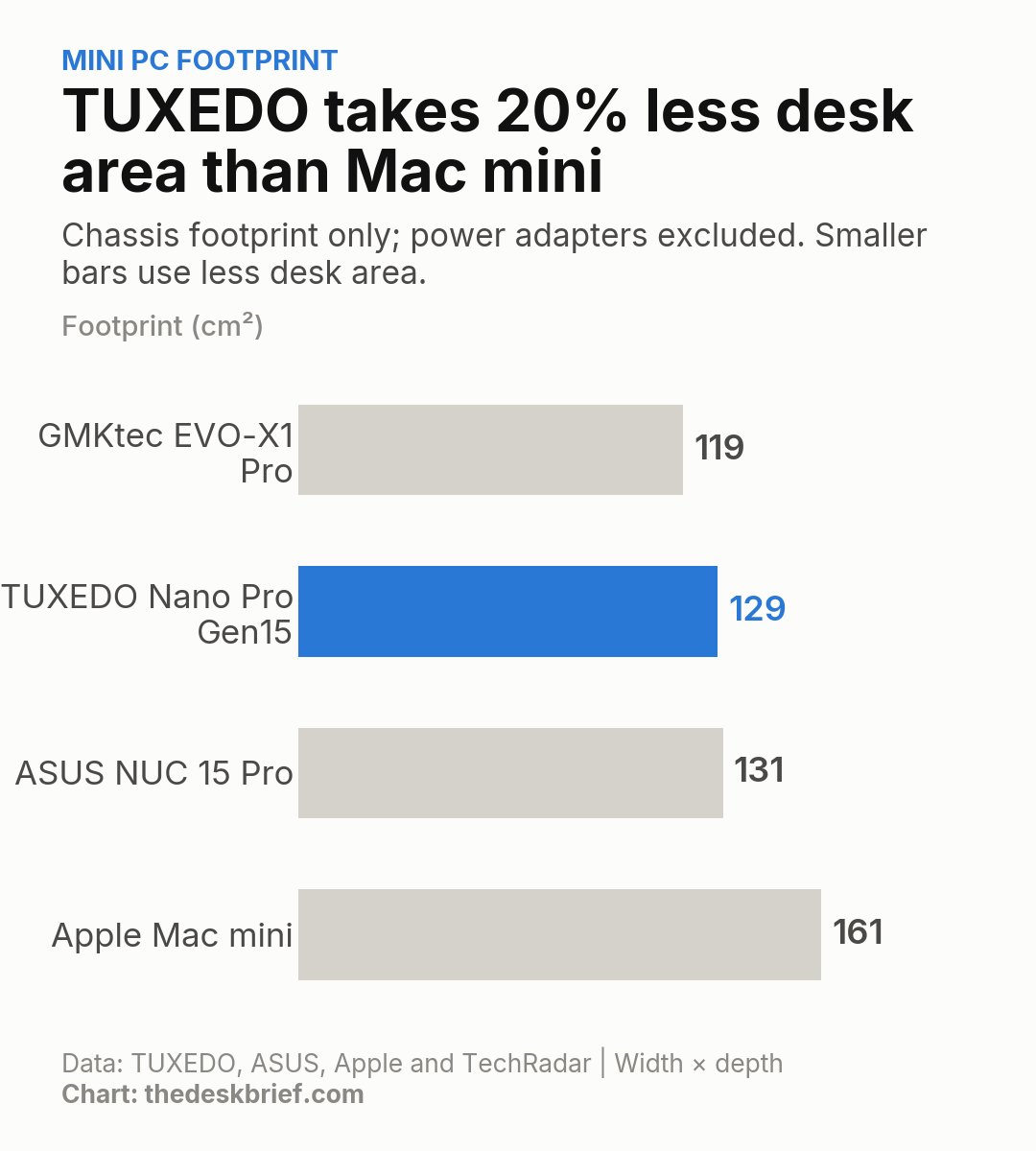
The chart compares chassis area, not total setup volume. Apple’s power supply is internal; the other three comparison machines use external adapters. TUXEDO’s plastic shell also weighs about 1 kg, which is heavier than its dimensions suggest. Small does not automatically mean quiet, and no independent outlet has measured this fan under a 45 W sustained load.
Who Should Look Elsewhere
TUXEDO Nano Pro Gen15 is a poor fit when 16GB or 32GB is enough, macOS suits the work, or verified gaming performance matters today. The Mac mini costs far less and includes its power supply inside the chassis. A conventional desktop is easier to cool and expand if VESA mounting is not important.
Local-AI buyers should also pause. The ability to fit a model in memory is only the first gate; memory bandwidth, driver support and inference software decide whether it runs usefully. Start with the site’s local LLM guide, then choose hardware for a named model and workload. For a higher-end compact comparison, the RTX Spark mini PC roundup covers CUDA-focused systems with a very different price and software case.
Evidence to Check Once Units Ship
Customer delivery is the first fact to confirm, rather than another change to a preorder date. The useful evidence after that is a tested 128GB kit, real DDR5 speed, sustained CPU power, fan noise at idle and load, Arc B390 gaming, 4K display behavior under Linux, and local inference across several model sizes. Price and regional delivery costs will also need a fresh check because import tax can turn the ex-VAT figure into fiction quickly.
Nano Pro Gen15 FAQ
Does it really support 128GB of RAM?
TUXEDO says yes and lists two socketed DDR5-7200 slots. Intel’s processor page still listed a 96GB maximum and LPDDR5X 9600 MT/s on November 9. A validated 128GB kit from TUXEDO or an exact-system test would resolve the conflict.
When does the TUXEDO Nano Pro Gen15 ship?
TUXEDO says shipping starts in mid-November 2026 and warns that production-start delays can occur. On November 9, its page still showed “Available for Pre-order Now” rather than customer delivery.
Can it run local AI models?
It should run supported models through Linux tools that can use Intel Arc graphics, and large system-memory configurations may fit bigger quantized models. Exact-model speed is untested. Do not convert a capacity claim into a performance claim.
Is it better than a Mac mini?
It is more upgradeable and offers dual Ethernet plus factory Linux support. The M6 Mac mini is cheaper, shipping and already has a mature software ecosystem. The TUXEDO is better only when its repairable Linux-first design solves your actual job.
The Short Version
TUXEDO Nano Pro Gen15 is one of the most interesting tiny Linux PCs announced this fall, but preordering it means paying for unverified promises. The socketed memory, two SSD slots, dual 2.5GbE and supported Linux image are real advantages. The 128GB claim conflicts with Intel’s public processor table, HDMI is limited to 4K 60 Hz under Linux, and no one has measured the exact chassis yet. Most buyers should let the first shipped systems prove the memory and cooling claims before ordering.