Do blue light glasses work for digital eye strain? Mostly no. The best available review found no meaningful short-term advantage over ordinary clear lenses, and the American Academy of Ophthalmology does not recommend special eyewear for computer use.
That answer is less exciting than the sales pitch, but it saves you money. Blue-light filtering can change the colour of what you see. It may also have a limited role around late-evening light exposure for some people. Neither point turns a coating into a general screen-strain fix or proof that a laptop is damaging your retina.
This is consumer-tech analysis, not medical advice. It does not diagnose or treat an eye condition. Persistent, severe, or changing discomfort belongs in a conversation with an eye-care professional, not in an online shopping cart.
Table of Contents
- Do blue light glasses work for digital eye strain?
- What the strongest review found
- Why screens can still feel tiring
- What actually helps at a desk
- When blue-light lenses may still make sense
- What not to pay extra for
- Frequently asked questions
- The Short Version
Do blue light glasses work for digital eye strain?
The honest verdict is that blue light glasses do not meaningfully reduce digital eye strain for most people. The AAO’s EyeWiki page on computer vision syndrome quotes the Academy’s position directly: computer-screen light has not been shown to damage the eyes, so it does not recommend special eyewear for computer use.
Cleveland Clinic reaches the same practical conclusion. Its April 2026 review says blue-light glasses do not prevent eye strain and are not needed for eye health. It points instead to close focusing, reduced blinking, dryness, font size, viewing distance, and screen habits.
That does not mean anyone who likes a pair is imagining comfort. A tint can change perceived brightness. An anti-reflective coating can reduce reflections. A correct prescription can make text easier to resolve. Those are real optical differences, but they are not evidence that filtering blue wavelengths solved the strain.
What the strongest review found
The most useful single source is the 2023 Cochrane review of blue-light filtering spectacle lenses. It included 17 randomized controlled trials with 619 adults across six countries. Follow-up ranged from less than one day to five weeks, and study sizes ranged from five to 156 people.
For subjective visual fatigue, the review found that blue-light filtering lenses may offer no short-term advantage over non-filtering lenses. One 120-person trial reported no difference, and two smaller studies with 46 participants combined also found no significant difference between groups. Cochrane did not pool the studies because the populations, follow-up periods, and available numerical data were too different.
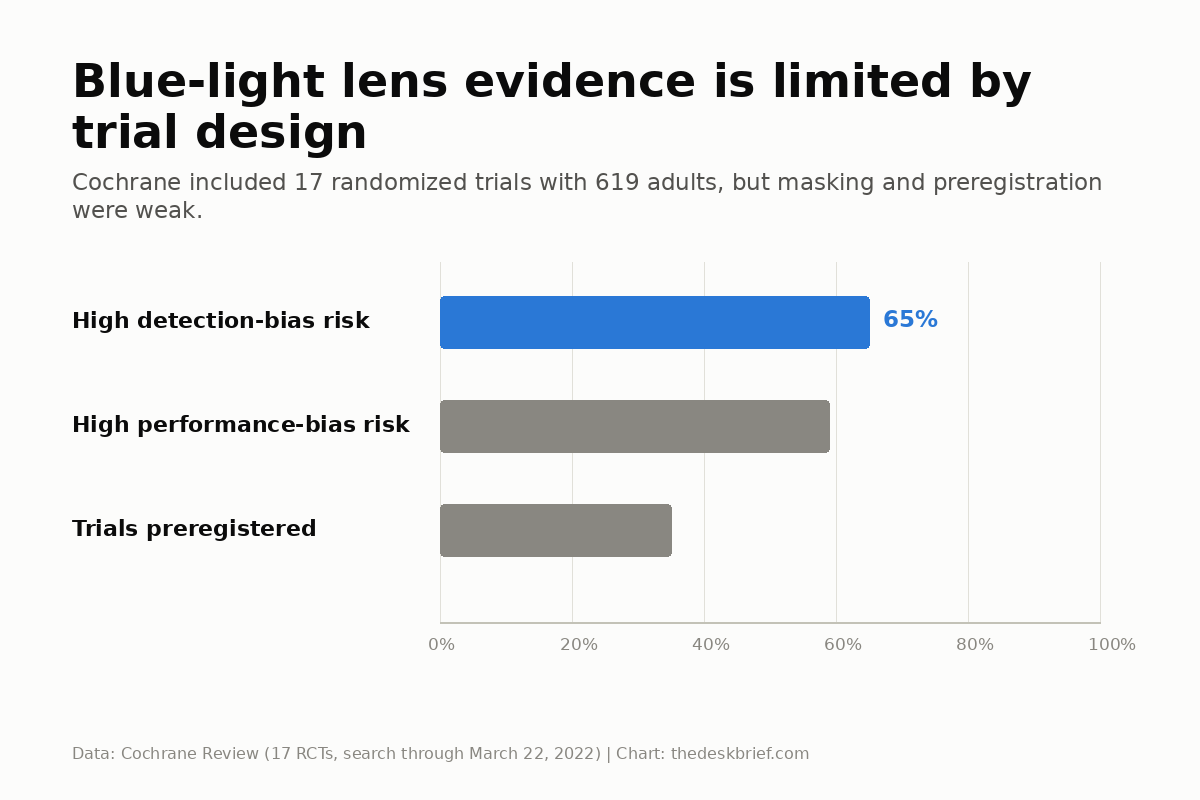
The evidence quality matters as much as the headline. Cochrane judged 65% of the trials at high risk of detection bias because outcome assessors were not masked. It judged 59% at high risk of performance bias because participants and personnel were not masked. Only 35% of trials were preregistered. Those weaknesses do not prove the lenses never help anyone, but they make large marketing claims especially hard to defend.
The review also found sleep results unclear. Six trials with 148 people split evenly: three reported improvement in sleep scores and three did not. That is a reason to say “uncertain,” not a reason to sell all-day office glasses as a sleep product.
Why screens can still feel tiring
A weak case for blue-light glasses does not mean screen discomfort is fake. Screen work asks the eyes to hold near focus for long stretches. People also tend to blink less completely while concentrating. Reflections, dry air, small text, a bright display in a dim room, and an outdated prescription can add separate problems to the same workday.
The problem with the blue-light story is that it collapses all of those variables into one villain. It is easy to market because the fix arrives in a box. Moving a monitor, increasing text size, changing room light, and taking regular breaks are less glamorous. They are also more directly connected to how a desk is actually used.
The Academy’s position is narrower than some retellings make it sound. It says screen light has not been shown to damage eyes and special eyewear is not recommended for computer use. It does not say people should ignore discomfort, skip eye exams, or keep a monitor at any distance that fits on the desk.
What actually helps at a desk
Start with the free changes. They are reversible, easy to test one at a time, and do not require believing a coating label.
- Use real distance. Set the screen far enough away that you can read without leaning forward. The correct monitor height guide explains how to set a practical screen position without leaning forward.
- Make text larger. Scaling text is usually better than pulling a 27-inch display closer until individual pixels and reflections dominate.
- Match brightness to the room. A white document should look like a lit sheet of paper, not a small window aimed at your face. There is no universal brightness percentage because monitors and rooms differ.
- Control reflections. Turn the monitor or move the light source before buying a filter. Matte coatings help with distinct reflections, though they can soften fine detail slightly.
- Remember to blink. Concentrated screen work can reduce complete blinking. A reminder is free and does not alter colour.
- Break near focus. The free 20-20-20 timer runs a 20-minute work interval and a 20-second look-away prompt. The exact rule has a modest evidence base, but it is a reasonable no-cost break habit.
- Set monitor height separately. The monitor-height guide addresses neck angle and screen position. Glasses cannot compensate for a display that makes you crane upward.
Change one or two variables, then give the setup enough time to judge. If you replace the monitor, glasses, lighting, chair position, and font size in one afternoon, you will not know which change mattered.
When blue-light lenses may still make sense
There are three defensible reasons to choose them. First, you may prefer the tint. Preference is not a clinical outcome, but comfort still has value. Second, the pair may include a good anti-reflective coating or the prescription you actually need. Ask the optician to separate the price of those features from the blue-light add-on.
Third, evening light timing is a different question from daytime eye strain. Blue-rich light can influence circadian timing, and Cleveland Clinic says filtering glasses may help some late-night screen users sleep. Cochrane found the spectacle-lens evidence inconclusive, so this remains a cautious “may,” not a guaranteed result. Reducing late-night screen time or using the device’s warmer evening mode costs nothing.
If you already own a pair and like it, there is no prize for throwing it away. The point is not that the glasses are forbidden. The point is that the evidence does not justify paying a large premium or delaying the setup changes that address glare, focus, blinking, and distance more directly.
What not to pay extra for
Skip claims that ordinary screen use is damaging your retina unless the seller provides credible human evidence at real device exposure levels. Cleveland Clinic notes that sunlight is a much larger blue-light source than phones, tablets, televisions, and monitors combined. A product page that moves from sunlight risk to computer glasses without showing that exposure gap is doing marketing, not careful science.
If you are asking do blue light glasses work because a retailer says a coating protects your eyes, ask for the outcome and the human trial behind it. A transmission percentage is a lens specification, not proof of less strain or better long-term eye health.
Skip vague percentage claims too. “Blocks 30% of blue light” says nothing about which wavelengths, how the lens was measured, how much colour shifts, or whether that filtering changes the outcome you care about. More filtering is not automatically better.
Finally, do not assume an expensive frame creates a better office tool. If you need prescription lenses, spend first on an accurate prescription, comfortable fit, and a solid anti-reflective coating. If you do not need correction, an ordinary pair of clear blue-light glasses has not shown a reliable eye-strain advantage.
Frequently asked questions
Do blue light glasses work for headaches?
The current evidence does not establish blue-light filtering lenses as a headache treatment. Headaches during screen work can have many contributors, and this article cannot identify yours. Treat product claims that promise prevention or treatment as a reason to slow down.
Can blue light from a monitor damage your eyes?
The AAO says there is no scientific evidence that light from computer screens damages the eyes. That is why the Academy does not recommend special computer eyewear. Sunlight is a much larger blue-light exposure.
Do blue light glasses help with sleep?
Possibly for some evening users, but the lens evidence is mixed. Cochrane found three trials with improved sleep scores and three without a significant difference. Reducing late-night screen exposure is the cheaper first test.
Is night mode the same as blue light glasses?
No. A device night mode changes the display’s colour output, while the glasses filter light after it leaves the screen. Both can make the image warmer. Neither has been proven to fix daytime digital eye strain.
The Short Version
Do blue light glasses work? Not as a reliable digital-eye-strain fix. AAO guidance, Cleveland Clinic, and the best systematic review all point away from the coating as the main answer. Spend nothing first: adjust distance, text size, brightness, glare, blinking, and breaks. Buy the glasses only if you prefer the tint, need the prescription, or want to test an evening-use habit without pretending the evidence is stronger than it is.