Lenovo does not currently list a Legion 7i Gen 11 in Canada. Model 83KY008AUS, the 2026 Intel configuration with a 12GB RTX 5070, is officially named Legion 7i Gen 10 on Lenovo’s own page. The actual Gen 11 option in this comparison is the AMD Legion 7a Gen 11 with a Ryzen AI 9 HX 470 and RTX 5060, but its 32GB of soldered memory is a major upgradeability downgrade.
The honest comparison is therefore not an Intel Gen 11 replacement against Gen 10. It is a newer Gen 10 Intel configuration with 12GB of graphics memory against the official Gen 11 AMD model with weaker graphics and fixed system memory. I bought Gen 10 model 83KY0002US in November 2025 and have used it for nine months. Neither current choice makes an automatic upgrade from that machine.
Last updated: September 2, 2026. I own and use Gen 10 model 83KY0002US. I have not tested model 83KY008AUS or the Gen 11 7a, so their specifications, prices, and availability come from Lenovo’s live listings. Model names below now follow Lenovo’s own pages. Any real performance difference still needs independent testing on the exact retail configuration.
Table of Contents
- What Lenovo actually calls Gen 11
- Newer Legion 7i Gen 10 vs original Gen 10
- Legion 7i Gen 10 vs Legion 7a Gen 11
- The likely performance difference
- What nine months with Gen 10 tells me
- The pricing story
- Who should upgrade
- Who should skip this
- Frequently asked questions
- The Short Version
What Lenovo Actually Calls Gen 11
Lenovo’s official Canadian page calls 83KY008AUS a Legion 7i Gen 10, not Gen 11. It is a later configuration of the same chassis with a Core Ultra 9 290HX Plus. Compared with the 275HX in my model, both processors have 24 cores and 24 threads, while maximum P-core and E-core clocks rise from 5.4GHz and 4.6GHz to 5.5GHz and 4.7GHz.
The larger change is graphics memory. Lenovo’s 2026 retail configuration, model 83KY008AUS, combines the RTX 5070 with 12GB of GDDR7. My original Gen 10 has 8GB. The new GPU still lists 4,608 CUDA cores, a 2,347MHz boost clock, and 115W including Dynamic Boost. This is a useful memory upgrade, not a jump to an RTX 5070 Ti.
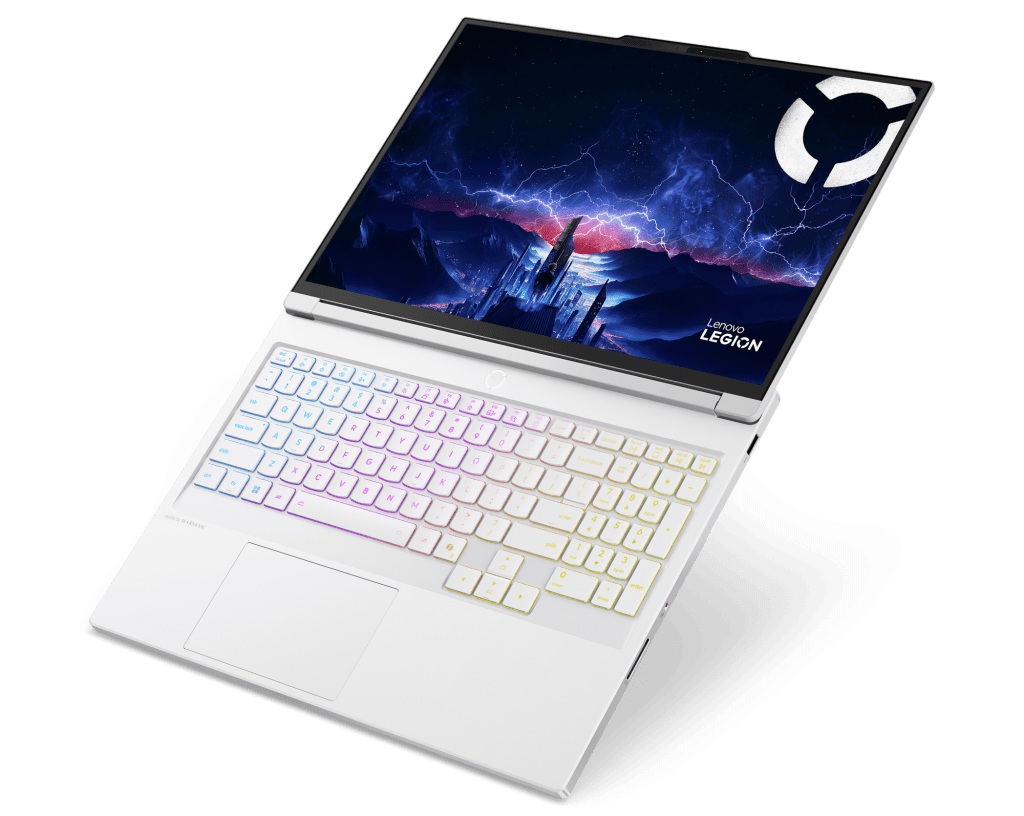
Everything else on the Intel version is familiar. Lenovo keeps the 16-inch 2560 × 1600 OLED panel with a 240Hz variable refresh rate, the 84Wh battery, 245W adapter, Wi-Fi 7, two SODIMM slots, and two SSD positions. The fixed Intel configuration includes 32GB of DDR5-5600 and one 1TB SSD. My Gen 10 arrived with 32GB and two 1TB SSDs.
Two Legion 7i Gen 10 Configurations vs Gen 11 AMD
| Specification | Gen 10 owned here | Newer Gen 10 7i Intel | Gen 11 7a AMD |
|---|---|---|---|
| Model | 83KY0002US | 83KY008AUS | 83Q80003US |
| Processor | Core Ultra 9 275HX | Core Ultra 9 290HX Plus | Ryzen AI 9 HX 470 |
| Graphics | RTX 5070, 8GB | RTX 5070, 12GB | RTX 5060, 8GB |
| Memory and upgradeability | Originally 32GB, upgraded to 64GB; two SODIMMs | 32GB DDR5-5600; two SODIMMs | 32GB LPDDR5X-8533; soldered |
| Included storage | 2TB, two 1TB SSDs | 1TB SSD | 1TB SSD |
| Display | 16-inch 2560 × 1600 OLED, 240Hz | 16-inch 2560 × 1600 OLED, 240Hz | 16-inch 2560 × 1600 OLED, 240Hz |
| Lenovo Canada price, Aug. 30 | CA$4,119.99, temporarily unavailable | CA$3,300.29, temporarily unavailable | CA$3,149.99, available |
The port layout also carries over: Thunderbolt 4, a second USB-C port, two USB-A ports, HDMI 2.1, an SD 4.0 reader, audio, and rear DC input. Both USB-C ports support display output and USB Power Delivery, but neither replaces the 245W adapter during gaming. Anyone expecting a new rear I/O layout or one-cable full-power dock has no upgrade here.
Legion 7i Gen 10 vs Legion 7a Gen 11
Lenovo’s 16-inch Legion 7a Gen 11 listing pairs the Ryzen AI 9 HX 470 with an RTX 5060 8GB, 32GB LPDDR5X-8533, a 1TB SSD, and the same-resolution 240Hz OLED. At CA$3,149.99, it was only CA$150.30 below the CA$3,300.29 Intel listing during this check. The 7a was available; the 7i was temporarily unavailable.
The soldered memory is the decisive tradeoff. I upgraded my Gen 10 to 64GB after purchase by replacing its SODIMMs. That doubled its memory when my workloads grew. The Intel 7i Gen 10 retains that option, but the 7a Gen 11 is fixed at 32GB for the life of the motherboard. Faster LPDDR5X does not compensate if a future workload needs more capacity.
The AMD model can still suit a buyer who knows 32GB will remain enough and prefers the configuration that is available now. It is a weaker gaming specification, however: RTX 5060 8GB versus RTX 5070 12GB. Without controlled battery and performance tests, the AMD badge alone is not evidence of better runtime or value.
The Likely Performance Difference
The CPU change should be small. The Core Ultra 9 290HX Plus has the same core count and architecture as the 275HX, with only 100MHz added to the maximum clocks. That can help short CPU workloads, but it is not the platform change implied by a new generation number.
The 12GB RTX 5070 is the real reason to care. Four extra gigabytes give high-resolution texture packs, render projects, and local AI workloads more breathing room. Games that already fit inside 8GB should not receive a large gain from capacity alone because CUDA cores, listed boost, memory bus width, and power remain unchanged. Games that exceed 8GB can gain smoother frame delivery or avoid reduced textures, which is more important than a flattering average frame-rate number.
A detailed Gen 11 hands-on comparison puts the 275HX and 290HX Plus systems side by side and tests the 12GB GPU in current games. It is useful launch-window evidence, but one sample is not enough to declare a universal percentage. Cooling mode, game settings, firmware, and whether a workload crosses 8GB all matter.
What Nine Months With the Gen 10 Actually Tells Me
My full Legion 7i Gen 10 owner review covers the chassis strengths and compromises. The OLED remains the standout feature. It is sharp, fast, and genuinely good for both games and work, although its glossy surface is not ideal beside a bright window.
Battery life is still the clearest weakness. My normal mixed use is roughly two to three hours unless I use an energy-saving mode and keep the OLED dim. I did not record a controlled battery-health baseline at purchase, so I cannot calculate a nine-month degradation percentage honestly. The newer Intel configuration keeps the same 84Wh capacity, and I would not assume a major runtime improvement without a controlled test.
I also do not have before-and-after thermal telemetry proving that cooling changed with age. An independent test of this chassis reached 54.6 dB(A) in Performance mode and 45.9 dB(A) in Balanced mode. The thin body remains loud when pushed. Gen 11 uses the same chassis and GPU power, so buyers should expect similar behaviour until exact-model testing proves otherwise.
The upgrade paths have aged better. Both SSD positions are useful when games and local models share the machine. I upgraded from 32GB to 64GB using the two SODIMM slots, a concrete advantage over the soldered 32GB in the 7a. Thunderbolt handles data and displays, while the laptop still needs Lenovo’s 245W adapter for reliable high-load power.
The ownership record does not document hinge looseness, keyboard failure, or a quantified thermal decline. I am not turning missing measurements into a durability score. The defensible conclusion is narrower: Gen 10 still performs the work I bought it for, and the newer Gen 10 configuration improves VRAM without fixing its battery or docking compromises.
The Pricing Story: Buy Now or Wait for Black Friday?
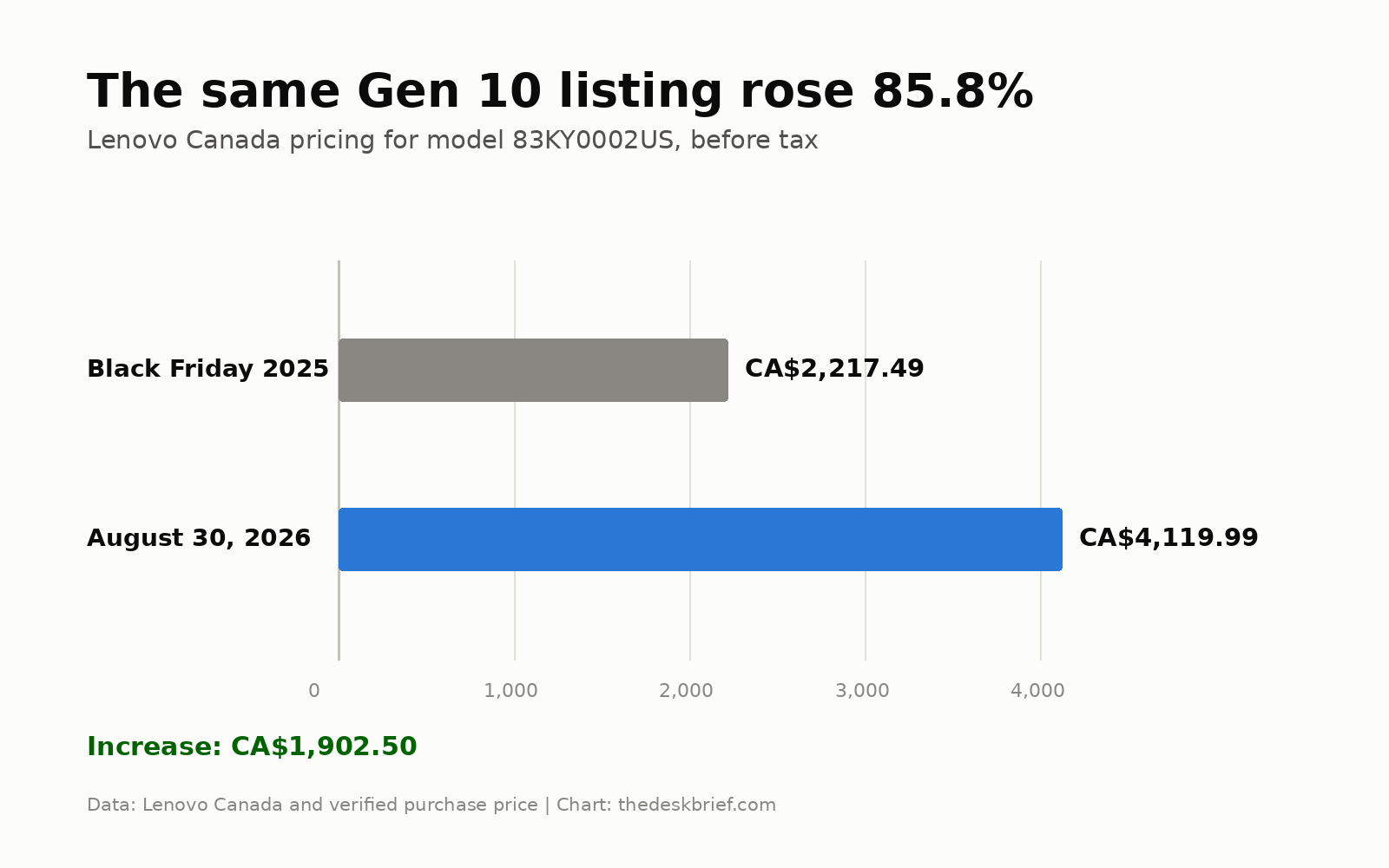
I bought model 83KY0002US from Lenovo Canada on Black Friday, November 25, 2025, for CA$2,217.49 before tax with free shipping. CA$87.42 in Lenovo rewards lowered my effective pre-tax cost to about CA$2,130. Lenovo also advertised tiered Black Friday codes: CA$10 off CA$100, CA$20 off CA$500, CA$50 off CA$1,000, and CA$100 off CA$2,000. I have not subtracted an unused coupon from my purchase price.
On August 30, 2026, Lenovo listed that same Gen 10 model at CA$4,119.99 and temporarily unavailable. The difference is CA$1,902.50, or 85.8%. The newer Gen 10 7i was CA$3,300.29 and temporarily unavailable; the 7a was on sale from CA$4,129.99 to CA$3,149.99 and available.
That history supports waiting for a Lenovo sale, though it does not prove Black Friday will always produce the current price. The site’s Canadian RAM data study found DDR5 configurations up 4.3% to 30.2% over a common July 24 to August 29 window, while DDR4 fell. The RAM buying guide and daily RAM price tracker show what the component market is doing now.
Storage is moving too. The SSD price outlook separates rising NAND contract forecasts from mixed Canadian retail lows. If the newer 12GB Legion 7i Gen 10 returns to stock before late November, compare its checkout price with the CA$2,217.49 Gen 10 benchmark. Do not assume launch promotions, rewards, or coupon stacking until Lenovo publishes the terms.
Who Should Upgrade From Gen 10?
Most Gen 10 owners should keep what they have. Upgrade only if a specific game, renderer, or local model is already failing because 8GB of VRAM is insufficient and the 12GB machine solves that limit. Selling a nine-month-old laptop to buy the same chassis is an expensive way to add 4GB.
New buyers have a better case for the newer 12GB Gen 10 7i because there is no reason to choose 8GB at a similar final price. Its 12GB GPU and replaceable RAM are more durable than the 7a’s RTX 5060 8GB and fixed 32GB. The 7i becomes compelling near the Gen 10 Black Friday price, not at CA$3,300.29 while unavailable.
If local AI is the main reason for wanting more graphics memory, compare the RTX Spark laptop platforms before buying another gaming laptop. Unified memory can matter more than gaming frame rates for large models. Gaming-first buyers should wait for a serious Gen 11 discount or choose a higher GPU tier if the price gap is small.
Who Should Skip This
Skip the newer Lenovo Legion 7i Gen 10 if you already own a working Gen 10, need all-day battery life, expect one-cable dock charging, or would pay full retail for 4GB of extra VRAM. Skip the 7a if 32GB may become restrictive because its memory cannot be replaced. Also avoid any listing without an exact model number and complete specification sheet.
Buyers who need a laptop immediately should compare the final checkout price against other RTX 5070 and 5070 Ti machines. The Legion 7i is attractive when discounted. The generation number alone does not make the arithmetic work.
Lenovo Legion Gen 11 vs Gen 10 FAQ
Is model 83KY008AUS a Legion 7i Gen 11?
No. Lenovo’s Canadian product page identifies 83KY008AUS as Legion 7i Gen 10. It combines a Core Ultra 9 290HX Plus processor and an RTX 5070 with 12GB of GDDR7, while the chassis, OLED display, battery capacity, GPU power specification, memory slots, storage positions, and port layout remain substantially the same as the earlier Gen 10 configuration.
How much did the 12GB Legion 7i Gen 10 cost in Canada?
Lenovo Canada listed model 83KY008AUS at CA$3,300.29 and temporarily unavailable on August 30, 2026. Price and availability can change, so use the exact model number when checking.
Is the 12GB RTX 5070 faster than the 8GB version?
It is better when a workload exceeds 8GB because the system can avoid a graphics-memory bottleneck. Both versions list the same CUDA-core count, boost clock, memory bus, and 115W power, so workloads that already fit within 8GB should see a smaller difference.
Can you upgrade the Legion 7a Gen 11 RAM?
No. Lenovo lists 32GB LPDDR5X-8533 as soldered on model 83Q80003US. Both checked 7i Gen 10 configurations use replaceable SODIMMs. I upgraded my Gen 10 to 64GB after purchase, which would be impossible on this 7a configuration.
Should Gen 10 owners upgrade?
No, unless 8GB of VRAM is already blocking a specific workload. The CPU clock increase is small, the GPU tier and power remain the same, and the newer fixed Intel configuration includes less storage than the Gen 10 machine covered here.
The Short Version
Lenovo’s official naming makes the choice clear: the 12GB RTX 5070 model 83KY008AUS is still Legion 7i Gen 10, while the actual Legion 7a Gen 11 uses an RTX 5060 8GB and soldered 32GB of memory. Existing Gen 10 owners should keep their upgradeable machines. New buyers should compare exact model numbers and wait for a strong discount rather than paying for a generation label the Intel product does not have.
Current listing context: Lenovo identifies 83KY008AUS as a Legion 7i Gen 10.
Current offer checked August 30, 2026: CA$3300.29, out of stock. Prices and availability can change.