25G590B is a US$999.99 answer, based on LG’s list price checked September 25, 2026, to a question almost nobody with a day job needs to ask: how much should I pay to cut a 280 Hz screen’s refresh interval by another 2.57 milliseconds? LG’s 24.5-inch UltraGear runs at a native 1,000 Hz at 1920 x 1080, with an advertised 1,100 Hz overclock. That is real product hardware, not a trade-show prototype. It is also a very specialized monitor that asks you to spend flagship money on Full HD.
This page contains affiliate links. If you buy through these links, we may earn a small commission at no extra cost to you. Full disclosure.
Last updated: September 25, 2026. Now available in the US: LG lists the 25G590B at US$999.99, and Amazon.com has it in stock sold by Amazon.com. LG lists a CA$1,299.99 MSRP, while Amazon.ca is taking preorders for release on September 26, 2026. Independent testing now exists too: TFTCentral measured very low processing lag and strong motion clarity, but pixel transitions still take longer than one 1,000 Hz refresh.
My verdict is simple. Independent testing confirms that competitive players who can sustain four-digit frame rates get unusually clear motion and almost no display-side delay. Everyone building one desk for work and games should still buy the much cheaper 1440p alternative. PC Gamer published a full hands-on review on September 17, 2026. The monitor is in stock in the US, and Amazon.ca is taking preorders for its September 26 Canadian release.
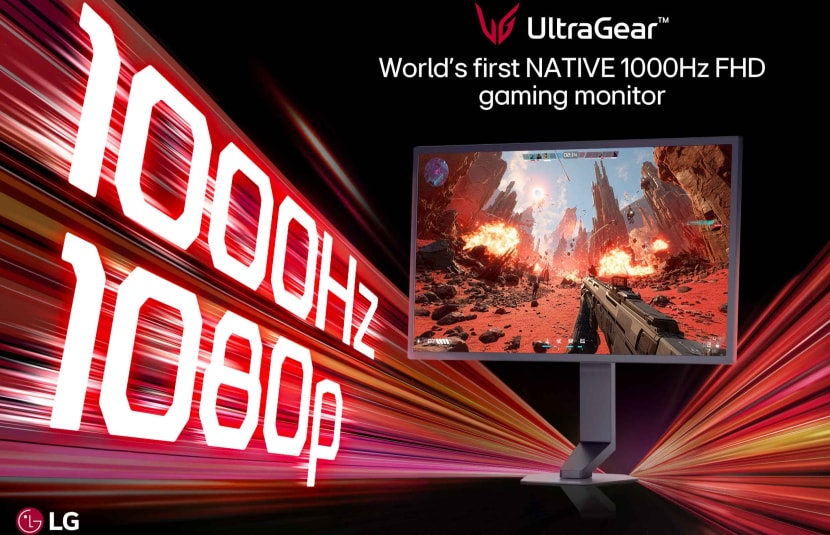
Table of Contents
- 25G590B Specs That Matter
- The Sensible Comparison
- What 1,000 Hz Actually Buys
- Your PC Is Part of the Price
- Why It Is a Poor Work Monitor
- The Cheaper Monitor I Would Buy
- Who Should Skip This
- Frequently Asked Questions
- The Short Version
25G590B Specs That Matter
LG’s current product page lists a 24.5-inch IPS panel, 1920 x 1080 resolution, native 1,000 Hz refresh, DisplayHDR 400, 99% sRGB coverage, and a typical 1,000:1 contrast ratio. The stand adjusts for height, swivel, and tilt. Video inputs include DisplayPort 2.1 UHBR 20 and two HDMI 2.1 ports, plus a four-pole headphone jack. LG 25G590B on Amazon
The advertised response time is below 1 ms GtG. That is a manufacturer specification, not a measured average across transitions, and LG has not published an overshoot chart. The same caution applies to Motion Blur Reduction Pro and the monitor’s AI scene and sound modes. Feature names are cheap. Clean motion at 1,000 Hz is not.
LG says 1,000 Hz requires Windows 11, DisplayPort 2.1, and a recent GPU: GeForce RTX 50 series, Radeon RX 9070, RX 9060, RX 7900 series, or newer. The 1,100 Hz overclock also drops AMD FreeSync Premium support, while G-SYNC compatibility is certified only at 1,000 Hz. LG Canada lists a CA$1,299.99 MSRP, and Amazon.ca is taking preorders for release September 26, 2026. TFTCentral has also published independent response-time, motion, and latency measurements.
The Sensible Comparison
The established reference is the Alienware AW2726DL, not another four-digit-refresh experiment. Dell Canada currently lists it at CA$299.99. It gives a mixed work-and-gaming desk a 27-inch 2560 x 1440 IPS panel at 280 Hz, a fully adjustable stand, 400-nit brightness, and a three-year advanced exchange warranty.
| Buying detail | LG 25G590B | Alienware AW2726DL |
|---|---|---|
| Price checked September 25, 2026 | US$999.99 / CA$1,299.99 manufacturer list | CA$299.99 at Dell Canada |
| Canadian availability | Amazon.ca preorder; releases September 26, 2026 | Available |
| Panel and size | 24.5-inch IPS | 27-inch IPS |
| Resolution | 1920 x 1080 | 2560 x 1440 |
| Maximum refresh | 1,000 Hz native, 1,100 Hz overclock | 280 Hz |
| Typical brightness | 400 nits | 400 nits |
| Adaptive sync | G-SYNC Compatible, FreeSync Premium | FreeSync Premium, VESA AdaptiveSync |
| Main drawback | Extreme price, Full HD, demanding PC requirements | Far lower refresh, no USB hub |
The comparison is lopsided because the products solve different problems. The 25G590B serves elite esports players chasing motion clarity at low resolution. The Alienware serves people who want one affordable screen for documents, games, and everything between. Our full AW2726DL guide covers its limitations, including the absent USB hub and basic HDR performance.
What 1,000 Hz Actually Buys
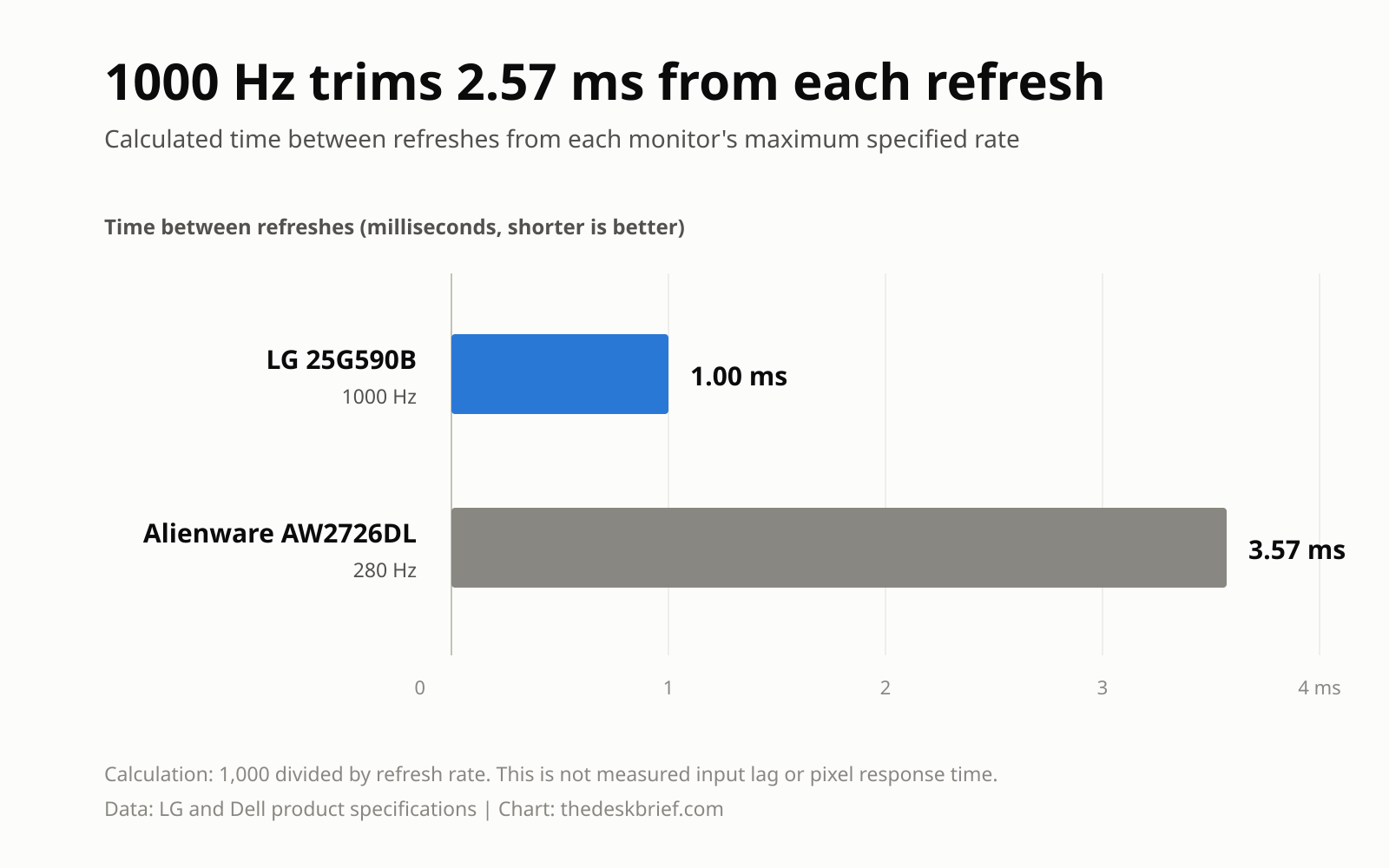
A 1,000 Hz display begins a new refresh every 1 millisecond. A 280 Hz display does so every 3.57 milliseconds. The gap is 2.57 milliseconds before pixel response, input processing, the game engine, network latency, and your hands join the queue. That reduction can matter at the edge of competitive play, but it does not turn a slower player into a sponsored one.
TFTCentral’s instrumented review measured about 2.4 ms average pixel response in the fastest overdrive mode, so the panel cannot finish every transition inside the 1 ms refresh window, but it found essentially no added processing lag at native refresh. MBR Pro produced clearer motion while retaining 289 nits, though it disables variable refresh. PC Gamer’s hands-on review saw motion clarity keep improving past 500 Hz in TestUFO, but its system reached only the high 400s in Counter-Strike 2 and roughly 500 to 800 fps in Valorant. That is the real limit: the display is fast enough, but feeding it is difficult.
Your PC Is Part of the Price
Owning a compatible GPU only clears the connection requirement. The game must still render close to 1,000 frames per second for each refresh to carry a genuinely new frame. Lightweight competitive titles at reduced settings are the plausible target. A demanding new game with ray tracing is not going to become a 1,000 fps showcase because the cable is optimistic.
This makes the real purchase larger than US$999.99. A player may need a current high-end GPU, a fast gaming CPU, carefully chosen settings, and a title that scales cleanly. If your frame counter lives below 300 fps, the extra refresh capacity mostly sits idle. The broader gaming monitor versus office monitor guide explains why refresh rate is only one part of a useful desk display.
Why It Is a Poor Work Monitor
Full HD at 24.5 inches works out to roughly 90 pixels per inch. The AW2726DL reaches 109 pixels per inch at 27 inches. That difference gives the cheaper Dell more room and finer text, useful benefits in a browser, spreadsheet, or code editor. Refresh rate cannot sharpen a letter that lacks pixels.
The LG also lacks the desk features I would expect near this price. Regional specification pages list no USB-C video, power delivery, KVM, Ethernet, speakers, or USB hub. There is no pivot adjustment either. The compact stand and headset hook are thoughtful, but they do not replace a dock. If work matters as much as games, the Q27G4ZRAD specification analysis shows how much more balanced a fast QHD screen can be.
The Cheaper Monitor I Would Buy
I would buy the Alienware AW2726DL from Dell Canada at CA$299.99 and keep the difference. It is not a substitute for a professional esports training monitor. It is the better purchase for nearly everyone else, with higher resolution, more screen area, strong refresh, a Canadian storefront, and a stated three-year warranty.
TFTCentral has now measured full-transition response, processing lag, and backlight-strobing behaviour at 1,000 Hz, and the results are better than the launch sheet alone suggested. The Canadian price is settled too. Neither fact changes the broad buying advice: LG is selling a specialized speed record at CA$1,299.99, while Dell is selling the better desk for most people.
Who Should Skip This
Skip it if you work on the same screen, prefer detailed single-player games, use a laptop dock, need a USB hub, or rarely exceed 300 fps. Streamers should also account for the second display and capture workflow that this monitor does not simplify. The ideal buyer is narrow: a highly competitive FPS player with suitable hardware, suitable games, and evidence that 280 Hz is already the limiting part of the setup.
Frequently Asked Questions
Is the 25G590B really a native 1,000 Hz monitor?
Yes. LG specifies native 1,000 Hz at 1920 x 1080 rather than a lower-resolution dual mode. The company also advertises a 1,100 Hz overclock. TFTCentral’s independent testing found excellent motion clarity and virtually no added processing lag, although its roughly 2.4 ms average pixel response does not fully fit inside a 1 ms refresh interval.
How much does it cost?
LG listed the monitor at US$999.99 and CA$1,299.99 when checked on September 25, 2026. It is in stock in the US; Amazon.ca is taking preorders for the September 26 Canadian release.
Does it need DisplayPort 2.1?
LG says its maximum refresh modes require DisplayPort 2.1 UHBR 20, Windows 11, and a supported recent GPU. HDMI 2.1 is present, but the company’s 1,000 Hz requirement specifically names DisplayPort 2.1.
Is 1,000 Hz useful for office work?
No practical office task justifies the price. A higher-resolution 1440p or 4K panel gives text and workspace benefits you can see all day, while 1,000 Hz targets competitive motion at very high frame rates.
The Short Version
The 25G590B is technically impressive and economically silly for a normal desk. Its native 1,000 Hz IPS panel cuts the refresh interval to 1 millisecond, but it stays at 1080p, costs US$999.99, requires serious PC hardware, and still cannot finish every pixel transition inside a 1 ms refresh. Wait if you compete at the level it targets. Buy the CA$299.99 AW2726DL if you want a fast monitor that also earns its space from Monday to Friday.
Editorial rating: 3.0 out of 5. The 25G590B is an extraordinary 1000 Hz esports display but an impractical choice for a normal desk at 1080p and US$999.99. Independent tests confirm excellent motion clarity and low processing lag, but its narrow audience and demanding frame-rate target remain.
Current availability checked September 25, 2026: the monitor is in stock in the US. LG Canada lists a CA$1,299.99 MSRP, and the LG 25G590B is available to preorder for release September 26, 2026. Retail prices and availability can change.