This page contains affiliate links. If you buy through these links, we may earn a small commission at no extra cost to you. Full disclosure.
Prices checked and links verified September 2026.
The Samsung 990 QLC is slower than the drive it effectively replaces, ships without a DRAM cache, and still costs more than that older model did when it launched. It reached Samsung’s US store this month at CA$378 (US$270) for 1TB and CA$743 (US$530) for 2TB, and reviewers tacked “QLC” onto the name to keep it apart from the faster 990 Pro and 990 EVO. Four years ago the 990 Pro ran quicker and cost less. That is not a typo, and it is not Samsung getting lazy.
Currency note: Canadian dollar equivalents use the Bank of Canada daily average of 1 USD = 1.4014 CAD on July 17, 2026. Converted amounts are approximate; the original US price is shown in brackets.
Storage is the quiet casualty of the same AI-driven crunch that pushed RAM prices up and sent GPU prices well over list. NAND flash is being vacuumed up by data centers, and Samsung’s response is a cheaper-to-build drive sold at a price that is anything but cheap. So what actually matters isn’t whether the Samsung 990 QLC is a good SSD. It’s whether you should buy any consumer drive right now, and if you have no choice, whether this is the one to grab. I pulled the specs from Samsung’s own listing and checked them against two independent teardowns and a price tracker, none of which I ran myself.
Before buying, compare the most affordable SSD prices in Canada. The daily tracker separates NVMe Gen4, NVMe Gen5, and SATA drives and shows price per TB without mixing capacities.
Table of Contents
- What the Samsung 990 QLC Actually Is
- The Speed You Give Up
- Why It Still Costs This Much
- What to Buy Instead
- Who Should Skip This SSD
- FAQ
- The Short Version
What the Samsung 990 QLC Actually Is
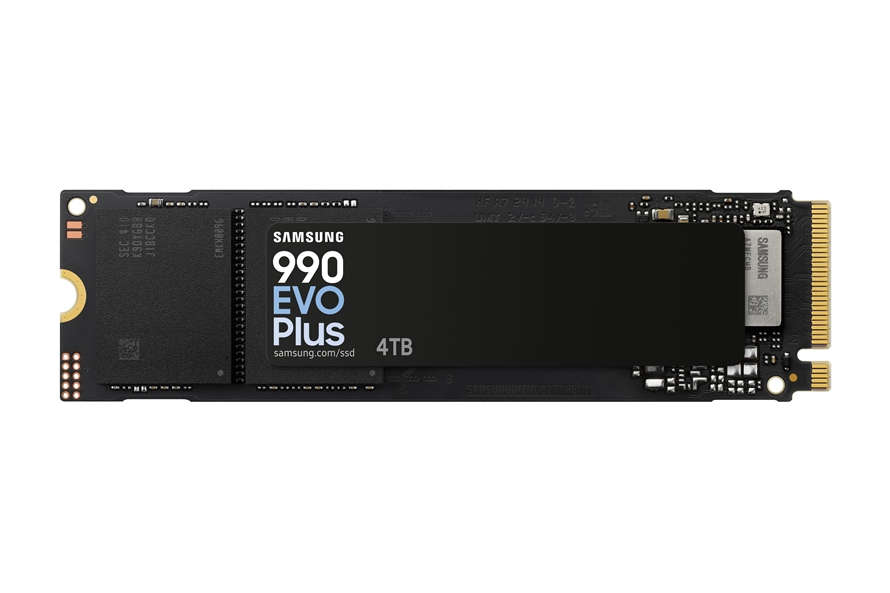
Underneath the familiar black label, the Samsung 990 QLC is a budget drive wearing a flagship badge. It uses Samsung’s ninth-generation QLC V-NAND on a PiccoloQ controller, runs on a PCIe 4.0 x4 link, and has no onboard DRAM. QLC packs four bits into every memory cell instead of the three you get from the TLC flash in the Pro line. That makes it cheaper and denser to manufacture, and slower and less durable to live with. DRAM-less means the drive borrows a slice of your system memory through Host Memory Buffer rather than carrying its own cache chip, which shaves cost and trims a little speed off random work.
Here is what you actually get for your money, per Samsung’s listing and the early spec breakdowns:
- Capacities and price: 1TB at CA$378 (US$270), 2TB at CA$743 (US$530)
- Sequential read up to 7,150 MB/s (1TB) or 7,250 MB/s (2TB); write up to 6,450 MB/s
- Random performance: 850K read IOPS, 1,200K write IOPS
- Endurance: 400 TBW on the 1TB, 800 TBW on the 2TB
- Warranty: three years
None of that is embarrassing on its own. The sequential numbers are within a rounding error of the drives people paid flagship money for a couple of years ago, and 7,000 MB/s reads will saturate anything a normal desktop throws at them. The trouble starts when you line the Samsung 990 QLC up against its own ancestor and notice which direction the arrows point.
The Speed You Give Up
The 2022 Samsung 990 Pro, still on sale today, reads at 7,450 MB/s and writes at 6,900 MB/s, with 1,400K read and 1,550K write IOPS. Put the two side by side and the sequential gap is small, maybe a few percent you will never feel opening a game or copying a video file. The random 4K numbers are where the story lives. The new drive gives up roughly 40 percent of the Pro’s random read throughput and a big chunk of its write IOPS, and random 4K is the work your PC actually does all day: loading a browser with thirty tabs, launching apps, shuffling small files.
QLC has one more habit worth knowing about. These drives keep a fast slice of flash set aside as a write cache, and while that cache holds up, they feel quick. Fill it with a sustained write, a 60GB game install, a folder of RAW photos, a virtual machine image, and the speed falls off a cliff to native QLC rates that can dip below a cheap SATA drive. The DRAM-less design adds a second small tax on top, since the controller leans on system memory to track where everything lives. If you ever swap large model weights to disk on a mini PC like the Beelink GTR9 Pro, that combination is exactly the wrong tool.
For a lot of people none of this matters. If the drive is going to hold a Steam library and some media, the write cliff rarely shows up, and the read speed is plenty. The point isn’t that the Samsung 990 QLC is broken. It’s that you are paying more than the old flagship cost while getting less than it delivered, and you should know that going in.
Why It Still Costs This Much
A cheaper-to-build drive landing at CA$378 (US$270) for 1TB only makes sense once you look at what happened to flash prices. NAND contract prices, the wholesale rate drive makers pay, climbed hard through the last three quarters. TrendForce pegs the quarter-over-quarter jumps at 55 to 60 percent in the first quarter of 2026 and another 70 to 75 percent in the second, on top of the increases that started in late 2025, and its mid-year update says contract prices more than doubled across the first half of the year alone.
The cause is the same one behind every other price story on this site. Enterprise SSDs for AI data centers now eat roughly 60 percent of global NAND output, and Samsung, SK Hynix, and Micron would rather sell high-margin drives to hyperscalers than budget M.2 sticks to you. IDC expects average PC prices to rise by up to 8 percent this year on memory costs alone, and some prebuilt vendors have started shipping machines with empty RAM slots to dodge the problem. The chart below shows what that did to a handful of popular consumer drives between last year and now.
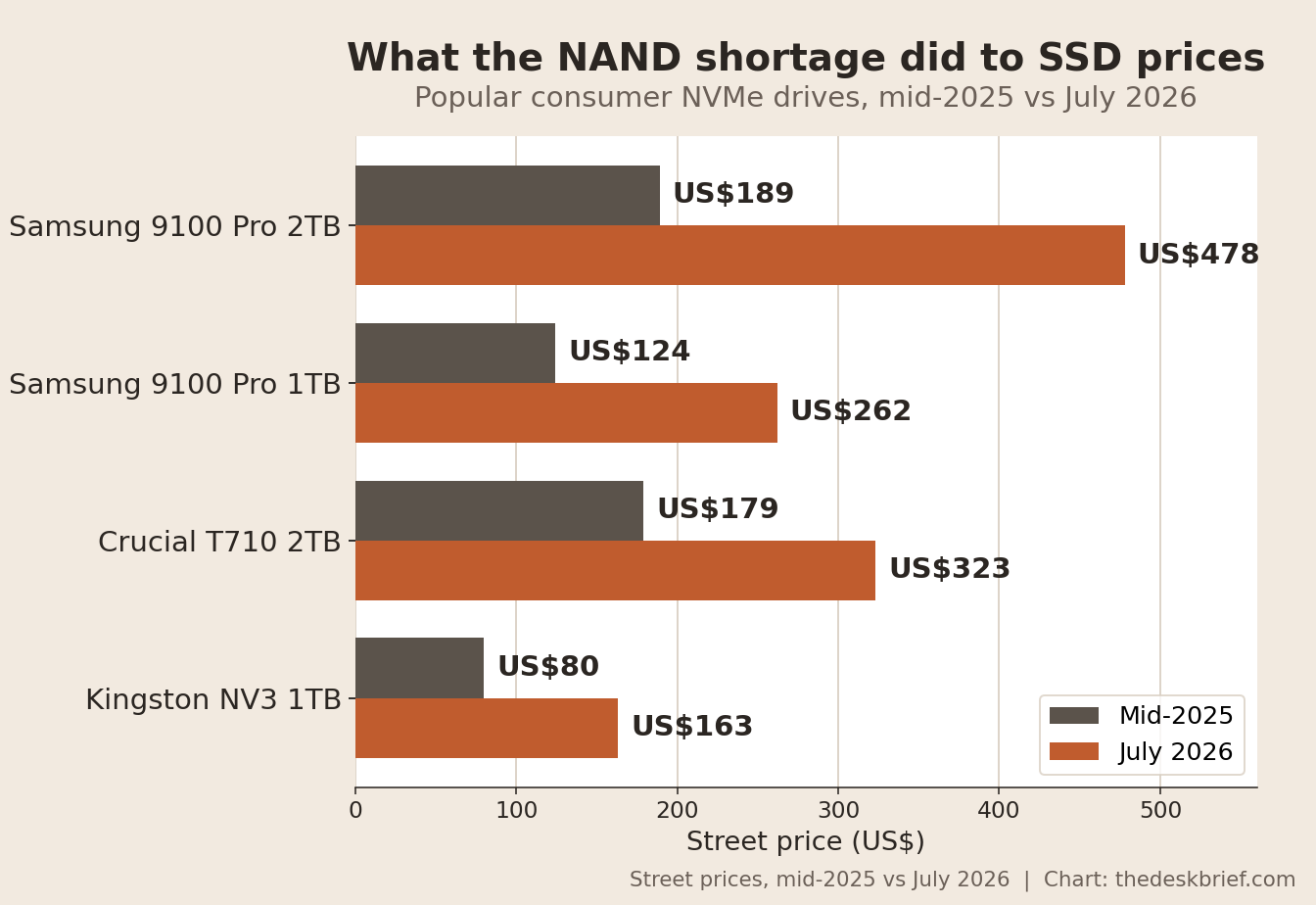
Those are not launch-versus-inflated-scalper numbers. They are ordinary retail prices roughly a year apart, and most doubled. Against that backdrop, Samsung building a lower-cost QLC drive is rational. The frustrating part is that the savings land in Samsung’s margin, not your cart, because the price floor for any 1TB NVMe drive has moved up under everyone’s feet.
What to Buy Instead
Start with the boring advice that saves the most money: buy the capacity you need and not one tier more. At today’s prices, jumping from 1TB to 2TB “just in case” is a CA$364 (US$260) decision, not a CA$56 (US$40) one. If you already have a working drive, the most affordable upgrade is no upgrade. Wait, and use an external USB SSD or a spare drive for overflow in the meantime.
If you do need a new internal drive, price-per-TB is the only number that matters, and QLC is not automatically the answer. When a TLC drive like the 990 EVO Plus or a used 990 Pro sits within about CA$42 (US$30) of the Samsung 990 QLC at the same capacity, take the TLC drive every time. It writes faster, lasts longer, and usually carries a five-year warranty against the QLC drive’s three. The QLC drive only earns its place when it is genuinely, clearly cheaper per terabyte than anything with better flash, and right now that gap is thin.
For bulk storage where you mostly read, a big second drive you rarely write to, QLC is fine and always has been. That is the job it was built for. Just do not let a flashy 990 label talk you into using it as your boot and work drive when a better-built option costs about the same.
Who Should Skip This SSD
Skip the Samsung 990 QLC if it’s going to be your main drive. Boot volumes, video scratch disks, virtual machines, database work, and local AI setups all lean on sustained writes and random 4K speed, the two things this drive gives up. Skip it too if you can find a TLC drive at a similar price per terabyte, which happens more often than the marketing wants you to think.
It’s a reasonable buy in exactly one case: a second drive for game and media storage where you care about dollars per terabyte, write to it rarely, and have confirmed it actually undercuts the TLC competition on the day you check. Buy it for the capacity, never for the badge.
FAQ
Is the Samsung 990 QLC good for gaming?
For loading games, yes. Game loads are read-heavy, and the drive’s 7,000-plus MB/s reads handle them without breaking a sweat. The DRAM-less QLC design only bites during big sustained writes, so a 90GB install will crawl once the cache fills, but day-to-day play feels the same as a pricier drive.
Does DRAM-less really hurt everyday performance?
Less than forums suggest. Host Memory Buffer covers most of what a dedicated DRAM chip would, so light desktop use feels fine. The gap shows up under heavy random load and long writes, which is why a DRAM-less QLC drive is a poor pick for a busy primary disk but perfectly usable as secondary storage.
Is QLC flash reliable enough for a main drive?
For a typical user, yes, within its rated endurance. The 1TB model is rated for 400 TBW, meaning 400 terabytes written before Samsung stops guaranteeing it, which most people take years to approach. Heavy writers, video editors and anyone running virtual machines will chew through that faster and should choose TLC with a longer warranty.
Should I wait for SSD prices to drop?
If you can, yes, but do not hold your breath. TrendForce doesn’t expect real relief before late 2027, and possibly 2028, because new flash fabs take years to come online. Buy only what you need now, and treat any sale as a genuine win rather than a return to normal.
The Short Version
The Samsung 990 QLC is a cheaper-to-build, DRAM-less QLC drive priced at CA$378 (US$270) for 1TB and CA$743 (US$530) for 2TB, and it is measurably slower than the 2022 990 Pro that still sits next to it on the shelf. Sequential speed is fine; random 4K and sustained writes are where it gives ground. It exists because the AI NAND shortage roughly doubled flash prices in a year, and Samsung would rather protect its margin than pass savings along.
Buy it only as a read-mostly second drive when it clearly wins on price per terabyte, and reach for a TLC 990 EVO Plus or a used 990 Pro the moment the gap closes to about CA$42 (US$30). If your current storage works, the smartest move in this market is to wait it out and buy nothing at all.
Editorial rating: 3.0 out of 5. The Samsung 990 SSD delivers strong read speed but gives up sustained-write and random performance through its DRAM-less QLC design. It is reasonable as a read-mostly secondary drive only when it clearly undercuts TLC alternatives, not as a premium main drive.
Current offer checked August 30, 2026: US$269.99, in stock. Prices and availability can change.