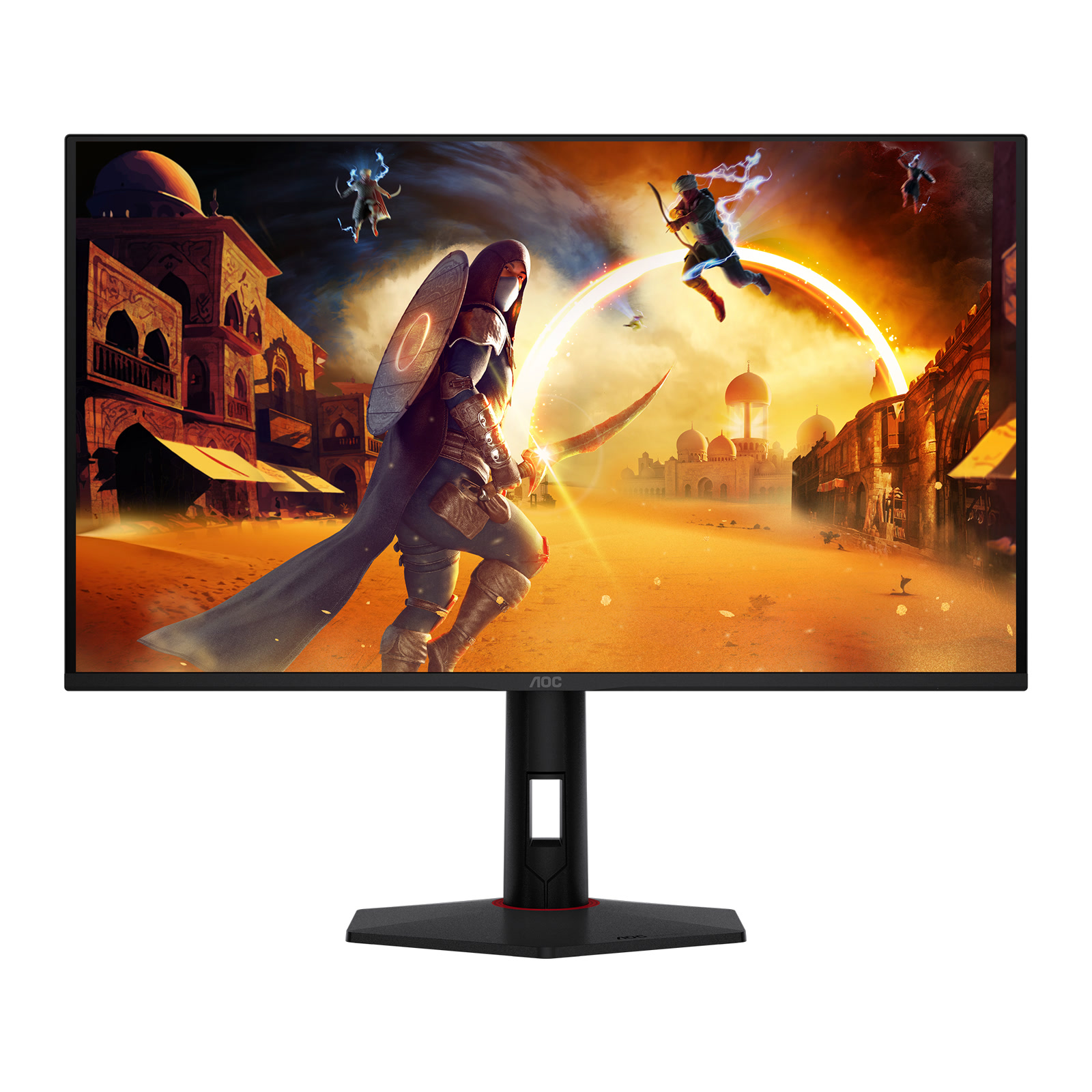
AOC U32G5D is a 31.5-inch 4K QD-OLED monitor that makes a surprisingly sensible bet: 180 Hz may be enough. It is not yet on sale anywhere as of November 2, 2026. AOC’s official China product page lists the complete specification but disables its purchase control, while AOC’s global, US, UK and Canadian catalogues have no exact-model listing. Price and ship date have not been announced.
This is specification analysis, not a hands-on review. I compared AOC’s claims with Dell’s current AW3225QF specification and published independent testing of that shipping reference monitor. The short verdict is to wait. The AOC U32G5D has the right panel resolution, a useful DisplayPort 2.1 link and a refresh rate that is already fast, but price, warranty coverage and measured performance decide whether those parts add up to a good monitor.
What we will update at launch: regional price, retailer availability, OLED burn-in coverage, firmware behavior, measured brightness, color accuracy, input lag and response performance.
Table of Contents
- What AOC has confirmed
- AOC U32G5D vs AW3225QF
- Why 180 Hz is the sensible part
- What the Penta Tandem panel does not prove
- Ports and desk use
- The price that would make sense
- Who Should Skip This
- What we will update at launch
- AOC U32G5D FAQ
- The Short Version
What AOC has confirmed
The flat 31.5-inch panel runs at 3840 by 2160 and 180 Hz. That works out to roughly 140 pixels per inch, the same useful density as other 32-inch 4K monitors. Text should be far sharper than on a 32-inch 1440p panel, though the subpixel layout and operating-system text rendering still need an exact-model examination.
AOC identifies the panel as Penta Tandem QD-OLED using EL Gen.3 technology. Its published figures include 250 nits for a full-screen SDR image, 450 nits for a 10% HDR window, 99% DCI-P3 coverage, average Delta E below 1 in the sRGB mode and DisplayHDR True Black 400 certification. Those are AOC laboratory claims, not independent measurements. The 0.03 ms gray-to-gray response figure belongs in the same bucket.
The stand adjusts 150 mm for height and supports tilt, swivel and pivot. A 100 by 100 mm VESA mount is supported. The monitor has no speakers, no USB-C video input and no KVM switch. Those omissions matter on a work desk even if they barely register in a gaming spec sheet.
AOC U32G5D vs AW3225QF
The Alienware AW3225QF is the honest reference because it is a shipping 32-inch 4K QD-OLED with extensive testing, not a weak predecessor chosen to flatter the new model. Dell currently lists it at US$999.99. That live price can change, but it gives the unreleased AOC a real target.
| Specification | AOC U32G5D | Alienware AW3225QF |
|---|---|---|
| Availability | Announced, not shipping | Shipping |
| Manufacturer price | Not announced | US$999.99 checked November 2 |
| Panel | 31.5-inch flat Penta Tandem QD-OLED | 31.6-inch 1700R curved QD-OLED |
| Resolution and refresh | 3840 by 2160 at 180 Hz | 3840 by 2160 at 240 Hz |
| Display link | DisplayPort 2.1 UHBR13.5, two HDMI 2.1 | DisplayPort 1.4, two HDMI 2.1 |
| USB | Two 5 Gbps USB-A ports | USB-A hub plus downstream USB-C charging |
| Warranty | Global terms not announced | Three years, including OLED burn-in coverage |
| Named drawbacks | No USB-C video, KVM or speakers; untested | Curved screen, mirror-like reflections, burn-in risk |
The AOC wins the connector-label contest with DisplayPort 2.1 UHBR13.5 at 54 Gbps. Its HDMI 2.1 ports provide 48 Gbps, but AOC says 4K at 180 Hz with 10-bit RGB or 4:4:4 still needs Display Stream Compression over HDMI. DisplayPort can carry that mode without DSC. That is a clean technical advantage, though compression support is not the same thing as visible image quality.
Why AOC U32G5D at 180 Hz is the sensible part
A refresh at 180 Hz lasts 5.56 ms. At 240 Hz it lasts 4.17 ms, so the Alienware cuts another 1.39 ms from the display cycle when both monitors are fed at their maximum rate. Moving from 60 Hz to 180 Hz removes 11.11 ms. The first jump is enormous; the second is real but much smaller.
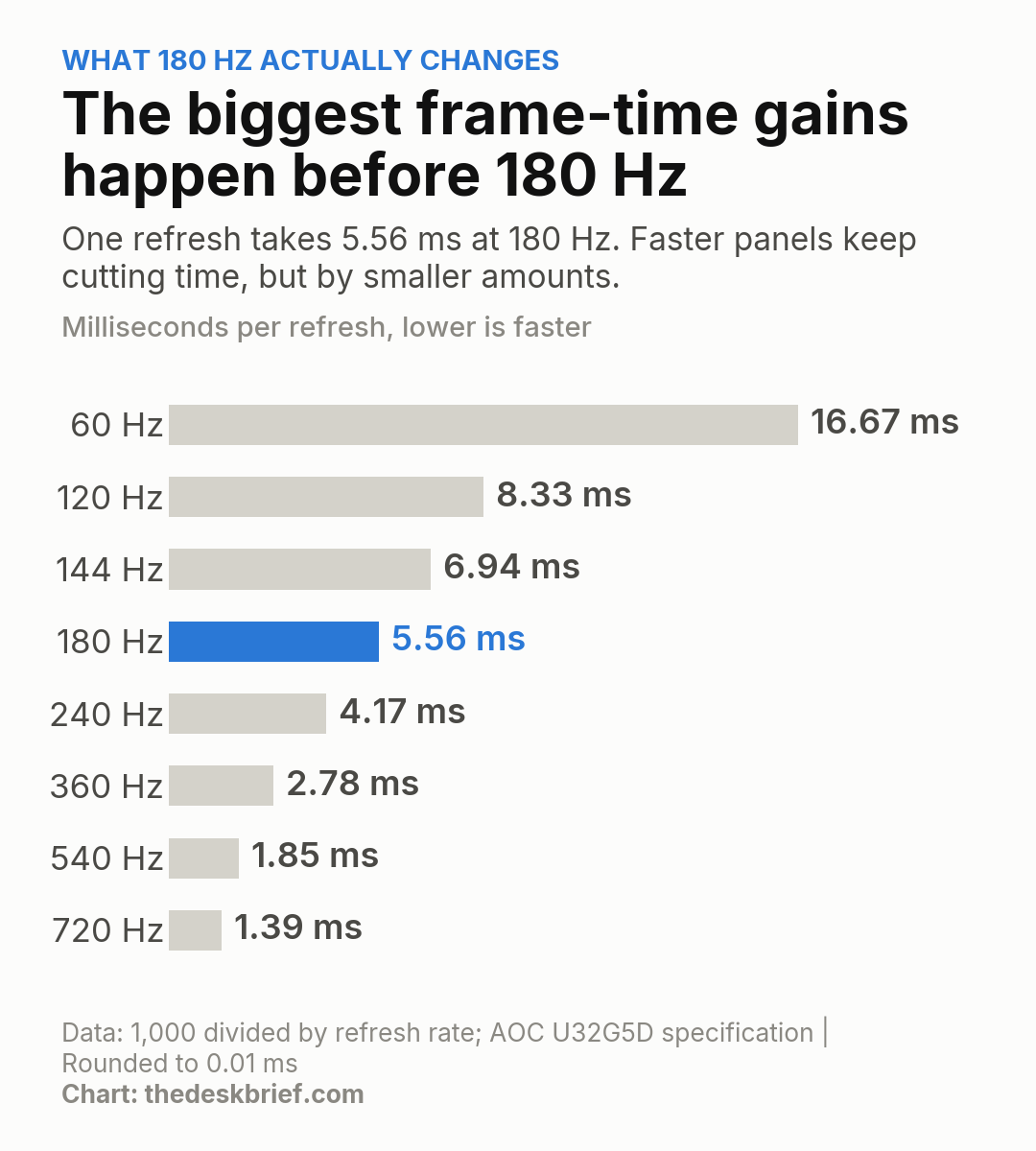
That makes 180 Hz a defensible ceiling for a mixed-use 4K display. It is fast enough to make ordinary desktop motion and games look substantially smoother than 60 Hz, while asking less of the GPU than a 240 Hz target. A steady 4K 180 frames per second is already demanding in modern games. Competitive players who actually hold more than 180 fps should buy the faster panel, but desk workers who also game may get more value from a lower price.
The catch is that AOC has not announced that lower price. A 180 Hz limit is only a smart trade when the savings are substantial. If this model lands close to the AW3225QF, the tested 240 Hz alternative with established burn-in coverage is the safer purchase.
What the Penta Tandem panel does not prove
Five OLED emission layers sound like an automatic upgrade. They are not a review result. The design may improve efficiency or longevity, but AOC has not published a global burn-in warranty and no independent outlet has measured this exact monitor. Pixel-refresh software and a graphene heat spreader are useful protective features, not proof that static taskbars and application chrome are harmless.
That distinction matters for eight-hour desk use. RTINGS found the AW3225QF delivers excellent text clarity and near-instant response, but also flags mirror-like reflections, raised blacks in bright rooms and burn-in risk with static productivity elements. Those findings belong to the Alienware, not the AOC. They show the questions that testing must answer, not the answers for a different panel.
If eye comfort is the priority, read the site’s evidence on OLED monitor eye strain before treating a hardware low-blue-light label as a complete solution. OLED dimming behavior, room lighting, brightness and individual sensitivity all matter.
Ports and desk use
The AOC U32G5D is built around desktop graphics cards and consoles. Two HDMI inputs, one DisplayPort input and picture-by-picture support make source switching practical. The upstream USB-B connection feeds two downstream USB-A ports for a keyboard and mouse.
It is not a laptop dock. USB-C video and power delivery are absent, Ethernet is absent and there is no KVM to move the USB devices with the active video source. Anyone trying to collapse a work laptop and gaming PC onto one cable should look at the site’s gaming monitor versus office monitor guide. A separate dock can fill the gap, but it also erases some of the value a cheaper monitor might offer.
The price that would make sense
I would not preorder this monitor without a meaningful discount against the AW3225QF. The AOC gives up 60 Hz, Dolby Vision, a tested performance record and confirmed global warranty terms. Its flat panel and newer DisplayPort link are genuine reasons to prefer it, but they do not cancel the uncertainty.
The decision gets interesting well below Dell’s current US$999.99. AOC does not need to win every row. It needs to make the missing 60 Hz feel expensive, then publish burn-in terms that make full-time desktop use less of a gamble. Until both happen, the released Alienware is the reference and the AOC is a watch-list item.
Who Should Skip This
Skip it if you need one-cable laptop charging, a built-in KVM, speakers or a proven warranty today. Competitive players with a system that can sustain more than 180 fps should keep the 240 Hz and faster options on the list. Bright-room users should also wait for reflection and full-screen brightness measurements instead of assuming a new panel name fixes every OLED weakness.
For anyone considering another unreleased 32-inch OLED, the site’s XG32UQDS comparison explains the same basic discipline: new panel technology is interesting, but price, ports, warranty and measurements decide the purchase.
What we will update at launch
The first update will verify whether the AOC U32G5D has actually shipped outside China, then add official US, Canadian and European pricing where AOC publishes it. The next priorities are the exact warranty language and independent measurements from an outlet that tests the retail unit.
Firmware matters too. I will look for DSC behavior over HDMI, variable-refresh performance, pixel-refresh interruptions, standby wake problems and whether the USB hub follows the selected input cleanly. Until those details exist, this page remains a sourced specification analysis, not a verdict dressed up as testing.
AOC U32G5D FAQ
Is the AOC U32G5D on sale?
No. AOC’s China page lists the monitor but disables its purchase control, and exact-model searches found no shipped listing in the US, Canada, UK or China as of November 2, 2026. AOC has not announced a ship date.
Does the U32G5D need DSC at 4K 180 Hz?
AOC says HDMI needs DSC for 4K at 180 Hz with 10-bit RGB or 4:4:4 output. The DisplayPort 2.1 UHBR13.5 connection can carry that mode without DSC.
Is 180 Hz enough for 4K gaming?
For most mixed-use systems, yes. One refresh takes 5.56 ms at 180 Hz versus 4.17 ms at 240 Hz. Players who sustain more than 180 fps can benefit from a faster display, but 180 Hz is already a large step beyond 60 or 120 Hz.
Does AOC cover OLED burn-in?
AOC has not announced global warranty terms for this exact model. The China page describes OLED Care features, but protective features are not a substitute for written burn-in coverage.
The Short Version
The AOC U32G5D puts a modern 4K QD-OLED panel, 180 Hz refresh and a 54 Gbps DisplayPort link into a flat 31.5-inch monitor. The refresh ceiling is not the problem. Missing price, ship date, global warranty terms and independent testing are. Wait for a substantial discount against the tested AW3225QF and for written burn-in coverage before buying.